

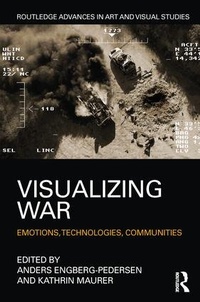
Visualizing War
Emotions, Technologies, Communities
1st Edition
Published on 13. October 2017
Book
Hardback
208 pages
978-1-138-69343-2 (ISBN)
Description
Wars have always been connected to images. From the representation of war on maps, panoramas, and paintings to the modern visual media of photography, film, and digital screens, images have played a central role in representing combat, military strategy, soldiers, and victims. Such images evoke a whole range of often unexpected emotions from ironic distance to boredom and disappointment. Why is that? This book examines the emotional language of war images, how they entwine with various visual technologies, and how they can build emotional communities. The book engages in a cross-disciplinary dialogue between visual studies, literary studies, and media studies by discussing the links between images, emotions, technology, and community. From these different perspectives, the book provides a comprehensive overview of the nature and workings of war images from 1800 until today, and it offers a frame for thinking about the meaning of the images in contemporary wars.
More details
Series
Language
English
Place of publication
London
United Kingdom
Publishing group
Taylor & Francis Ltd
Target group
College/higher education
Illustrations
34 s/w Abbildungen, 34 s/w Photographien bzw. Rasterbilder
34 Halftones, black and white; 34 Illustrations, black and white
Dimensions
Height: 246 mm
Width: 174 mm
Weight
703 gr
ISBN-13
978-1-138-69343-2 (9781138693432)
Copyright in bibliographic data and cover images is held by Nielsen Book Services Limited or by the publishers or by their respective licensors: all rights reserved.
Schweitzer Classification
Other editions
Additional editions
Book
05/2019
1st Edition
Routledge
€67.30
Shipment within 15-20 days
E-Book
09/2017
Routledge
€60.49
Available for download
E-Book
09/2017
Routledge
€60.49
Available for download
Persons
Anders Engberg-Pedersen is Associate Professor of Comparative Literature at the University of Southern Denmark. He holds a PhD from Harvard University in Comparative Literature and from Humboldt Universitaet in German Literature. He is the author of Empire of Chance: The Napoleonic Wars and the Disorder of Things and editor of Literature and Cartography: Theories, Histories, Genres.
Kathrin Maurer is Associate Professor of German Literature at the University of Southern Denmark. She holds a PhD from Columbia University in German Literature and has also worked as an Assistant Professor at the University of Arizona. She is the author of Visualizing the Past: The Power of the Image in German Historicism.
Kathrin Maurer is Associate Professor of German Literature at the University of Southern Denmark. She holds a PhD from Columbia University in German Literature and has also worked as an Assistant Professor at the University of Arizona. She is the author of Visualizing the Past: The Power of the Image in German Historicism.
Content
Preface (W.J.T Mitchell)
Introduction (Anders Engberg-Pedersen and Kathrin Maurer)
Part I: Equivocal Emotions
1. Cropped Vision: Photography and Complicity in Women's World War II Memoirs (Elisabeth Krimmer)
2. Horsemeat with Cucumber Salad: Laughing at the Images of War in Alexander Kluge's Films (Andrea Schuette)
3. Max Beckmann's Revenants and Ernst Juenger's Drones: Vision and Coolness in the Interwar Period (Christine Kanz)
Part II: Emotional Technologies
4. Flat Emotions: Maps and Wargames as Emotional Technologies (Anders Engberg-Pedersen)
5. The Paradox of Total Immersion: Watching War in Nineteenth-Century Panoramas (Kathrin Maurer)
6. Post-Traumatic Stress Disorder in Drone Operators: Relying on Uncertainty in Omer Fast's 5,000 Feet is the Best (2011) (Svea Braeunert)
7. Towards a Poor Cinema: The Performativity of Mobile Cameras in New Image Wars (Katarzyna Ruchel-Stockmans)
Part III: Building Emotional Communities
8. Visualizing Community: A Look at World War II Propaganda Films (Hermann Kappelhoff)
9. From Warrior Heroes to Vulnerable Boys: Debunking "Soldierly Masculinity" in Tim Hetherington's Infidel Photos (Thomas AErvold Bjerre)
10. Visualizing War in the Museum: Experiential Spaces, Emotions, and Memory Politics (Stephan Jaeger)
11. War in the Age of Anti-Social Media (Jan Mieszkowski)
Introduction (Anders Engberg-Pedersen and Kathrin Maurer)
Part I: Equivocal Emotions
1. Cropped Vision: Photography and Complicity in Women's World War II Memoirs (Elisabeth Krimmer)
2. Horsemeat with Cucumber Salad: Laughing at the Images of War in Alexander Kluge's Films (Andrea Schuette)
3. Max Beckmann's Revenants and Ernst Juenger's Drones: Vision and Coolness in the Interwar Period (Christine Kanz)
Part II: Emotional Technologies
4. Flat Emotions: Maps and Wargames as Emotional Technologies (Anders Engberg-Pedersen)
5. The Paradox of Total Immersion: Watching War in Nineteenth-Century Panoramas (Kathrin Maurer)
6. Post-Traumatic Stress Disorder in Drone Operators: Relying on Uncertainty in Omer Fast's 5,000 Feet is the Best (2011) (Svea Braeunert)
7. Towards a Poor Cinema: The Performativity of Mobile Cameras in New Image Wars (Katarzyna Ruchel-Stockmans)
Part III: Building Emotional Communities
8. Visualizing Community: A Look at World War II Propaganda Films (Hermann Kappelhoff)
9. From Warrior Heroes to Vulnerable Boys: Debunking "Soldierly Masculinity" in Tim Hetherington's Infidel Photos (Thomas AErvold Bjerre)
10. Visualizing War in the Museum: Experiential Spaces, Emotions, and Memory Politics (Stephan Jaeger)
11. War in the Age of Anti-Social Media (Jan Mieszkowski)