

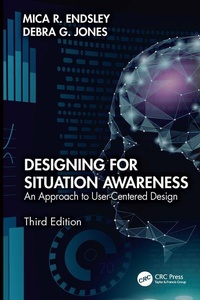
Designing for Situation Awareness
An Approach to User-Centered Design, Third Edition
3rd Edition
Published on 24. March 2025
Book
Paperback/Softback
546 pages
978-1-032-48211-8 (ISBN)
Description
Developed by the leading scientists in the field, Designing for Situation Awareness: An Approach to User-Centered Design, Third Edition offers a systematic and successful methodology for supporting the situation awareness (SA) of individuals and teams who work in complex and demanding environments.
Newly updated to reflect the latest research on SA, this new edition provides needed background on common SA challenges, the cognitive processes people use to form and maintain SA, and the agile design processes that the SA-Oriented Design processes can compliment. The chapters feature detailed examples of SA-Oriented Design focused on SA in driving, SA in healthcare, SA in command and control, SA in unmanned and remotely operated vehicles, and SA with augmented reality. It also includes 60 detailed design principles for engineers and designers who want to improve the SA provided by their systems based on leading research in the field, as well as 12 principles and proven approaches for developing effective SA training. Design principles focus on supporting people's SA processes and dealing with common SA challenges, supporting an understanding of information certainty, dealing with complexity and alarms, and the effects of automation and AI on SA, as well as supporting the unique SA needs of teams.
This book will appeal to any engineer, human factors practitioner, system designer, or other professional interested in situation awareness. It will be highly pertinent to aviation engineers, military engineers, intelligence professionals, emergency management personnel, medical practitioners, air traffic controllers, automobile engineers, financial and business management workers, and power and process control room staff.
Newly updated to reflect the latest research on SA, this new edition provides needed background on common SA challenges, the cognitive processes people use to form and maintain SA, and the agile design processes that the SA-Oriented Design processes can compliment. The chapters feature detailed examples of SA-Oriented Design focused on SA in driving, SA in healthcare, SA in command and control, SA in unmanned and remotely operated vehicles, and SA with augmented reality. It also includes 60 detailed design principles for engineers and designers who want to improve the SA provided by their systems based on leading research in the field, as well as 12 principles and proven approaches for developing effective SA training. Design principles focus on supporting people's SA processes and dealing with common SA challenges, supporting an understanding of information certainty, dealing with complexity and alarms, and the effects of automation and AI on SA, as well as supporting the unique SA needs of teams.
This book will appeal to any engineer, human factors practitioner, system designer, or other professional interested in situation awareness. It will be highly pertinent to aviation engineers, military engineers, intelligence professionals, emergency management personnel, medical practitioners, air traffic controllers, automobile engineers, financial and business management workers, and power and process control room staff.
More details
Edition
3rd edition
Language
English
Place of publication
London
United Kingdom
Publishing group
Taylor & Francis Ltd
Target group
Professional and scholarly
Academic, Professional, and Professional Practice & Development
Product notice
Paperback (trade)
Unsewn / adhesive bound
Illustrations
192 farbige Abbildungen, 117 Farbfotos bzw. farbige Rasterbilder, 75 farbige Zeichnungen, 37 farbige Tabellen
37 Tables, color; 75 Line drawings, color; 117 Halftones, color; 192 Illustrations, color
Dimensions
Height: 231 mm
Width: 155 mm
Thickness: 24 mm
Weight
928 gr
ISBN-13
978-1-032-48211-8 (9781032482118)
Copyright in bibliographic data and cover images is held by Nielsen Book Services Limited or by the publishers or by their respective licensors: all rights reserved.
Schweitzer Classification
Other editions
Additional editions
Mica R. Endsley | Debra G. Jones
Designing for Situation Awareness
An Approach to User-Centered Design, Third Edition
E-Book
03/2025
3rd Edition
CRC Press
€128.99
Available for download
Mica R. Endsley | Debra G. Jones
Designing for Situation Awareness
An Approach to User-Centered Design, Third Edition
E-Book
03/2025
3rd Edition
CRC Press
€128.99
Available for download
Mica R. Endsley | Debra G. Jones
Designing for Situation Awareness
An Approach to User-Centered Design, Third Edition
Book
03/2025
3rd Edition
CRC Press
€329.50
Shipment within 10-20 days
Previous edition
Mica R. Endsley
Designing for Situation Awareness
An Approach to User-Centered Design, Second Edition
Book
12/2011
2nd Edition
CRC Press
€102.50
Article exhausted; check for reprint
Persons
Mica R. Endsley is President of SA Technologies and is the former Chief Scientist for the United States Air Force. She has also held the positions of Visiting Associate Professor at the Massachusetts Institute of Technology in the Department of Aeronautics and Astronautics and Associate Professor of Industrial Engineering at Texas Tech University. With over 40 years of experience, she is a recognized world leader in the design, development and evaluation of systems to support situation awareness and decision making in advanced systems, including aviation, air traffic control, healthcare, power, and military operations. Dr. Endsley is a Fellow and Past-President of the Human Factors and Ergonomics Society. She received a Ph.D. in Industrial and Systems Engineering from the University of Southern California.
Debra G. Jones is the Senior Manager of Human Engineering at Boeing Defense, Space & Security (BDS) and leads the strategic integration of human engineering across the BDS portfolio. Dr. Jones is an expert in human systems engineering with a distinguished career that includes roles as Principal Research Associate and Vice President of Operations at SA Technologies, and Principal Research Engineer and Head of the Human Engineering Branch at Georgia Tech Research Institute. She specializes in analyzing complex systems to enhance situation awareness, evaluating human performance in operational contexts, and improving tactical decision-making. Dr. Jones holds a Ph.D. in Industrial Engineering from Texas Tech University, is a Certified Human Factors Professional, and has significantly advanced the application of human engineering principles in high-stakes environments.
Debra G. Jones is the Senior Manager of Human Engineering at Boeing Defense, Space & Security (BDS) and leads the strategic integration of human engineering across the BDS portfolio. Dr. Jones is an expert in human systems engineering with a distinguished career that includes roles as Principal Research Associate and Vice President of Operations at SA Technologies, and Principal Research Engineer and Head of the Human Engineering Branch at Georgia Tech Research Institute. She specializes in analyzing complex systems to enhance situation awareness, evaluating human performance in operational contexts, and improving tactical decision-making. Dr. Jones holds a Ph.D. in Industrial Engineering from Texas Tech University, is a Certified Human Factors Professional, and has significantly advanced the application of human engineering principles in high-stakes environments.
Content
Contents
Preface
Acknowledgements
About the authors
Part One: Understanding Situation Awareness in System Design
Chapter 1 User-centered Design
Chapter 2 What is Situation Awareness?
Chapter 3 SA Demons: The Enemies of Situation Awareness
Chapter 4 The Design Process
Part Two: Creating SA-Oriented Designs
Chapter 5 SA Requirements
Chapter 6 Principles of Designing for SA
Chapter 7 Confidence and Uncertainty in SA and Decision Making
Chapter 8 Dealing with Complexity
Chapter 9 Alarms, Diagnosis, and SA
Chapter 10 Automation, AI and Situation Awareness
Chapter 11 Designing to Support SA for Multiple and Distributed Operators
Part Three: SA-Oriented Design in Complex Domains
Chapter 12 Design Schema
Chapter 13 Situation Awareness in Driving
Chapter 14 SA in Healthcare
Chapter 15 SA in Command and Control
Chapter 16 Unmanned and Remotely Operated Vehicles
Chapter 17 SA With Augmented Reality
Part Four: Completing the Design Cycle
Chapter 18 Evaluating Design Concepts for SA
Chapter 19 SA-Oriented Training
Chapter 20 Applying SA-Oriented Design to Complex Systems
Appendix A
References
Index
Preface
Acknowledgements
About the authors
Part One: Understanding Situation Awareness in System Design
Chapter 1 User-centered Design
Chapter 2 What is Situation Awareness?
Chapter 3 SA Demons: The Enemies of Situation Awareness
Chapter 4 The Design Process
Part Two: Creating SA-Oriented Designs
Chapter 5 SA Requirements
Chapter 6 Principles of Designing for SA
Chapter 7 Confidence and Uncertainty in SA and Decision Making
Chapter 8 Dealing with Complexity
Chapter 9 Alarms, Diagnosis, and SA
Chapter 10 Automation, AI and Situation Awareness
Chapter 11 Designing to Support SA for Multiple and Distributed Operators
Part Three: SA-Oriented Design in Complex Domains
Chapter 12 Design Schema
Chapter 13 Situation Awareness in Driving
Chapter 14 SA in Healthcare
Chapter 15 SA in Command and Control
Chapter 16 Unmanned and Remotely Operated Vehicles
Chapter 17 SA With Augmented Reality
Part Four: Completing the Design Cycle
Chapter 18 Evaluating Design Concepts for SA
Chapter 19 SA-Oriented Training
Chapter 20 Applying SA-Oriented Design to Complex Systems
Appendix A
References
Index