

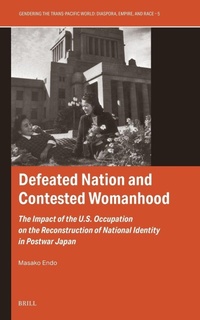
Defeated Nation and Contested Womanhood
The Impact of the U.S. Occupation on the Reconstruction of National Identity in Postwar Japan
Will be published approx. on 27. November 2025
Book
Hardback
240 pages
978-90-04-72459-4 (ISBN)
Description
This book investigates the impact of the U.S. occupation of Japan on the discursive remaking of Japanese womanhood. While exploring historical dynamics of Japanese femininity, it focuses on the context of the occupation in which meanings of gender, sexuality, race, and social class became particularly fluid.
Drawing on insights from studies of gender, sexuality, race, and nation, Masako Endo considers how the occupation overtly sexualized and situationally or essentially racialized certain groups of people. She argues that they, by challenging traditional Japanese gender roles and sexual mores, shaped national discourses of Japanese womanhood and nationhood in occupied and post-occupation Japan.
Drawing on insights from studies of gender, sexuality, race, and nation, Masako Endo considers how the occupation overtly sexualized and situationally or essentially racialized certain groups of people. She argues that they, by challenging traditional Japanese gender roles and sexual mores, shaped national discourses of Japanese womanhood and nationhood in occupied and post-occupation Japan.
More details
Series
Language
English
Place of publication
Leiden
Netherlands
Target group
Professional and scholarly
Product notice
sewn/stitched
Cloth over boards
Dimensions
Height: 235 mm
Width: 155 mm
Thickness: 14 mm
Weight
513 gr
ISBN-13
978-90-04-72459-4 (9789004724594)
Copyright in bibliographic data and cover images is held by Nielsen Book Services Limited or by the publishers or by their respective licensors: all rights reserved.
Schweitzer Classification
Person
Masako Endo is a sociologist who received her Ph.D. from Binghamton University-State University of New York. Curently, she is a faculty member in the Department of Sociology at Drexel University.
Content
Acknowledgements
List of Figures
A Note on Japanese Names
?Introduction
?1?Rethinking Gender, Race, Sexuality, and Class in the Occupation
?2?Womanhood and Nationhood
?3?Defeat and Female Sexuality
?4?Gendered Work, Sexualized Work, and Emotional Work
?5?Beyond the Conceptualization of Panpan as the Symbol of the Occupation
?6?Exploring Ambiguous Boundaries of Race and Sexuality
?7?The Structure of This Book
1 The Making of Modern Japanese Womanhood
?1?Japan and "Civilization"
?2?Civilizing Japanese Women
?3?Wars, Nationalism, and Women
?4?Japanese Women at War
?5?The Virtuous Japanese Woman
2 Defense of Japanese Womanhood
?1?"Sudden" Defeat
?2?Panic over the Occupation
?3?Operation "Floodwall of Chastity"
?4?Serving the Occupier
?5?The Weakening State and the End of the RAA
3 Devious Women of the Occupation: Blurring Gender and Racial Lines
?1?Panpan-Devious Women of the Occupation
?2?Humanizing Panpan: Interviews with a Sex Worker
?3?Who Became Panpan?: Women from Diverse Backgrounds
?4?Unclear Boundaries between "Good" and "Bad" Women
?5?Challenging Womanhood and Nationhood
4 Sexualizing Japanese Womanhood
?1?Getting to Know America, Its Culture, and Its People
?2?The Impact of Panpan on Occupied Japan
?3?Sexualizing Japanese Women
?4?Panpan Culture and the Youth
?5?"Panpanizing" Womanhood and Nationhood
5 Transgressing Boundaries: Interracial Intimacy and Racial Mixing
?1?Stigma and Interracial Intimacy
?2?Stigma and Mixed-Blood Children of the Occupation
?3?Stigmatized Mothers and Racialized Children
?4?Interracial Romance as Cautionary Tales
?5?International Romance to Represent Exemplary Japanese Femininity
6 Reclaiming Japanese Femininity
?1?Growing Nationalist Sentiment after Independence
?2?Searching Japanese Identity: Ideal and Reality
?3?The Resurgence of Chastity Discourse
?4?Otoki and Post-Occupation Japanese Womanhood
?Conclusion
Bibliography
Index
List of Figures
A Note on Japanese Names
?Introduction
?1?Rethinking Gender, Race, Sexuality, and Class in the Occupation
?2?Womanhood and Nationhood
?3?Defeat and Female Sexuality
?4?Gendered Work, Sexualized Work, and Emotional Work
?5?Beyond the Conceptualization of Panpan as the Symbol of the Occupation
?6?Exploring Ambiguous Boundaries of Race and Sexuality
?7?The Structure of This Book
1 The Making of Modern Japanese Womanhood
?1?Japan and "Civilization"
?2?Civilizing Japanese Women
?3?Wars, Nationalism, and Women
?4?Japanese Women at War
?5?The Virtuous Japanese Woman
2 Defense of Japanese Womanhood
?1?"Sudden" Defeat
?2?Panic over the Occupation
?3?Operation "Floodwall of Chastity"
?4?Serving the Occupier
?5?The Weakening State and the End of the RAA
3 Devious Women of the Occupation: Blurring Gender and Racial Lines
?1?Panpan-Devious Women of the Occupation
?2?Humanizing Panpan: Interviews with a Sex Worker
?3?Who Became Panpan?: Women from Diverse Backgrounds
?4?Unclear Boundaries between "Good" and "Bad" Women
?5?Challenging Womanhood and Nationhood
4 Sexualizing Japanese Womanhood
?1?Getting to Know America, Its Culture, and Its People
?2?The Impact of Panpan on Occupied Japan
?3?Sexualizing Japanese Women
?4?Panpan Culture and the Youth
?5?"Panpanizing" Womanhood and Nationhood
5 Transgressing Boundaries: Interracial Intimacy and Racial Mixing
?1?Stigma and Interracial Intimacy
?2?Stigma and Mixed-Blood Children of the Occupation
?3?Stigmatized Mothers and Racialized Children
?4?Interracial Romance as Cautionary Tales
?5?International Romance to Represent Exemplary Japanese Femininity
6 Reclaiming Japanese Femininity
?1?Growing Nationalist Sentiment after Independence
?2?Searching Japanese Identity: Ideal and Reality
?3?The Resurgence of Chastity Discourse
?4?Otoki and Post-Occupation Japanese Womanhood
?Conclusion
Bibliography
Index