

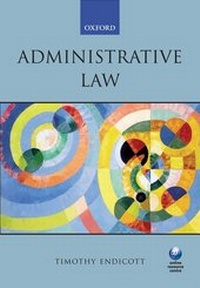
Administrative Law
1st Edition
Published on 2. July 2009
Book
Paperback/Softback
672 pages
978-0-19-927728-5 (ISBN)
Description
Administrative Law aims to explain the constitutional principles that underlie the varieties of administrative law, and to give some unity to the diverse topics that students need to master in order to understand this complex branch of public law. The book uses the law of judicial review to identify and explain the constitutional principles, and then proceeds to show how those principles ought to be worked out in the private law of tort and contract, in the new Tribunals Service, and in non-judicial techniques such as investigations by ombudsmen, auditors, and other government agencies. The author takes an analytical approach to the subject and makes use of innovative learning features, helping the reader engage critically with the subject. The objective is to provide students with the resources needed to apply constitutional principles to the problems of administrative law. Online Resource Centre The book is supported by an extensive Online Resource Centre offering updates to the law; summaries of key cases and legislation; guidance on answering the questions in the text; weblinks to cases, legislation, and reports; a glossary of key terms; and a Guide for Teachers.
More details
Language
English
Place of publication
Oxford
United Kingdom
Target group
College/higher education
Illustrations
Illustrations
Dimensions
Height: 246 mm
Width: 171 mm
Thickness: 36 mm
Weight
1139 gr
ISBN-13
978-0-19-927728-5 (9780199277285)
Copyright in bibliographic data and cover images is held by Nielsen Book Services Limited or by the publishers or by their respective licensors: all rights reserved.
Schweitzer Classification
Other editions
New editions
Timothy Endicott
Administrative Law
Book
06/2011
2nd Edition
Oxford University Press
€43.32
Article exhausted; check different version
Content
PART 1: INTRODUCTION; 1. Administration and the principles of the constitution; 2. The rule of law, and the rule of judges; 3. Convention rights and administrative law; PART 2: PROCESS; 4. Due process; 5. Impartiality and independence; 6. Reasons: process and substance; PART 3: SUBSTANCE; 7. Discretion and deference; 8. Substantive fairness; 9. Error of law, and control of fact finding; PART 4: LITIGATION; 10. How to sue the government; 11. Standing: litigation and the public interest; PART 5: ADMINISTRATIVE JUSTICE; 12. The Reconstruction of Tribunals; 13. Ombudsmen and other investigators; PART 6: PRIVATE LAW AND PUBLIC AUTHORITIES; 14. Tort; 15. Contract