

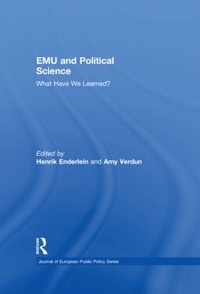
EMU and Political Science
What Have We Learned?
1st Edition
Published on 26. February 2010
Book
Hardback
170 pages
978-0-415-57482-2 (ISBN)
Description
Europe's Economic and Monetary Union (EMU) celebrated its tenth anniversary in 2009. Before its birth many observers were concerned about its viability. This volume examines a number of noteworthy concerns that were heard a decade ago and it assesses what has become of them. The contributors to this volume examine various topics. Has EMU been a failure or success? Does EMU require more political integration? What type of deeper integration in the financial market has occurred because of EMU? Does the public like EMU? Does EMU cause a decline of the welfare state, reduce the role of labour unions and are adjustments now made mainly through the labour market? Do countries in EMU become more similar over time? Is EMU sustainable in the long-run? Will EMU survive the global financial crisis? The contributors to this book are leading Political Scientists in the field, and draw on a wealth of research and experience.
This book was published as a special issue of the Journal of European Public Policy.
This book was published as a special issue of the Journal of European Public Policy.
More details
Series
Language
English
Place of publication
London
United Kingdom
Publishing group
Taylor & Francis Ltd
Target group
College/higher education
Product notice
Paper over boards
Illustrations
15 s/w Tabellen
15 Tables, black and white
Dimensions
Height: 246 mm
Width: 174 mm
Weight
490 gr
ISBN-13
978-0-415-57482-2 (9780415574822)
Copyright in bibliographic data and cover images is held by Nielsen Book Services Limited or by the publishers or by their respective licensors: all rights reserved.
Schweitzer Classification
Other editions
Additional editions
Book
04/2015
1st Edition
Routledge
€76.94
Shipment within 10-20 days
E-Book
10/2013
1st Edition
Routledge
€64.49
Available for download
E-Book
10/2013
1st Edition
Routledge
€64.49
Available for download
Persons
Henrik Enderlein is Associate Dean and teaches Political Economy and Economics at the Hertie School of Governance, Germany. He was awarded the Max Planck Society's Otto-Hahn Medal in 2003 for outstanding achievements by young scientists, and in 2007 was Fulbright Distinguished Chair at Duke University's Political Science Department. He has published numerous articles on economic policy-making in Europe and beyond.
Amy Verdun is Professor of Political Science, Jean Monnet Chair, Director of the Jean Monnet Centre of Excellence at the University of Victoria, in Canada. Some of her earlier books include (as author) Britain and Canada and their Large Neighboring Monetary Unions; The Euro: European Integration and Economic and Monetary Union, and European Responses to Globalization and Financial Market Integration: Perceptions of EMU in Britain, France and Germany, and (as co-author) Ruling Europe: The Politics of the Stability and Growth Pact; and EMU Rules: The Political and Economic Consequences of European Monetary Integration.
Amy Verdun is Professor of Political Science, Jean Monnet Chair, Director of the Jean Monnet Centre of Excellence at the University of Victoria, in Canada. Some of her earlier books include (as author) Britain and Canada and their Large Neighboring Monetary Unions; The Euro: European Integration and Economic and Monetary Union, and European Responses to Globalization and Financial Market Integration: Perceptions of EMU in Britain, France and Germany, and (as co-author) Ruling Europe: The Politics of the Stability and Growth Pact; and EMU Rules: The Political and Economic Consequences of European Monetary Integration.
Content
1. Preface Henrik EnderleinandAmy Verdun 2. EMU's Teenage Challenge: What have We Learned and Can We Predict from Political Science? Henrik EnderleinandAmy Verdun 3. EMU and Political Union: What, if Anything, have We Learned from the Euro's First Decade? Dermot Hodson 4. On Consensus, Constraint and Choice: Economic and Monetary Integration and Europe's Welfare States H. Tolga Bolukbasi 5. EMU's Diverging Micro Foundations: A Study of Governments' Preferences and the Sustainability of EMUTal Sadeh 6. Economic Interests and Public Support for the Euro Susan A. Banducci, Jeffrey A. KarpandPeter H. Loedel 7. EMU: The Last Stand for the Policy Convergence Hypothesis? David H. Bearce 8. Wage Inflation and Labour Unions in EMU Alison JohnstonandBob Hancke 9. Political Science and the 'Cinderellas' of Economic and Monetary Union: Payment Services and Clearing and Settlement Lucia Quaglia