

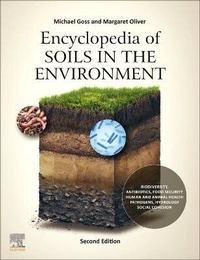
Encyclopedia of Soils in the Environment
Academic Press
2nd Edition
Published on 17. August 2023
Book
3552 pages
978-0-12-822974-3 (ISBN)
Description
Encyclopedia of Soils in the Environment, Second Edition, Five Volume Set updates and expands the previous version to ensure coverage of topics relevant to current world problems such as population pressure, food security and global change.
Since publication of the previous edition there has been a huge change in our ability to carry out bioinformatics related to soil organisms and their functioning. Major developments in next generation DNA sequencing techniques have made it possible to identify both the diversity of microbial populations and their functioning. Furthermore, it allows the management of microbes within the soil. Imaging is changing our perceptions and improving our knowledge of soil aggregation. This also applies to remote and proximal sensing of laboratory and field soils, which is undergoing rapid change. Soil physics is a core area of soil science, but new techniques and technology have increased our understanding of processes.
This reference work covers the entire field of soil science, bridging the gap between basic science and applications, and is designed to serve students and expert researchers. It is organized around four core topics, the main components of soil science - biology, chemistry, physics and environment and management.
Soil science is becoming a crucial subject as world governments realize its importance in food production, water quality, flood control, greenhouse gas management, source of antibiotics and other drugs. As such this work is of interest not only to academics but to policy makers, government researchers and the geographical and environmental community who are not necessarily in research roles but need information on soil to support their core work.
Since publication of the previous edition there has been a huge change in our ability to carry out bioinformatics related to soil organisms and their functioning. Major developments in next generation DNA sequencing techniques have made it possible to identify both the diversity of microbial populations and their functioning. Furthermore, it allows the management of microbes within the soil. Imaging is changing our perceptions and improving our knowledge of soil aggregation. This also applies to remote and proximal sensing of laboratory and field soils, which is undergoing rapid change. Soil physics is a core area of soil science, but new techniques and technology have increased our understanding of processes.
This reference work covers the entire field of soil science, bridging the gap between basic science and applications, and is designed to serve students and expert researchers. It is organized around four core topics, the main components of soil science - biology, chemistry, physics and environment and management.
Soil science is becoming a crucial subject as world governments realize its importance in food production, water quality, flood control, greenhouse gas management, source of antibiotics and other drugs. As such this work is of interest not only to academics but to policy makers, government researchers and the geographical and environmental community who are not necessarily in research roles but need information on soil to support their core work.
More details
Edition
2nd edition
Language
English
Place of publication
San Diego
United States
Publishing group
Elsevier Science Publishing Co Inc
Target group
Professional and scholarly
Students and researchers in earth, environmental and biological science looking for fundamental information in soil science, geology, agriculture, conservation, environmental health and climate change.
Organizations working across the world in policy making, industries involved in landscape and environmental management.
Dimensions
Height: 276 mm
Width: 215 mm
Weight
1000 gr
ISBN-13
978-0-12-822974-3 (9780128229743)
Copyright in bibliographic data and cover images is held by Nielsen Book Services Limited or by the publishers or by their respective licensors: all rights reserved.
Schweitzer Classification
Other editions
Additional editions
E-Book
08/2023
2nd Edition
Academic Press
€2,607.00
Available for download
Previous edition
Book
10/2004
Academic Press
€2,576.24
Article exhausted; check for reprint
Persons
Michael Goss is a soil scientist and worked for over 20 years in the UK (Letcombe Laboratory, Rothamsted Research and the James Hutton Research Institute), collaborating with colleagues in France, Germany, Portugal and Australia. In 1990 he joined University of Guelph, Canada, as Research Chair in Land Stewardship and is Professor Emeritus in the School of Environmental Sciences. Michael is an Honorary Member and Fellow of the British Society of Soil Science. He was Editor-in-Chief of 'Soil Use and Management' and part of the editorial team for 10 years until 2019. He has written over 175 academic papers, edited two books and co-written a University-level textbook (2 editions) on water in plant production and a book on the management of arbuscular mycorrhizas. Margaret Oliver was Reader in Spatial Analysis at the University of Reading until she retired, and then awarded a visiting professorship. She continued to teach university courses at Reading, and short geostatistics courses at other universities abroad. Margaret became Co-editor-in-Chief of Precision Agriculture in 2005 for six years, and was also an Associate Editor of Mathematical Geosciences. She was an Associate Editor for the European Journal of Soil Science before becoming Deputy Editor in 2011 for four years, and then Editor-in-Chief in 2015. Margaret is an Honorary Member of the British Society of Soil Science. She has written over 100 academic papers and has also made several contributions to books. She is co-author of three text books and has edited two books. Margaret`s research interests include the application of numerical and geostatistical methods to soil, other data and precision agriculture. She has an award named after her for young pedometricians.
Content
1. Soil Biology - organic matter, and macro and meso organisms 2. Soil Biology - microbiology and biological processes 3. Soil Chemistry - major and minor elements 4. Soil Chemistry - cation exchange and surface processes related to minerals and organic matter 5. Soil Physics - hydrology and particle forces 6. Soil Physics - processes and sensing 7. Soil and Environment - pedology 8. Soil and Environment - natural events (e.g. erosion) and human management and spatial variation