

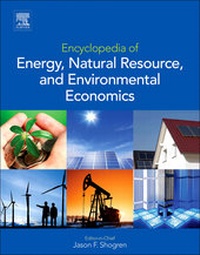
Encyclopedia of Energy, Natural Resource, and Environmental Economics
Elsevier (Publisher)
Published on 15. May 2013
Book
1056 pages
978-0-12-375067-9 (ISBN)
Description
Every decision about energy involves its price and cost. The price of gasoline and the cost of buying from foreign producers; the price of nuclear and hydroelectricity and the costs to our ecosystems; the price of electricity from coal-fired plants and the cost to the atmosphere. Giving life to inventions, lifestyle changes, geopolitical shifts, and things in-between, energy economics is of high interest to Academia, Corporations and Governments.
For economists, energy economics is one of three subdisciplines which, taken together, compose an economic approach to the exploitation and preservation of natural resources:
energy economics, which focuses on energy-related subjects such as renewable energy, hydropower, nuclear power, and the political economy of energy
resource economics, which covers subjects in land and water use, such as mining, fisheries, agriculture, and forests
environmental economics, which takes a broader view of natural resources through economic concepts such as risk, valuation, regulation, and distribution
Although the three are closely related, they are not often presented as an integrated whole. This Encyclopedia has done just that by unifying these fields into a high-quality and unique overview.
For economists, energy economics is one of three subdisciplines which, taken together, compose an economic approach to the exploitation and preservation of natural resources:
energy economics, which focuses on energy-related subjects such as renewable energy, hydropower, nuclear power, and the political economy of energy
resource economics, which covers subjects in land and water use, such as mining, fisheries, agriculture, and forests
environmental economics, which takes a broader view of natural resources through economic concepts such as risk, valuation, regulation, and distribution
Although the three are closely related, they are not often presented as an integrated whole. This Encyclopedia has done just that by unifying these fields into a high-quality and unique overview.
Reviews / Votes
"This exhaustive work is greatly enriched by being part of ScienceDirect..., which offers superb searching/navigation mechanisms for locating some 130 articles by nearly 200 contributors. The content is excellent and wide-ranging...the integration of a major reference work with other sources creates a cohesive context for understanding the complex and vexing economic challenges underpinning environmental issues. Summing Up: Highly recommended." --Choice Reviews Online, April 2014More details
Language
English
Place of publication
United States
Target group
Professional and scholarly
University and research libraries, especially with collections in economics or earth sciences; corporations engaged in these utility services: electric power, natural gas, steam supply, water supply, and sewage removal; and government agencies regulating these utilities in the generation, transmission, and distribution of energy and the treatment of waste.
Dimensions
Height: 276 mm
Width: 216 mm
Weight
3990 gr
ISBN-13
978-0-12-375067-9 (9780123750679)
Copyright in bibliographic data and cover images is held by Nielsen Book Services Limited or by the publishers or by their respective licensors: all rights reserved.
Schweitzer Classification
Other editions
New editions
Book
11/2024
2nd Edition
Elsevier
€1,311.96
Shipment within 15-20 days
Additional editions
E-Book
03/2013
1st Edition
Elsevier
from
€1,435.00
Available for download
Person
Jason Shogren is the Stroock Professor of Natural Resource Conservation and Management and Chair of the Department of Economics and Finance at the University of Wyoming, his alma mater. He works on the economics of environmental and natural resource policy. Shogren is a foreign member of the Royal Swedish Academy of Sciences, and has served as professor to the King of Sweden, a lead author for the Intergovernmental Panel on Climate Change, and as a senior economist on the Council of Economic Advisers in the White House. He likes music and fishing.
Photograph (c) Ted Brummond
Photograph (c) Ted Brummond
Content
Energy
Climate change and policy
Markets/technology innovation/adoption/diffusion
Non-renewable Fossil/Nuclear/Electricity Markets
Renewable/Alternative Energy
Resources
Media non-biological
Media: Biological
Microeconomics
Policy Tools
Theoretical Tools
Environment
Allocation Tools
Media: policies/incentives
Political Economy
Valuation tools
Climate change and policy
Markets/technology innovation/adoption/diffusion
Non-renewable Fossil/Nuclear/Electricity Markets
Renewable/Alternative Energy
Resources
Media non-biological
Media: Biological
Microeconomics
Policy Tools
Theoretical Tools
Environment
Allocation Tools
Media: policies/incentives
Political Economy
Valuation tools