

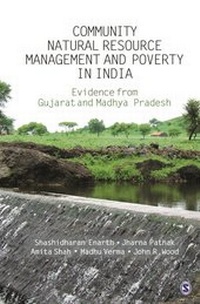
Community Natural Resource Management and Poverty in India
The Evidence from Gujarat and Madhya Pradesh
1st Edition
Published on 27. July 2016
Book
Hardback
440 pages
978-93-5150-652-2 (ISBN)
Description
A comparative analysis of two contrasting strategies in the implementation of Community Natural Resource Management (CNRM) programmes in Gujarat and Madhya Pradesh
This book examines whether the introduction of CNRM schemes in rural India made an impact on poverty alleviation. These programmes were implemented in various phases and manners in different states over the last two decades and their comparative performance as well as successes and failures are analysed. Inspired by the Millennial Development Goals established by the United Nations in 2000, the book focuses on participatory irrigation management, watershed development, joint forest management, and inland fishing cooperatives.
This book is indispensable to scholars of development studies, environmental studies, community resource management, and sociology.
This book examines whether the introduction of CNRM schemes in rural India made an impact on poverty alleviation. These programmes were implemented in various phases and manners in different states over the last two decades and their comparative performance as well as successes and failures are analysed. Inspired by the Millennial Development Goals established by the United Nations in 2000, the book focuses on participatory irrigation management, watershed development, joint forest management, and inland fishing cooperatives.
This book is indispensable to scholars of development studies, environmental studies, community resource management, and sociology.
More details
Edition
First Edition
Language
English
Place of publication
New Delhi
India
Target group
College/higher education
Professional and scholarly
Dimensions
Height: 216 mm
Width: 140 mm
Weight
629 gr
ISBN-13
978-93-5150-652-2 (9789351506522)
Copyright in bibliographic data and cover images is held by Nielsen Book Services Limited or by the publishers or by their respective licensors: all rights reserved.
Schweitzer Classification
Other editions
Additional editions
Shashidharan Enarth | Jharna Pathak | Amita Shah
Community Natural Resource Management and Poverty in India
The Evidence from Gujarat and Madhya Pradesh
Book
04/2016
1st Edition
SAGE Publications India Pvt Ltd
€69.52
Article not available for order
Persons
Shashidharan Enarth is Senior Advisor at the Institute of Livelihood Research and Training, Hyderabad. With over two decades of professional experience in development sector spread across three Indian NGOs-LOCOST, AKRSP and DSC-he has promoted programmes ranging from holistic health to natural resources development and good governance. He has also worked as a consultant to the World Bank on NRM programmes in Nigeria, Tanzania and India. After a PhD from University of British Columbia, he pursued research interests on decentralization, democratization and role of civil society in creating system changes. He was also closely involved in watershed and irrigation policy reforms and the introduction of Participatory Irrigation Management (PIM) in various states of India. Jharna Pathak is Assistant Professor, Gujarat Institute of Development Research, Ahmedabad. Her research interests include dryland farming and institutions in managing natural resources. Dr Pathak is also a visiting professor at Gujarat University and various management institutes in Ahmedabad. Her research mainly concerns issues in policy and institutional development in the areas of managing natural resources, dryland agriculture, innovations in farms and agriculture and sustainable development. She has edited a volume of essays (jointly with Amita Shah) titled Tribal Development in Western India, (2014). Amita Shah is Professor of Economics and former Director of Gujarat Institute of Development Research, Ahmedabad. Her major areas of research are dryland agriculture and forestry, environmental impact assessment, gender and environment, agriculture-industry interface, employment and livelihood issues and chronic poverty. She has published several books and over 75 research papers in reputed journals. She has worked closely with a number of government, non-government and international organizations. She has also been a consultant to various donor agencies within and outside India. Madhu Verma is Professor, Indian Institute of Forest Management (IIFM), Bhopal. She has 27 years of work experience with postdoctoral research work at University of California (Berkeley) and University of Massachusetts (Amherst), USA. She has more than 40 publications in international and national journals/books to her credit and has conducted projects on valuation, green accounting and payment for ecosystem services with the support of the World Bank, United Nations Environment Programme (UNEP), European Union (EU), Department for International Development (DFID), Asian Development Bank (ADB), International Institute for Environment and Development (IIED), Winrock International and various ministries of the Government of India, the National Forestry Commission and the 13th Finance Commission of India. She has also contributed to the world acclaimed projects on Millennium Ecosystem Assessment and on The Economics of Ecosystems and Biodiversity. John R. Wood is Professor Emeritus of the Department of Political Science, University of British Columbia (UBC), Vancouver. He taught Comparative Politics with a special focus on India at UBC for 36 years and was Founder/Director of its Centre for India and South Asia Research. Throughout his career, he was involved with the Shastri Indo-Canadian Institute (SICI) which promotes academic exchange and research collaboration between India and Canada. He served as the Resident Director at SICI's India Office (New Delhi) between 1973-75, 1989-90 and 2004-06. He was the author of The Politics of Water Resources Development in India-The Narmada Dam Controversy (SAGE, 2007) and co-translator/editor of The Autobiography of Indulal Yagnik (2012).
Content
Preface
CNRM in India: The Problem and the Context John R Wood
Comparative CNRM: From Concepts to Field Research John R Wood, Shashidharan Enarth and Amita Shah
Participatory Irrigation Management in Gujarat and Madhya Pradesh: When and How Can It Benefit the Poor? Shashidharan Enarth
Resource Management and Poverty in Gujarat's and Madhya Pradesh's Inland Fisheries: Hopeful Opportunities and Hard Realities Jharna Pathak
Participatory Watershed Development Projects in Gujarat and Madhya Pradesh: Do They Impact Poverty? Amita Shah
Poverty Reduction and the Community Management of Forests: The Experience of Joint Forest Management Institutions Madhu Verma
Conclusion: Comparing CNRM Institutions and Their Impact on Poverty in Gujarat and Madhya Pradesh John R Wood
CNRM and Poverty in India: The Way Forward John R Wood
Glossary
References and Select Bibliography
Index
CNRM in India: The Problem and the Context John R Wood
Comparative CNRM: From Concepts to Field Research John R Wood, Shashidharan Enarth and Amita Shah
Participatory Irrigation Management in Gujarat and Madhya Pradesh: When and How Can It Benefit the Poor? Shashidharan Enarth
Resource Management and Poverty in Gujarat's and Madhya Pradesh's Inland Fisheries: Hopeful Opportunities and Hard Realities Jharna Pathak
Participatory Watershed Development Projects in Gujarat and Madhya Pradesh: Do They Impact Poverty? Amita Shah
Poverty Reduction and the Community Management of Forests: The Experience of Joint Forest Management Institutions Madhu Verma
Conclusion: Comparing CNRM Institutions and Their Impact on Poverty in Gujarat and Madhya Pradesh John R Wood
CNRM and Poverty in India: The Way Forward John R Wood
Glossary
References and Select Bibliography
Index