

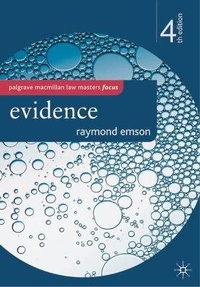
Evidence
4th Edition
Published on 19. June 2008
Book
Paperback/Softback
584 pages
978-0-230-53747-7 (ISBN)
Description
This is a clear and concise guide to the law of evidence, which explains the fundamentals of the law and outlines the context in which it operates.It is thoroughly revised and updated in a new larger format to become more user-friendly. It addresses the changes introduced by the Criminal Justice Act 2003 including, in particular, all the key cases on the 'bad character' and hearsay provisions. It contains 'hot topics' detailing the relevance of the law of evidence to a number of controversial and contemporary issues such as misconduct in the jury room. It is designed to enhance learning with summaries and further reading provided for each chapter.From DNA profiling to consideration of the accused's previous conduct, the law of evidence is a fascinating amalgam of logic, common sense, philosophy and tactics. "Evidence" explains the fundamentals and looks at the principles behind it. It is aimed at satisfying the needs of undergraduates, LPC and BVC students.
More details
Series
Edition
4th Revised edition
Language
English
Place of publication
Basingstoke
United Kingdom
Target group
College/higher education
Edition type
Revised edition
Illustrations
3 black & white line drawings
Dimensions
Height: 245 mm
Width: 170 mm
Thickness: 30 mm
Weight
1004 gr
ISBN-13
978-0-230-53747-7 (9780230537477)
Copyright in bibliographic data and cover images is held by Nielsen Book Services Limited or by the publishers or by their respective licensors: all rights reserved.
Schweitzer Classification
Other editions
Person
RAYMOND N. EMSON, LLM, Barrister, is a lawyer in the Government Legal Service specialising in the criminal law and the law of criminal evidence. He also contributes on a part-time basis to the teaching of Evidence at King's College London, UK.
Content
Preliminaries Relevance and 'Similar Facts' The Criminal Evidence Act 1898 The Scope of the Hearsay Rule Exceptions to the Hearsay Rule Admissions Hearsay in Civil Proceedings Silence as Evidence Evidence Obtained by Unlawful or Unfair Means Safeguards Against Unreliability and Error Opinion Evidence Disclosure and Public Interest Immunity Privilege The Mechanics of Proof The Trial Sexual Experience as Evidence Index