

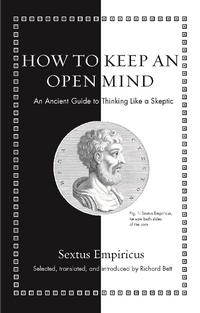
How to Keep an Open Mind
An Ancient Guide to Thinking Like a Skeptic
Published on 13. April 2021
Book
Hardback
280 pages
978-0-691-20604-2 (ISBN)
Description
How ancient skepticism can help you attain tranquility by learning to suspend judgment
Along with Stoicism and Epicureanism, Skepticism is one of the three major schools of ancient Greek philosophy that claim to offer a way of living as well as thinking. How to Keep an Open Mind provides an unmatched introduction to skepticism by presenting a fresh, modern translation of key passages from the writings of Sextus Empiricus, the only Greek skeptic whose works have survived.
While content in daily life to go along with things as they appear to be, Sextus advocated-and provided a set of techniques to achieve-a radical suspension of judgment about the way things really are, believing that such nonjudging can be useful for challenging the unfounded dogmatism of others and may help one achieve a state of calm and tranquility. In an introduction, Richard Bett makes the case that the most important lesson we can draw from Sextus's brand of skepticism today may be an ability to see what can be said on the other side of any issue, leading to a greater open-mindedness.
Complete with the original Greek on facing pages, How to Keep an Open Mind offers a compelling antidote to the closed-minded dogmatism of today's polarized world.
Along with Stoicism and Epicureanism, Skepticism is one of the three major schools of ancient Greek philosophy that claim to offer a way of living as well as thinking. How to Keep an Open Mind provides an unmatched introduction to skepticism by presenting a fresh, modern translation of key passages from the writings of Sextus Empiricus, the only Greek skeptic whose works have survived.
While content in daily life to go along with things as they appear to be, Sextus advocated-and provided a set of techniques to achieve-a radical suspension of judgment about the way things really are, believing that such nonjudging can be useful for challenging the unfounded dogmatism of others and may help one achieve a state of calm and tranquility. In an introduction, Richard Bett makes the case that the most important lesson we can draw from Sextus's brand of skepticism today may be an ability to see what can be said on the other side of any issue, leading to a greater open-mindedness.
Complete with the original Greek on facing pages, How to Keep an Open Mind offers a compelling antidote to the closed-minded dogmatism of today's polarized world.
Reviews / Votes
"[How to Keep an Open Mind] gives a modern audience an accessible introduction to the school of thought, and shows us a better way to think about skepticism in a radically polarized world."---Steven Gambardella, The Sophist (Medium)More details
Series
Language
English
Place of publication
New Jersey
United States
Product notice
Trade binding
Dimensions
Height: 177 mm
Width: 122 mm
Thickness: 27 mm
Weight
315 gr
ISBN-13
978-0-691-20604-2 (9780691206042)
Copyright in bibliographic data and cover images is held by Nielsen Book Services Limited or by the publishers or by their respective licensors: all rights reserved.
Schweitzer Classification
Other editions
Additional editions
E-Book
04/2021
1st Edition
Princeton University Press
€16.49
Available for download