

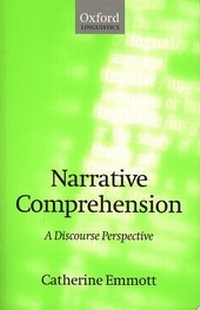
Narrative Comprehension
A Discourse Perspective
Published on 1. April 1999
Book
Paperback/Softback
340 pages
978-0-19-823868-3 (ISBN)
Description
Despite the current explosion of interest in cognitive linguistics, there has so far been relatively little research by cognitive linguists on narrative comprehension. Catherine Emmott draws on insights from discourse analysis and artificial intelligence to present a detailed model of how readers build, maintain, and use mental representations of fictional contexts, and how they keep track of characters and contexts within a complex, changing fictional world.
The book begins with a summary of current issues in text-processing theory and a discussion of the methodological importance of recognizing the hierarchical structure of discourse. The core of the book explores the significance of contextual monitoring in narrative comprehension and looks particularly at the cognitive demands placed on readers by flashbacks. Later chapters examine the implications of contextual monitoring for reference theory and for a literary-linguistic model of narrative text types.
The study focuses on anaphoric pronouns in narratives, assessing the accumulated knowledge required for readers to interpret these key grammatical items. The work has implications for linguistic theory since it questions several long-held assumptions about anaphora, arguing for a `levels of consciousness' model for the processing of referring expressions.
The book begins with a summary of current issues in text-processing theory and a discussion of the methodological importance of recognizing the hierarchical structure of discourse. The core of the book explores the significance of contextual monitoring in narrative comprehension and looks particularly at the cognitive demands placed on readers by flashbacks. Later chapters examine the implications of contextual monitoring for reference theory and for a literary-linguistic model of narrative text types.
The study focuses on anaphoric pronouns in narratives, assessing the accumulated knowledge required for readers to interpret these key grammatical items. The work has implications for linguistic theory since it questions several long-held assumptions about anaphora, arguing for a `levels of consciousness' model for the processing of referring expressions.
Reviews / Votes
a major advance in narrative analysis the book will be an invaluable resource for discourse analysts, cognitive scientists, and narrative theorists alike. * David Herman, North Carolina State University, USA, Language * This is a book which a lot of people should read. It has relevant things to say to linguists and psychologists interested in text and discourse analysis, narratologists, stylisticians, literary theorists, reading theorists and those interested in the empirical study of literature and in the teaching of literacy skills. * Professor Mick Short, Lancaster University, Journal of Literary Semantics * any future serious treatments of written narrative, and particularly of anaphora, will have to take this work into account. * Professor Wallace Chafe, University of California, Santa Barbara, USA *More details
Language
English
Place of publication
Oxford
United Kingdom
Target group
Professional and scholarly
Illustrations
5 text-figures
Dimensions
Height: 216 mm
Width: 138 mm
Thickness: 19 mm
Weight
510 gr
ISBN-13
978-0-19-823868-3 (9780198238683)
Copyright in bibliographic data and cover images is held by Nielsen Book Services Limited or by the publishers or by their respective licensors: all rights reserved.
Schweitzer Classification
Other editions
Additional editions
Book
04/1997
Oxford University Press
€261.10
Shipment within 15-20 days
Person
Content
PART I: COGNITION AND DISCOURSE ; 1. Narrative Comprehension: Text, Knowledge, and Inference-Making ; 2. Key Topics in Processing Research ; 3. A Discourse Perspective: Understanding Full, Real Texts ; PART II: NARRATIVE STRUCTURE AND PROCESSING ; 4. Creating Functional Texts ; 5. Modifying, Switching, and Recalling Texts ; 6. Characters and Texts ; PART III: IMPLICATIONS: LINGUISTIC THEORY AND NARRATIVE THEORY ; 7. Mental Representations, Inference-Making, and Reference Theory ; 8. Distinguishing Narrative Types ; 9. Conclusion ; Bibliography