

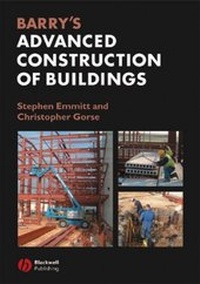
Barry's Advanced Construction of Buildings
Published on 5. January 2006
Book
Paperback/Softback
640 pages
978-1-4051-1054-9 (ISBN)
Description
The second volume of the revised 'Barry' will cover commercial and industrial (or advanced) construction, and brings together material from volumes 3, 4 and part of 5. The extensive revision includes modern concepts on site assembly, environmental issues and safety, and features further reading.
More details
Language
English
Place of publication
Oxford
United Kingdom
Publishing group
John Wiley and Sons Ltd
Target group
Professional and scholarly
Illustrations
513
Dimensions
Height: 244 mm
Width: 172 mm
Weight
1224 gr
ISBN-13
978-1-4051-1054-9 (9781405110549)
Copyright in bibliographic data and cover images is held by Nielsen Book Services Limited or by the publishers or by their respective licensors: all rights reserved.
Schweitzer Classification
Other editions
New editions
Stephen Emmitt | Christopher Gorse
Barry's Advanced Construction of Buildings
Book
01/2010
2nd Edition
Wiley-Blackwell
€37.90
Article exhausted; check for reprint
Previous edition
Book
11/2000
5th Edition
Blackwell Science Ltd
€43.55
Article exhausted; check for reprint
Persons
Stephen Emmitt BA (Hons), Dip Arch, MA Prof. Ed, PhD is the Hoffmann Professor of Innovation and Management in Building at the Technical University of Denmark. He is a registered architect with industrial experience and teaches construction technology across a wide range of built environment programmes. Christopher Gorse BSc (Hons), Dip Ed, Dip (H&S), MSc, PhD, MCIOB, MAPM is a Senior Lecturer in Construction Project Management at Leeds Metropolitan University. He is a construction and project management consultant with industrial experience and teaches construction technology across a wide range of built environment programmes.
Content
CONTENTS Preface; Acknowledgements; CHAPTER 1 INTRODUCTION; 1.1 The function and performance of buildings; 1.2 Environmental concerns; 1.3 New methods and products; 1.4 Product selection and specification; CHAPTER 2 SCAFFOLDING AND ASSOCIATED WORK; 2.1 Scaffolding; 2.2 Refurbishment and facade retention; 2.3 Demolition; CHAPTER 3 FOUNDATIONS AND SUBSTRUCTURES; 3.1 Ground stability; 3.2 Functional requirements; 3.3 Foundation types; 3.4 Substructures and basements; CHAPTER 4 SINGLE STOREY FRAMES, SHELLS AND LIGHTWEIGHT COVERINGS; 4.1 Lattice truss, beam, portal frame and flat roof structures; 4.2 Roof and wall cladding and decking; 4.3 Rooflights; 4.4 Diaphragm, fin wall and tilt-up construction; 4.5 Shell structures; CHAPTER 5 STRUCTURAL STEEL FRAMES;5.1 Functional requirements; 5.2 Methods of design; 5.3 Steel sections; 5.4 Structural steel frames; 5.5 Welding; 5.6 Fire protection of structural steelwork; 5.7 Floor and roof construction; CHAPTER 6 STRUCTURAL CONCRETE FRAMES; 6.1 Concrete; 6.2 Concrete mixes; 6.3 Reinforcement; 6.4 Formwork and falsework; 6.5 Pre-stressed concrete; 6.6 Lightweight concrete; 6.7 Concrete structural frames; 6.8 Precast reinforced concrete frames; 6.9 Lift slab construction; CHAPTER 7 CLADDING AND CURTAIN WALL CONSTRUCTION; 7.1 Functional requirements; 7.2 Terms and definitions; 7.3 Infill wall framing to a structural grid; 7.4 Solid and cavity walling; 7.5 Facings applied to solid and cavity wall backing; 7.6 Cladding panels; 7.7 Sheet metal wall cladding; 7.8 Glazed wall systems; 7.9 Internal walls and partitions; CHAPTER 8 PREFABRICATION AND OFF-SITE PRODUCTION; 8.1 Terms and concepts; 8.2 Functional requirements; 8.3 Off-site production; 8.4 The production process; 8.5 Pre-cut timber; 8.6 Metal; 8.7 Concrete; 8.8 Joints and jointing; CHAPTER 9 LIFTS AND ESCALATORS; 9.1 Functional requirements; 9.2 Lifts (elevators); 9.3 Escalators and moving walkways; CHAPTER 10 FIT OUT AND SECOND FIX; 10.1 Commercial fit out; 10.2 Raised floors; 10.3 Suspended ceilings; 10.4 Internal partition walls; 10.5 Painting and decorating; CHAPTER 11 HEATING, COOLING AND SERVICES PROVISION; 11.1 Functional requirements; 11.2 Indoor climate control; 11.3 Hot water supply systems; 11.4 Water services to multi-story buildings; 11.5 Estimation of pipe sizes; 11.6 Recycled water systems; 11.7 Electronic communication systems: broadband; CHAPTER 12 ALTERNATIVE APPROACHES TO CONSTRUCTION; 12.1 Functional requirements; 12.2 Straw; 12.3 Earth; 12.4 Green Roofs; 12.5 Recycled materials; Appendix A Web sites; Appendix B Additional references; Index