

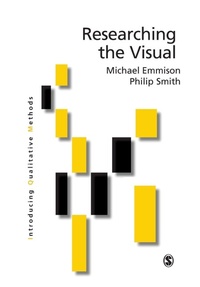
Researching the Visual
2nd Edition
Published on 18. December 2012
Book
Paperback/Softback
296 pages
978-1-4462-0788-8 (ISBN)
Description
This second edition provides an excellent overview of the field by covering the traditional themes and current trends in image centred photographic visual inquiry but extends this by demonstrating the rich possibilities available through the analysis of everyday objects, places and interactions. The book includes chapters on researching 2D and 3D visual data, along with lived and living visual data, and also features a brand new chapter on researching the virtual world of the internet.
Drawing on theoretical traditions as diverse as semiotics, ethnomethodology, symbolic interactionism and material culture studies, the second edition provides an invaluable guide for researchers interested in conducting innovative visual inquiry. Packed with exercises and projects, the book makes it easy for students to undertake their own research with limited resources and budget. The new edition also features helpful icons alerting researchers to important ethical considerations that are vital in the field of visual research.
Generously illustrated with images and diagrams, this new edition is the perfect companion to those doing projects, dissertations or theses involving visual research.
Drawing on theoretical traditions as diverse as semiotics, ethnomethodology, symbolic interactionism and material culture studies, the second edition provides an invaluable guide for researchers interested in conducting innovative visual inquiry. Packed with exercises and projects, the book makes it easy for students to undertake their own research with limited resources and budget. The new edition also features helpful icons alerting researchers to important ethical considerations that are vital in the field of visual research.
Generously illustrated with images and diagrams, this new edition is the perfect companion to those doing projects, dissertations or theses involving visual research.
Reviews / Votes
Stocked with artful new insights, methods and observations without jettisoning more enduring concerns, the field of visual research as presented here is a very welcome sight.David Rowe
University of Western Sydney
In this newest edition, the authors take visual research far beyond the study of two-dimensional images to show readers how observational techniques can be marshalled to analyze public and private spaces in the built environment, human interaction and the culture of everyday life. Researching the Visual is a real eye-opener.
David Grazian
University of Pennsylvania ...Although the book does not explicitly say that this would be useful for educational researchers, the content and style does lend itself well to be a useful methodological resource for those educationalists engaged in research or postgraduate study who are curious about visual methods. And for the adventurous, the many excellent examples of exercises and projects and the illustrations throughout will provide a good place to start. This book would also be a positive addition to the reading list of any lecturers who are keen to explore visual methods with their students. -- Jill Clark, School of Education, Communication and Language Sciences, Newcastle University The Impact of the Social Sciences provides wide-ranging new data on how non-academic impact occurs in social, business or policy contexts as well as identifying the types of research and researcher best placed to produce these 'auditable or recordable occasions of influence'. It also proposes the idea of 'a hidden iceberg mass of knowledge' called the Dynamic Knowledge Inventory that builds up in the public domain and remains dormant, ready for some unspecified use. This framework also highlights the collective and cumulative nature of social science research available to user communities. As REF impact case studies and 'Pathway to Impact' statements rely on specific impacts emerging from individual research projects, the Dynamic Knowledge Inventory challenges a major assumption of the impact agenda. -- Jacqueline Aldridge, Kent Business School, University of Kent The Impact of the Social Sciences provides wide-ranging new data on how non-academic impact occurs in social, business or policy contexts as well as identifying the types of research and researcher best placed to produce these 'auditable or recordable occasions of influence'. It also proposes the idea of 'a hidden iceberg mass of knowledge' called the Dynamic Knowledge Inventory that builds up in the public domain and remains dormant, ready for some unspecified use. This framework also highlights the collective and cumulative nature of social science research available to user communities. As REF impact case studies and 'Pathway to Impact' statements rely on specific impacts emerging from individual research projects, the Dynamic Knowledge Inventory challenges a major assumption of the impact agenda. -- Jacqueline Aldridge, Kent Business School, University of Kent The Impact of the Social Sciences provides wide-ranging new data on how non-academic impact occurs in social, business or policy contexts as well as identifying the types of research and researcher best placed to produce these 'auditable or recordable occasions of influence'. It also proposes the idea of 'a hidden iceberg mass of knowledge' called the Dynamic Knowledge Inventory that builds up in the public domain and remains dormant, ready for some unspecified use. This framework also highlights the collective and cumulative nature of social science research available to user communities. As REF impact case studies and 'Pathway to Impact' statements rely on specific impacts emerging from individual research projects, the Dynamic Knowledge Inventory challenges a major assumption of the impact agenda. -- Jacqueline Aldridge, Kent Business School, University of Kent
More details
Series
Edition
2nd Revised edition
Language
English
Place of publication
London
United Kingdom
Target group
College/higher education
Edition type
Revised edition
Dimensions
Height: 244 mm
Width: 170 mm
Thickness: 16 mm
Weight
502 gr
ISBN-13
978-1-4462-0788-8 (9781446207888)
Copyright in bibliographic data and cover images is held by Nielsen Book Services Limited or by the publishers or by their respective licensors: all rights reserved.
Schweitzer Classification
Other editions
Additional editions
Michael Emmison | Philip D. Smith | Margery Mayall
Researching the Visual
E-Book
12/2012
2nd Edition
SAGE Publications Ltd
€80.59
Available for download
Michael Emmison | Philip D. Smith | Margery Mayall
Researching the Visual
E-Book
12/2012
2nd Edition
SAGE Publications Ltd
from
€80.59
Available for download
Michael Emmison | Philip D. Smith | Margery Mayall
Researching the Visual
Book
12/2012
2nd Edition
SAGE Publications Ltd
€221.35
Shipment within 15-20 days
Previous edition
Michael Emmison | Philip D. Smith
Researching the Visual
Images, Objects, Contexts and Interactions in Social and Cultural Inquiry
Book
03/2000
SAGE Publications Inc
€48.46
Article exhausted; check for reprint
Persons
After nearly four decades at the University of Queensland, Michael Emmison retired in 2012 from his position as Reader in the School of Social Science. He is currently an Honorary Reader and Research Fellow and is still active in a number of areas of research, particularly visual social inquiry and language and social interaction. His most recent book is Researching The Visual, 2nd edition, co-authored with Philip Smith and Margery Mayall, published by SAGE in 2012.
Content
A Very Short Introduction: The Scope of Visual Research
Ethics in Visual Research
Visual Research: The Disciplinary Core
Two-Dimensional Visual Data: Photographs and Beyond
Three-Dimensional Visual Data
Lived Visual Data
Living Forms of Visual Data
Virtual Visual Data
Ethics in Visual Research
Visual Research: The Disciplinary Core
Two-Dimensional Visual Data: Photographs and Beyond
Three-Dimensional Visual Data
Lived Visual Data
Living Forms of Visual Data
Virtual Visual Data