

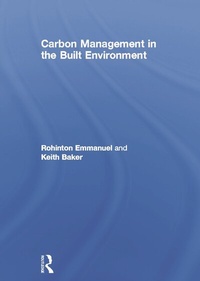
Carbon Management in the Built Environment
1st Edition
Published on 7. June 2012
Book
Hardback
236 pages
978-0-415-68406-4 (ISBN)
Description
Three broad sectors of the economy are generally recognized as key to a low carbon future: energy, construction and transportation. Of these, carbon management in the built environment remains the least well-studied.
This much-needed book brings together the latest developments in the field of climate change science, building design, materials science, energy and policy in a form readily accessible to both students of the built environment and practitioners. Although several books exist in the broad area of carbon management, this is the first to bring together carbon management technology, technique and policy as they apply to the building sector.
Clear and succinct sections on the overarching principles, policies, approaches and technologies are combined with case studies and more in-depth coverage of the most relevant topics. It explains how to produce a simple carbon footprint calculation, while also being an informative guide for those developing or implementing more advanced approaches. This easy to read book is the ideal primer for anyone needing to get to grips with carbon management in the built environment.
This much-needed book brings together the latest developments in the field of climate change science, building design, materials science, energy and policy in a form readily accessible to both students of the built environment and practitioners. Although several books exist in the broad area of carbon management, this is the first to bring together carbon management technology, technique and policy as they apply to the building sector.
Clear and succinct sections on the overarching principles, policies, approaches and technologies are combined with case studies and more in-depth coverage of the most relevant topics. It explains how to produce a simple carbon footprint calculation, while also being an informative guide for those developing or implementing more advanced approaches. This easy to read book is the ideal primer for anyone needing to get to grips with carbon management in the built environment.
Reviews / Votes
"I read this book with much enjoyment because it brings together multidisciplinary approaches in a single volume dedicated to carbon management in the built environment. The book provides useful introductory material to both students and practitioners concerned with the built environment. It has succinct sections on the overarching principles, policies, approaches, assessment tools and technologies." - Yangang Xing, Cardiff University, UK"With up to 90% of all energy use-primary, secondary, and final energy-occurring in cities, Carbon Management in the Built Environment is a book that presents ideas that all of us who are interested in tropical forest conservation and mitigating climate change need to be familiar with." - Gabriel Thoumi, CFA, Mongabay.com
More details
Language
English
Place of publication
London
United Kingdom
Publishing group
Taylor & Francis Ltd
Target group
College/higher education
Professional and scholarly
Postgraduate, Professional, Professional Practice & Development, and Undergraduate
Illustrations
30 s/w Abbildungen, 52 s/w Tabellen
52 Tables, black and white; 30 Illustrations, black and white
Dimensions
Height: 246 mm
Width: 174 mm
Weight
580 gr
ISBN-13
978-0-415-68406-4 (9780415684064)
Copyright in bibliographic data and cover images is held by Nielsen Book Services Limited or by the publishers or by their respective licensors: all rights reserved.
Schweitzer Classification
Other editions
Additional editions
Rohinton Emmanuel | Keith Baker
Carbon Management in the Built Environment
E-Book
07/2012
1st Edition
Routledge
€69.99
Available for download
Rohinton Emmanuel | Keith Baker
Carbon Management in the Built Environment
E-Book
07/2012
1st Edition
Routledge
€69.99
Available for download
Rohinton Emmanuel | Keith Baker
Carbon Management in the Built Environment
Book
06/2012
1st Edition
Routledge
€81.89
Shipment within 15-20 days
Persons
Rohinton Emmanuel is a Reader in Sustainable Design and Construction, and the Director of the Centre for Energy and the Built Environment at Glasgow Caledonian University, UK. He has pioneered the inquiry of urban climate change in warm regions and has taught and consulted on subjects including climate and environment sensitive design, building energy efficiency, and thermal comfort. He has authored over 50 research papers in the areas of climate change in the built environment, building and urban energy efficiency and thermal comfort and a book related to these efforts, An Urban Approach to Climate Sensitive Design: Strategies for the Tropics, was published by Routledge in 2005.
Keith Baker is a Researcher in Sustainable Urban Environments at the Centre for Energy and the Built Environment at Glasgow Caledonian University. He is also a member of the Scottish Carbon Accounting Group, and a founder member of ICARB (the Initiative for Carbon) and a long standing columnist on electronic waste for The Display Standard, a trade publication for the electronics industry. Keith's main research interests are in climate change, energy, the built environment, and the environmental impact of technology.
Keith Baker is a Researcher in Sustainable Urban Environments at the Centre for Energy and the Built Environment at Glasgow Caledonian University. He is also a member of the Scottish Carbon Accounting Group, and a founder member of ICARB (the Initiative for Carbon) and a long standing columnist on electronic waste for The Display Standard, a trade publication for the electronics industry. Keith's main research interests are in climate change, energy, the built environment, and the environmental impact of technology.
Content
1. Historical Background: from Sustainable Development to Carbon Management 2. Overview of Climate Change 3. Sectoral Approaches to Carbon Management 4. Energy Generation for a Low Carbon Built Environment 5. Carbon Management in the New Build 6. Carbon Management in the Existing Stock 7. Carbon Management in Cities 8. Operational and Embodied Carbon in Buildings 9. Regulations and Incentives for Low/Zero Carbon (LZC) Buildings 10. Tools and Assessment Systems for the Construction Industry 11. Carbon, GHG and Sustainability Accounting 12. Carbon Accounting in Organisations and Industry