

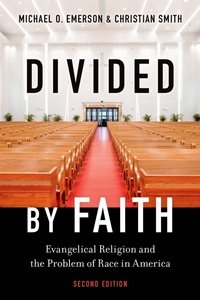
Divided by Faith
Evangelical Religion and the Problem of Race in America, Second Edition
2nd Edition
Published on 17. November 2025
Book
Hardback
328 pages
978-0-19-780261-8 (ISBN)
Description
First published in 2000, Divided by Faith has become a landmark book for understanding race and religion in the United States. Drawing on a nationwide telephone survey of two thousand people and an additional two hundred face-to-face interviews, it probes the grassroots of white evangelical America. A quarter of a century on from the first edition, Michael O. Emerson and Christian Smith find that despite efforts by the movement's leaders to address the problem of racial discrimination, evangelicals themselves are still preserving America's racial chasm. In fact, most white evangelicals see no systematic discrimination against Black Americans or other racial groups. The authors contend that it is not overt racism that prevents evangelicals from recognizing ongoing problems in American society. Instead, it is the evangelical movement's emphasis on individualism, free will, and personal relationships that makes invisible the pervasive injustice that perpetuates racial inequality.
This second edition has been thoroughly overhauled with updated statistics and an additional chapter covering developments over the last twenty-five years. The authors assess the growth of the rise of Christian nationalism, whiteness studies, critical race theory, the racialization of religion, and the religionization of race. Through a large body of evidence combined with sophisticated analysis and interpretation, they throw a bright light on the oldest American dilemma. In the end, they conclude that despite the best intentions of evangelical leaders and some positive trends, real racial reconciliation remains far over the horizon.
This second edition has been thoroughly overhauled with updated statistics and an additional chapter covering developments over the last twenty-five years. The authors assess the growth of the rise of Christian nationalism, whiteness studies, critical race theory, the racialization of religion, and the religionization of race. Through a large body of evidence combined with sophisticated analysis and interpretation, they throw a bright light on the oldest American dilemma. In the end, they conclude that despite the best intentions of evangelical leaders and some positive trends, real racial reconciliation remains far over the horizon.
More details
Edition
2nd Revised edition
Language
English
Place of publication
New York
United States
Target group
Professional and scholarly
Edition type
Revised edition
Product notice
sewn/stitched
Cloth over boards
Illustrations
5
Dimensions
Height: 216 mm
Width: 140 mm
Thickness: 19 mm
Weight
522 gr
ISBN-13
978-0-19-780261-8 (9780197802618)
Copyright in bibliographic data and cover images is held by Nielsen Book Services Limited or by the publishers or by their respective licensors: all rights reserved.
Schweitzer Classification
Other editions
Additional editions
Michael O. Emerson | Christian Smith
Divided by Faith
Evangelical Religion and the Problem of Race in America, Second Edition
Book
approx. 02/2026
2nd Edition
Oxford University Press Inc
€24.73
Not yet published
Persons
Michael O. Emerson is the Harry and Hazel Chavanne Fellow and Director of the Religion and Public Policy Program at Rice University's Baker Institute for Public Policy. He is the author of The Religion of Whteness: How Racism Distorts Christian Faith, among many other publications, and the winner of several research and teaching awards. He has featured in numerous media outlets, including CBS Evening News, National Public Radio, The Wall Street Journal, CNN, The New York Times, USA Today, podcasts, and SiriusXM radio.
Christian Smith is the William R. Kenan, Jr. Professor of Sociology at the University of Notre Dame. He is well known for his research focused on religion, adolescents and emerging adults, and social theory. For his work on evangelicalism, he developed the subcultural identity theory of religious persistence and strength.
Christian Smith is the William R. Kenan, Jr. Professor of Sociology at the University of Notre Dame. He is well known for his research focused on religion, adolescents and emerging adults, and social theory. For his work on evangelicalism, he developed the subcultural identity theory of religious persistence and strength.
Content
Preface
Introduction to Religion and the Racialized Society
1. Confronting the Black--White Divide
2. From Separate Pews to Separate Churches: Evangelical Racial Thought and Practice, 1700--1964
3. Becoming Active: Contemporary Involvement in the America Dilemma
4. Color Blind: Evangelicals Speak on the Race Problem
5. Controlling One's Own Destiny: Explaining Economic Inequality between Black and White Americans
6. Let's Be Friends: Exploring Solutions to the Race Problem
7. The Organization of Religion and Internally Similar Congregations
8. Structurally Speaking: Religion and Racialization
9. Conclusion
10. Twenty-Five Years Later . . . Evolving and Revolving
Appendix A
Appendix B
Notes
Bibliography
Index
Introduction to Religion and the Racialized Society
1. Confronting the Black--White Divide
2. From Separate Pews to Separate Churches: Evangelical Racial Thought and Practice, 1700--1964
3. Becoming Active: Contemporary Involvement in the America Dilemma
4. Color Blind: Evangelicals Speak on the Race Problem
5. Controlling One's Own Destiny: Explaining Economic Inequality between Black and White Americans
6. Let's Be Friends: Exploring Solutions to the Race Problem
7. The Organization of Religion and Internally Similar Congregations
8. Structurally Speaking: Religion and Racialization
9. Conclusion
10. Twenty-Five Years Later . . . Evolving and Revolving
Appendix A
Appendix B
Notes
Bibliography
Index