

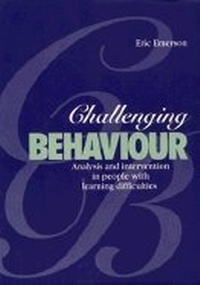
Challenging Behaviour
Analysis and Intervention in People with Learning Disabilities
Published on 12. October 1995
Book
Hardback
243 pages
978-0-521-40485-3 (ISBN)
Description
Assertion of the rights of the learning disabled to inclusion in society has brought increasing challenges to community services to meet the needs of a significant number of people whose behaviour represents a challenge. From aggression and self-injury through to bizarre mannerisms, the combination of intellectual and behavioural disabilities can easily jeopardise the health, safety and welfare of the affected and their carers. This book provides a concise overview of behavioural approaches to understanding, assessing and treating challenging behaviour. It discusses criticisms of these approaches and draws attention to recent developments which have implications for future practice. Also covering the social context and epidemiology, neurobiological models and psychopharmacological approaches to intervention, it will be an invaluable resource to clinical and educational psychologists, psychiatrists and all therapists involved in the assessment and treatment of challenging behaviour.
More details
Language
English
Place of publication
Cambridge
United Kingdom
Target group
Professional and scholarly
Illustrations
9 Tables, unspecified; 19 Line drawings, unspecified
Dimensions
Height: 255 mm
Width: 178 mm
Thickness: 19 mm
Weight
597 gr
ISBN-13
978-0-521-40485-3 (9780521404853)
Copyright in bibliographic data and cover images is held by Nielsen Book Services Limited or by the publishers or by their respective licensors: all rights reserved.
Schweitzer Classification
Other editions
New editions
Eric Emerson
Challenging Behaviour
Analysis and Intervention in People with Severe Intellectual Disabilities
Book
05/2001
2nd Edition
Cambridge University Press
€55.71
Article exhausted; check for reprint
Persons
Content
1. Introduction; 2. The social context of challenging behaviour; 3. Epidemiology; 4. Models and theories; 5. The bases of intervention; 6. Approaches to assessment; 7. Behavioural approaches; 8. Psychopharmacology; 9. Longer-term management; 10. Challenges ahead.