

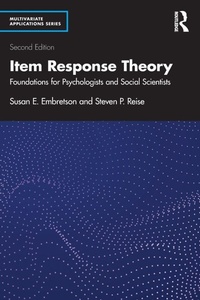
Item Response Theory
Foundations for Psychologists and Social Scientists
2nd Edition
Published on 3. November 2025
Book
Paperback/Softback
422 pages
978-0-8058-5303-2 (ISBN)
Description
This book provides an intuitive and accessible introduction to item response theory (IRT), making complex psychometric concepts easier to grasp through graphical displays and familiar analogies. It bridges theory and application, helping readers interpret and implement IRT models effectively to improve measurement quality in psychology and the social sciences. Covering both foundational and advanced topics, it offers a clear path for understanding contemporary IRT methods and their relevance in research and practice.
With a strong focus on applications, this book explains contemporary IRT models and estimation methods, placing special emphasis on polytomous IRT models, which are widely used in psychological assessments and rating scales. Applications in various research areas are explored in detail, alongside a dedicated chapter on available software to support implementation. The final section delves into advanced IRT topics, including multidimensional models and explanatory approaches for hypothesis testing, making it a valuable resource for those looking to deepen their understanding of psychometric analysis.
This book is essential for graduate students, researchers, and practitioners in psychology, education, and the social sciences. It is useful for researchers who are implementing or developing person assessments, as well as for professionals in clinical, industrial, counseling, and behavioral medicine fields who need a strong grasp of contemporary psychometric foundations. Professors teaching measurement courses will find it an ideal core textbook, offering a structured and engaging introduction to IRT and its applications in test development and analysis.
With a strong focus on applications, this book explains contemporary IRT models and estimation methods, placing special emphasis on polytomous IRT models, which are widely used in psychological assessments and rating scales. Applications in various research areas are explored in detail, alongside a dedicated chapter on available software to support implementation. The final section delves into advanced IRT topics, including multidimensional models and explanatory approaches for hypothesis testing, making it a valuable resource for those looking to deepen their understanding of psychometric analysis.
This book is essential for graduate students, researchers, and practitioners in psychology, education, and the social sciences. It is useful for researchers who are implementing or developing person assessments, as well as for professionals in clinical, industrial, counseling, and behavioral medicine fields who need a strong grasp of contemporary psychometric foundations. Professors teaching measurement courses will find it an ideal core textbook, offering a structured and engaging introduction to IRT and its applications in test development and analysis.
More details
Series
Edition
2nd edition
Language
English
Place of publication
New York
United States
Publishing group
Taylor & Francis Inc
Target group
Professional and scholarly
Product notice
Paperback (UK-B)
Illustrations
109 s/w Abbildungen, 109 s/w Zeichnungen, 77 s/w Tabellen
77 Tables, black and white; 109 Line drawings, black and white; 109 Illustrations, black and white
Dimensions
Height: 229 mm
Width: 152 mm
Thickness: 23 mm
Weight
630 gr
ISBN-13
978-0-8058-5303-2 (9780805853032)
Copyright in bibliographic data and cover images is held by Nielsen Book Services Limited or by the publishers or by their respective licensors: all rights reserved.
Schweitzer Classification
Other editions
Additional editions
Susan E. Embretson | Steven P. Reise
Item Response Theory
Foundations for Psychologists and Social Scientists
E-Book
11/2025
2nd Edition
Routledge
€69.99
Available for download
Susan E. Embretson | Steven P. Reise
Item Response Theory
Foundations for Psychologists and Social Scientists
E-Book
11/2025
2nd Edition
Routledge
€69.99
Available for download
Susan E. Embretson | Steven P. Reise
Item Response Theory
Foundations for Psychologists and Social Scientists
Book
11/2025
2nd Edition
Routledge
€207.80
Shipment within 10-20 days
Previous edition
Susan E. Embretson | Steven P. Reise
Item Response Theory for Psychologists
Book
05/2000
1st Edition
Psychology Press
€96.81
Shipment within 10-20 days
Persons
Susan E. Embretson is Professor Emeritus at both the University of Kansas and the Georgia Institute of Technology in the USA. She received her Ph.D. from the University of Minnesota. Her primary interest includes developing and applying item response theory (IRT) models for the response processes used by examinees to solve aptitude items.
Steven P. Reise received his Ph.D. from the Department of Psychology at the University of Minnesota in 1990. Currently, he is Professor of Quantitative Psychology at UCLA. His research explores the application of item response theory (IRT) models to personality, psychopathology, and health outcome measures. In recent years, his interests have centered on bifactor modeling and projective IRT models.
Steven P. Reise received his Ph.D. from the Department of Psychology at the University of Minnesota in 1990. Currently, he is Professor of Quantitative Psychology at UCLA. His research explores the application of item response theory (IRT) models to personality, psychopathology, and health outcome measures. In recent years, his interests have centered on bifactor modeling and projective IRT models.
Content
Section I. Introduction 1. Background and History 2. Advantages of Item Response Theory 3. Item Response Theory as Model-Based Measurement Section II. Basic Item Response Theory Models 4. Binary Item Response Theory Models 5. Polytomous Item Response Theory Models Section III. Estimating Item Parameters and Scoring Persons 6. Measuring Persons 7. Estimating Item Parameters 8. Testing Assumptions and Assessing Fit Section IV. Applications of Item Response Theory Models in Test Development and Assessment 9. Properties of Item Response Theory Scales 10. Differential Item Functioning, Computerized Adaptive Testing and Scale Analysis 11. An Overview of Item Response Theory-Related Computer Software Section V. Advanced Item Response Theory Models 12. Multidimensional Item Response Theory Models 13. Explanatory, Mixture and Other Advanced Item Response Theory Models