

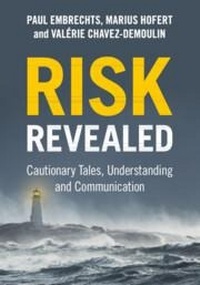
Risk Revealed
Cautionary Tales, Understanding and Communication
Published on 11. April 2024
Book
Paperback/Softback
384 pages
978-1-009-29981-7 (ISBN)
Description
Explore the concept of risk through numerous examples and their statistical modeling, traveling from a historical perspective all the way to an up-to-date technical analysis. Written with a wide readership in mind, this book begins with accounts of a selection of major historical disasters, such as the North Sea flood of 1953 and the L'Aquila earthquake. These tales serve to set the scene and to motivate the second part of the book, which describes the mathematical tools required to analyze these events, and how to use them. The focus is on the basic understanding of the mathematical modeling of risk and what types of questions the methods allow one to answer. The text offers a bridge between the world of science and that of everyday experience. It is written to be accessible to readers with only a basic background in mathematics and statistics. Even the more technical discussions are interspersed with historical comments and plentiful examples.
Reviews / Votes
'Everything you always wanted to know about understanding and communicating risks. This book is the ultimate reference at a critical time when scientists and policy-makers have had to work so closely together to handle uncertainty.' Pauline Barrieu, London School of Economics 'This book describes the big risks facing society. These include floods, earthquakes and financial crises. The authors showcase the statistical framework to model these risks. The book is garnished with quirky stories of mathematicians. I enjoyed the book's unique perspective and I found it insightful and ambitious.' Phelim Boyle, University of Waterloo 'We waited a long time for this book. This is the age of Big Risks - we know because we create many of them ourselves. Society can navigate these risks only by becoming much more numerate. This book is for everyone from concerned layman to specialist who wants to raise their risk numeracy. It starts with a highly textured inventory of modern risks, inundation, space flight, financial risks, earthquakes, tsunamis and pandemics. A pas de deux with mathematics ignites an infatuation, which sustains the novice through friendly yet meticulous chapters on probabilistic modeling. In the end the reader is empowered to build extreme value models.' Roger M. Cooke, Resources for the Future, Washington DC 'I very much enjoyed this excursion through a world of risk, as revealed in historical incidents from Dutch tulip mania to the coronavirus pandemic. Written by three experts in quantitative modeling, each episode holds important lessons on risk communication, as well as some accessible maths and a wealth of entertaining detail.' Alexander J. McNeil, University of York Management SchoolMore details
Language
English
Place of publication
Cambridge
United Kingdom
Product notice
Paperback (trade)
Illustrations
Worked examples or Exercises
Dimensions
Height: 249 mm
Width: 178 mm
Thickness: 21 mm
Weight
804 gr
ISBN-13
978-1-009-29981-7 (9781009299817)
Copyright in bibliographic data and cover images is held by Nielsen Book Services Limited or by the publishers or by their respective licensors: all rights reserved.
Schweitzer Classification
Other editions
Additional editions
Paul Embrechts | Marius Hofert | Valerie Chavez-Demoulin
Risk Revealed
Cautionary Tales, Understanding and Communication
Book
04/2024
Cambridge University Press
€134.20
Shipment within 15-20 days
Persons
Paul Embrechts is Emeritus Professor of Insurance Mathematics in the Department of Mathematics of ETH Zurich, Switzerland. He holds numerous distinctions and awards from universities and organizations worldwide. He co-authored the influential books 'Modelling Extremal Events for Insurance and Finance' and 'Quantitative Risk Management: Concepts, Techniques and Tools' and has published over 200 scientific papers in leading international scientific journals.
Content
Introduction; 1. The 1953 Great Flood; 2. The space shuttle Challenger disaster; 3. The 2007-2008 financial crisis; 4. Earthquakes and tsunamis; 5. The L'Aquila trial and the public communication of risk; 6. The coronavirus pandemic; 7. Mathematical wonderland; 8. Stochastic modeling; 9. The modeling of extreme events; 10. On climate change and related risk; 11. Further examples from the world of extremes; 12. Networks; 13. The black tulip and February 3, 1637; A note about the references; References; Index.