

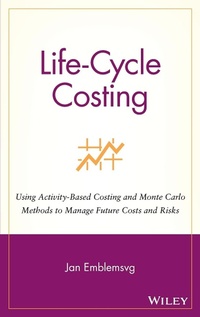
Life-Cycle Costing
Using Activity-Based Costing and Monte Carlo Methods to Manage Future Costs and Risks
1st Edition
Published on 21. March 2003
Book
Hardback
336 pages
978-0-471-35885-5 (ISBN)
Description
Everyone jokes about the 20/20 hindsight of cost management. In Life-Cycle Costing, Jan Emblemsvag proposes to do something about it. Here's a new approach to life cycle costing that brings activity-based costing, risk, and uncertainty into the forefront. You'll focus on future costs and learn how you can perform any type of cost management activity better than before by introducing uncertainty into models and exploiting them to the max.
Order your copy today!
Order your copy today!
More details
Language
English
Place of publication
New York
United States
Target group
Professional and scholarly
Product notice
sewn/stitched
Cloth over boards
With dust jacket
Illustrations
Tables: 80 B&W, 0 Color; Exhibits: 103 B&W, 0 Color
Dimensions
Height: 240 mm
Width: 161 mm
Thickness: 23 mm
Weight
677 gr
ISBN-13
978-0-471-35885-5 (9780471358855)
Copyright in bibliographic data and cover images is held by Nielsen Book Services Limited or by the publishers or by their respective licensors: all rights reserved.
Schweitzer Classification
Other editions
Additional editions
Jan Emblemsvåg
Life-Cycle Costing
Using Activity-Based Costing and Monte Carlo Methods to Manage Future Costs and Risks
E-Book
05/2003
Wiley
€121.99
Available for download
Person
JAN EMBLEMSVAG is a management consultant with Det Norske Veritas Consulting, where he works on cost management, risk management, and business development projects. Formerly, he was a partner with Considium Consulting Group AS. He is coauthor, with Bert A. Bras, of Activity-Based Cost and Environmental Management: A Different Approach to the ISO 14000 Compliance.
Content
Preface. Acknowledgments.
1. Introduction.
What Does It Cost?
The Role of Life-Cycle Costing.
Why Activity-Based Life-Cycle Costing?
Notes.
2. Basics of Life-Cycle Costing.
What Is a Life Cycle?
What Is a Cost?
Four Ways of LCC.
Notes.
3. Uncertainty Analysis and Risk Management.
What are Risk and Uncertainty?
Uncertainty, Risk, and Utility.
Common Ways of Analyzing Risk and Uncertainty.
How Belief Sheds Light on Risk and Uncertainty.
Reduce Risk by Introducing Uncertainty: How Monte Carlo Methods Work.
Traditional Risk Management.
Notes.
4. Activity-Based Costing.
Motivating Example.
Activity-Based Costing.
ABC Example and Case Study.
From the Trenches.
Notes.
5. Activity-Based Life-Cycle Costing.
Step 1: Define the Scope of the Model and the Corresponding Cost Objects.
Step 2: Obtain and Clean Bill of Materials for All Cost Objects.
Step 3: Identify and Quantify the Resources.
Step 4: Create an Activity Hierarchy and Network.
Step 5: Identify and Quantify Resource Drivers, Activity Drivers, and Their Intensities.
Step 6: Identify the Relationships between Activity Drivers and Design Changes.
Step 7: Model the Uncertainty.
Step 8: Estimate the Bill of Activities.
Step 9: Estimate the Cost of Cost Objects and Their Performance Measures.
Step 10: Perform Monte Carlo Simulations and Relevant Analyses.
Further Explanation Regarding Some Steps.
Notes.
6. Case Study: Life-Cycle Costing and Tire Disposal.
What the Decision Is About.
Traditional LCC Implementation.
Activity-Based LCC Implementation.
Discussion.
Closure.
Epilogue.
Notes.
7. Activity-Based Life-Cycle Costing for Platform Supply Vessels.
Operating a Platform Supply Vessel.
Problem Statement and System Boundaries.
Information Sources.
Activity-Based LCC Model Implementation and Results.
Identifying the Major Operational Risks.
Closure.
Notes.
8. Activity-Based Life-Cycle Costing at WagonHo!
WagonHo!'s New Strategy and Business Idea.
Developing an Activity-Based LCC Model.
Results and How to Use Them.
Closure.
Notes.
9. From Hindsight to Foresight.
Activity-Based LCC Revisited.
Ideas for the Future.
Some Thoughts at the End.
Notes.
Appendix A Monte Carlo Simulation Example.
Problem Definition.
Hypotheses to Be Tested.
Results and Discussion.
Appendix B SFI Group System.
Glossary.
Acronyms.
Index.
1. Introduction.
What Does It Cost?
The Role of Life-Cycle Costing.
Why Activity-Based Life-Cycle Costing?
Notes.
2. Basics of Life-Cycle Costing.
What Is a Life Cycle?
What Is a Cost?
Four Ways of LCC.
Notes.
3. Uncertainty Analysis and Risk Management.
What are Risk and Uncertainty?
Uncertainty, Risk, and Utility.
Common Ways of Analyzing Risk and Uncertainty.
How Belief Sheds Light on Risk and Uncertainty.
Reduce Risk by Introducing Uncertainty: How Monte Carlo Methods Work.
Traditional Risk Management.
Notes.
4. Activity-Based Costing.
Motivating Example.
Activity-Based Costing.
ABC Example and Case Study.
From the Trenches.
Notes.
5. Activity-Based Life-Cycle Costing.
Step 1: Define the Scope of the Model and the Corresponding Cost Objects.
Step 2: Obtain and Clean Bill of Materials for All Cost Objects.
Step 3: Identify and Quantify the Resources.
Step 4: Create an Activity Hierarchy and Network.
Step 5: Identify and Quantify Resource Drivers, Activity Drivers, and Their Intensities.
Step 6: Identify the Relationships between Activity Drivers and Design Changes.
Step 7: Model the Uncertainty.
Step 8: Estimate the Bill of Activities.
Step 9: Estimate the Cost of Cost Objects and Their Performance Measures.
Step 10: Perform Monte Carlo Simulations and Relevant Analyses.
Further Explanation Regarding Some Steps.
Notes.
6. Case Study: Life-Cycle Costing and Tire Disposal.
What the Decision Is About.
Traditional LCC Implementation.
Activity-Based LCC Implementation.
Discussion.
Closure.
Epilogue.
Notes.
7. Activity-Based Life-Cycle Costing for Platform Supply Vessels.
Operating a Platform Supply Vessel.
Problem Statement and System Boundaries.
Information Sources.
Activity-Based LCC Model Implementation and Results.
Identifying the Major Operational Risks.
Closure.
Notes.
8. Activity-Based Life-Cycle Costing at WagonHo!
WagonHo!'s New Strategy and Business Idea.
Developing an Activity-Based LCC Model.
Results and How to Use Them.
Closure.
Notes.
9. From Hindsight to Foresight.
Activity-Based LCC Revisited.
Ideas for the Future.
Some Thoughts at the End.
Notes.
Appendix A Monte Carlo Simulation Example.
Problem Definition.
Hypotheses to Be Tested.
Results and Discussion.
Appendix B SFI Group System.
Glossary.
Acronyms.
Index.