

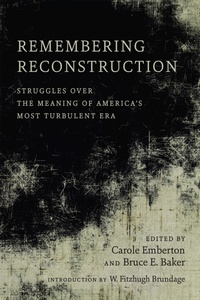
Remembering Reconstruction
Struggles Over the Meaning of America's Most Turbulent Era
Published on 30. April 2017
Book
Hardback
304 pages
978-0-8071-6602-4 (ISBN)
Description
Academic studies of the Civil War and historical memory abound, ensuring a deeper understanding of how the war's meaning has shifted over time and the implications of those changes for concepts of race, citizenship, and nationhood. The Reconstruction era, by contrast, has yet to receive similar attention from scholars. Remembering Reconstruction ably fills this void, assembling a prestigious lineup of Reconstruction historians to examine the competing social and historical memories of this pivotal and violent period in American history.
Many consider the period from 1863 (beginning with slave emancipation) to 1877 (when the last federal troops were withdrawn from South Carolina and Louisiana) an ""unfinished revolution"" for civil rights, racial-identity formation, and social reform. Despite the cataclysmic aftermath of the war, the memory of Reconstruction in American consciousness and its impact on the country's fraught history of identity, race, and reparation has been largely neglected. The essays in Remembering Reconstruction advance and broaden our perceptions of the complex revisions in the nation's collective memory. Notably, the authors uncover the impetus behind the creation of black counter-memories of Reconstruction and the narrative of the ""tragic era"" that dominated white memory of the period. Furthermore, by questioning how Americans have remembered Reconstruction and how those memories have shaped the nation's social and political history throughout the twentieth century, this volume places memory at the heart of historical inquiry.
Many consider the period from 1863 (beginning with slave emancipation) to 1877 (when the last federal troops were withdrawn from South Carolina and Louisiana) an ""unfinished revolution"" for civil rights, racial-identity formation, and social reform. Despite the cataclysmic aftermath of the war, the memory of Reconstruction in American consciousness and its impact on the country's fraught history of identity, race, and reparation has been largely neglected. The essays in Remembering Reconstruction advance and broaden our perceptions of the complex revisions in the nation's collective memory. Notably, the authors uncover the impetus behind the creation of black counter-memories of Reconstruction and the narrative of the ""tragic era"" that dominated white memory of the period. Furthermore, by questioning how Americans have remembered Reconstruction and how those memories have shaped the nation's social and political history throughout the twentieth century, this volume places memory at the heart of historical inquiry.
More details
Language
English
Place of publication
Baton Rouge
United States
Target group
Professional and scholarly
Product notice
sewn/stitched
Cloth over boards
Dimensions
Height: 237 mm
Width: 164 mm
Thickness: 29 mm
Weight
587 gr
ISBN-13
978-0-8071-6602-4 (9780807166024)
Copyright in bibliographic data and cover images is held by Nielsen Book Services Limited or by the publishers or by their respective licensors: all rights reserved.
Schweitzer Classification
Other editions
Additional editions
Carole Emberton
Remembering Reconstruction
Struggles over the Meaning of America's Most Turbulent Era
E-Book
04/2017
1st Edition
LSU Press
€133.99
Available for download
Carole Emberton
Remembering Reconstruction
Struggles over the Meaning of America's Most Turbulent Era
E-Book
04/2017
1st Edition
LSU Press
€133.99
Available for download
Persons
Bruce E. Baker, lecturer in United States history at Newcastle University, is the author of What Reconstruction Meant: Historical Memory in the American South.
Carole Emberton, associate professor of history at SUNY- Buffalo, is the author of Beyond Redemption: Race, Violence, and the American South after the Civil War.
Carole Emberton, associate professor of history at SUNY- Buffalo, is the author of Beyond Redemption: Race, Violence, and the American South after the Civil War.