

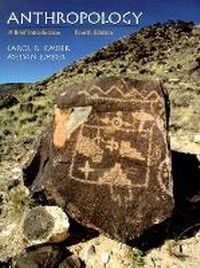
Anthropology
A Brief Introduction
4th Edition
Published on 18. July 2000
Book
Paperback/Softback
451 pages
978-0-13-015600-6 (ISBN)
Description
For one-semester courses in General Anthropology or courses where supplementary readings are used.
Designed to be used in conjunction with a book of selected readings or ethnographies, this brief, concise version of Ember/Ember's larger best-selling introductory text provides an ideal core book for courses that explore the significant achievements in physical and cultural anthropology or one-semester courses where supplemental readings are assigned.
Designed to be used in conjunction with a book of selected readings or ethnographies, this brief, concise version of Ember/Ember's larger best-selling introductory text provides an ideal core book for courses that explore the significant achievements in physical and cultural anthropology or one-semester courses where supplemental readings are assigned.
More details
Edition
4th edition
Language
English
Place of publication
United States
Publishing group
Pearson Education (US)
Target group
Professional and scholarly
ISBN-13
978-0-13-015600-6 (9780130156006)
Copyright in bibliographic data and cover images is held by Nielsen Book Services Limited or by the publishers or by their respective licensors: all rights reserved.
Schweitzer Classification
Other editions
New editions
Book
02/2004
5th Edition
Pearson
€55.79
Article exhausted; check for reprint
Content
I. INTRODUCTION TO ANTHROPOLOGY.
1. What Is Anthropology?
II. HUMAN EVOLUTION: BIOLOGICAL AND CULTURAL.
2. Evolution.
3. Primate Evolution: From Early Primates to Hominoids.
4. Early Hominoids and Their Cultures.
5. The Emergence of Homo sapiens and Their Cultures.
6. Human Variation.
7. The Emergence of Good Production and the Rise of States.
III. CULTURAL VARIATION.
8. The Concept of Culture.
9. Communication and Language.
10. Getting Food.
11. Economics and Social Stratification.
12. Sex, Gender, and Culture.
13. Marriage and the Family.
14. Marital Residence and Kinship.
15. Political Life: Social Order and Disorder.
16. Religion and Magic.
IV. ANTHROPOLOGY IN THE MODERN WORLD.
17. Applied Anthropology and Social Problems.
1. What Is Anthropology?
II. HUMAN EVOLUTION: BIOLOGICAL AND CULTURAL.
2. Evolution.
3. Primate Evolution: From Early Primates to Hominoids.
4. Early Hominoids and Their Cultures.
5. The Emergence of Homo sapiens and Their Cultures.
6. Human Variation.
7. The Emergence of Good Production and the Rise of States.
III. CULTURAL VARIATION.
8. The Concept of Culture.
9. Communication and Language.
10. Getting Food.
11. Economics and Social Stratification.
12. Sex, Gender, and Culture.
13. Marriage and the Family.
14. Marital Residence and Kinship.
15. Political Life: Social Order and Disorder.
16. Religion and Magic.
IV. ANTHROPOLOGY IN THE MODERN WORLD.
17. Applied Anthropology and Social Problems.