

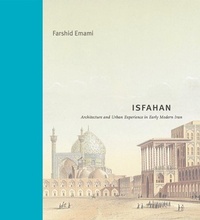
Isfahan
Architecture and Urban Experience in Early Modern Iran
Will be published approx. on 2. April 2024
Book
Hardback
276 pages
978-0-271-09552-3 (ISBN)
Description
A vibrant urban settlement from medieval times and the royal seat of the Safavid dynasty, the city of Isfahan emerged as a great metropolis during the seventeenth century. Using key sources, this book reconstructs the spaces and senses of this dynamic city.
Focusing on nuances of urban experience, Farshid Emami expands our understanding of Isfahan in a global context. He takes the reader on an evocative journey through the city's markets, promenades, and coffeehouses, bringing to life the social landscapes that animated the lives of urban dwellers and shaped their perceptions of themselves and the world. In doing so, Emami reveals seventeenth-century Isfahan as more than a cluster of beautiful monuments and gardens. It was a cosmopolitan city, where senses and materials, nature and artifice, and ritual and sociability acted in unison, engendering urban experiences that became paramount across the globe during the early modern period.
Drawing extensively on Persian literary and visual sources, including the "Guide for Strolling in Isfahan," this book casts new light on the history of a major Eurasian city and opens up new possibilities for cross-cultural studies of urban experience in the early modern period.
Focusing on nuances of urban experience, Farshid Emami expands our understanding of Isfahan in a global context. He takes the reader on an evocative journey through the city's markets, promenades, and coffeehouses, bringing to life the social landscapes that animated the lives of urban dwellers and shaped their perceptions of themselves and the world. In doing so, Emami reveals seventeenth-century Isfahan as more than a cluster of beautiful monuments and gardens. It was a cosmopolitan city, where senses and materials, nature and artifice, and ritual and sociability acted in unison, engendering urban experiences that became paramount across the globe during the early modern period.
Drawing extensively on Persian literary and visual sources, including the "Guide for Strolling in Isfahan," this book casts new light on the history of a major Eurasian city and opens up new possibilities for cross-cultural studies of urban experience in the early modern period.
Reviews / Votes
"Somewhere between a coffee-table book and an academic publication, it beckons the reader with colored plates of Isfahan's tiled masterpieces, clear reproductions of historical sketches, as well as the author's own architectural drawings, both floor-plans and angled projections, that bring back the grandeur and elegance of the Safavid capital."-David Chaffetz Asian Review of Books "Rather than a simple factual examination of Isfahan and its architecture, Emami offers a finely textured portrait of the city, a sensory experience that makes readers take in its sounds and smells, allowing them to listen in on the discussions in the coffeehouses flanking the square."
-R. P. Matthee Choice "Emami's approach to Isfahan considers this imperial city as a total lifeworld filled with movement, smells, sounds, and people. His prose is simply superb: it is such a pleasure that it transforms an otherwise deeply researched scholarly study into a spirited page-turner."
-Christiane Gruber, author of The Praiseworthy One: The Prophet Muhammad in Islamic Texts and Images "Farshid Emami's ambitious study of one of the most celebrated cities of the Islamic world sheds new light on Isfahan's urban transformation in the early modern period and reconstructs the way urban dwellers experienced and perceived the city, not only as a work of architecture but as a living space. Essential reading for all those interested in the global history of early modernity, urbanism, and visuality."
-Heghnar Watenpaugh, author of The Image of an Ottoman City and The Missing Pages
More details
Series
Language
English
Place of publication
University Park
United States
Target group
Professional and scholarly
Product notice
sewn/stitched
Illustrations
45 Halftones, color; 60 Halftones, black and white
Dimensions
Height: 235 mm
Width: 263 mm
Thickness: 27 mm
Weight
1326 gr
ISBN-13
978-0-271-09552-3 (9780271095523)
Copyright in bibliographic data and cover images is held by Nielsen Book Services Limited or by the publishers or by their respective licensors: all rights reserved.
Schweitzer Classification