

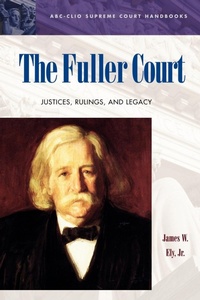
The Fuller Court
Justices, Rulings, and Legacy
Published on 13. August 2003
Book
Hardback
318 pages
978-1-57607-714-6 (ISBN)
Description
A fresh interpretation of the workings and legacy of the Supreme Court during the tenure of Chief Justice Melville W. Fuller.
The Fuller Court: Justices, Rulings, and Legacy presents an in-depth analysis of the decisions and impact of the U.S. Supreme Court during the twenty-two year reign of Chief Justice Melville W. Fuller. An exploration of key Court decisions-ranging from railroad rate regulation and the Due Process Clause to the 1894 income tax-reveals how the Court assigned a high priority to individual liberty, which it defined largely in economic terms.
A revealing discussion of the Commerce Clause and the Interstate Commerce Commission shows how the Fuller Court both limited and accepted some expansion of federal authority. Profiles of the nineteen justices who served on the Fuller Court place a special emphasis on those who made the most significant impact, including John Marshall Harlan, Samuel F. Miller, and Oliver Wendell Holmes, Jr.
Places the work of the Fuller Court in historical context and examines the economic and social changes that were transforming U.S. society at the end of the 19th century
Provides an analysis of the historical impact and continuing legacy of the Fuller Court's decisions in the areas of federalism, protection of liberty, and the rights of property owners
The Fuller Court: Justices, Rulings, and Legacy presents an in-depth analysis of the decisions and impact of the U.S. Supreme Court during the twenty-two year reign of Chief Justice Melville W. Fuller. An exploration of key Court decisions-ranging from railroad rate regulation and the Due Process Clause to the 1894 income tax-reveals how the Court assigned a high priority to individual liberty, which it defined largely in economic terms.
A revealing discussion of the Commerce Clause and the Interstate Commerce Commission shows how the Fuller Court both limited and accepted some expansion of federal authority. Profiles of the nineteen justices who served on the Fuller Court place a special emphasis on those who made the most significant impact, including John Marshall Harlan, Samuel F. Miller, and Oliver Wendell Holmes, Jr.
Places the work of the Fuller Court in historical context and examines the economic and social changes that were transforming U.S. society at the end of the 19th century
Provides an analysis of the historical impact and continuing legacy of the Fuller Court's decisions in the areas of federalism, protection of liberty, and the rights of property owners
Reviews / Votes
"This is one in a fourteen-volume series about the various eras of the U.S. Supreme Court . . . Like the other volumes, this one is written by an academic with extensive knowledge and prior public scholarship about the Supreme Court era covered in the book . . . does a good job laying out both the traditional (negative) and revisionist understandings of the Fuller Court." - Choice "[A] lucidly written reference guide . . . Ely ably sets this court in historical context and makes clear that it was entirely in keeping with the tradition of previous courts and the conservative temper of the Gilded Age . . . This guide will be a valuable resource for academic and large public libraries." - American Reference Books AnnualMore details
Series
Language
English
Place of publication
United States
Publishing group
Bloomsbury Publishing Plc
Target group
College/higher education
Professional and scholarly
Illustrations
23 Illustrations
Dimensions
Height: 260 mm
Width: 183 mm
Thickness: 23 mm
Weight
828 gr
ISBN-13
978-1-57607-714-6 (9781576077146)
Copyright in bibliographic data and cover images is held by Nielsen Book Services Limited or by the publishers or by their respective licensors: all rights reserved.
Schweitzer Classification