

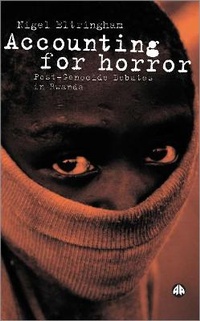
Accounting for Horror
Post-Genocide Debates in Rwanda
Will be published approx. on 20. January 2004
Book
Paperback/Softback
248 pages
978-0-7453-2000-7 (ISBN)
Description
The 1994 Rwandan genocide was a monumental atrocity in which at least 500,000 Tutsi and tens of thousands of Hutu were murdered in less than four months. Since 1994, members of the Rwandan political class who recognise those events as genocide have struggled to account for it and bring coherence to what is often perceived as irrational, primordial savagery.
Most people agree on the factors that contributed to the genocide -- colonialism, ethnicity, the struggle to control the state. However, many still disagree over the way these factors evolved, and the relationship between them. This continuing disagreemnt raises questions about how we come to understand historical events -- understandings that underpin the possibility of sustainable peace.
Drawing on extensive research among Rwandese in Rwanda and Europe, and on his work with a conflict resolution NGO in post-genocide Rwanda, Nigel Eltringham argues that conventional modes of historical representation are inadequate in a case like Rwanda. Single, absolutist narratives and representations of genocide actually reinforce the modes of thinking that fuelled the genocide in the first place. Eltringham maintains that if we are to understand the genocide, we must explore the relationship between multiple explanations of what happened and interrogate how -- and why -- different groups within Rwandan society talk about the genocide in different ways.
Most people agree on the factors that contributed to the genocide -- colonialism, ethnicity, the struggle to control the state. However, many still disagree over the way these factors evolved, and the relationship between them. This continuing disagreemnt raises questions about how we come to understand historical events -- understandings that underpin the possibility of sustainable peace.
Drawing on extensive research among Rwandese in Rwanda and Europe, and on his work with a conflict resolution NGO in post-genocide Rwanda, Nigel Eltringham argues that conventional modes of historical representation are inadequate in a case like Rwanda. Single, absolutist narratives and representations of genocide actually reinforce the modes of thinking that fuelled the genocide in the first place. Eltringham maintains that if we are to understand the genocide, we must explore the relationship between multiple explanations of what happened and interrogate how -- and why -- different groups within Rwandan society talk about the genocide in different ways.
Reviews / Votes
I think it is going to be a very fine contribution to African Studies. It is well structured, cogently argued, erudite and most of the time well-written -- Rene Lemarchand, author of Burundi: Ethnic Conflict and Genocide - professor Emeritus of Political Science at the University of Florida. The proposal certainly identifies some of the most critical issues in the discourse about the Rwandan Genocide. -- Carina TersakianMore details
Language
English
Place of publication
London
United Kingdom
Target group
Professional and scholarly
Product notice
Paperback (UK-trade)
Dimensions
Height: 215 mm
Width: 135 mm
ISBN-13
978-0-7453-2000-7 (9780745320007)
Copyright in bibliographic data and cover images is held by Nielsen Book Services Limited or by the publishers or by their respective licensors: all rights reserved.
Schweitzer Classification
Person
Nigel Eltringham is a Research Associate in the Department of Anthropology and Sociology of SOAS, London. He worked for three years with a conflict resolution NGO in Rwanda before conducting doctoral research in Rwanda and among the Rwandan Diaspora in Europe. He has extensively published on post-genocide Rwanda.
Content
Acknowledgements
Abbreviations
Introduction
1. 'Ethnicity': The Permeant Debate
2. The Pre-Cursor Debate
3. The Holocaust: The Comparative Debate
4. Debating Collective Guilt
5. Unresolved Allegations And The Culture Of Impunity
6. Appealling To The Past: The Debate Over History
Afterword
Bibliography
Endnotes
Index
Abbreviations
Introduction
1. 'Ethnicity': The Permeant Debate
2. The Pre-Cursor Debate
3. The Holocaust: The Comparative Debate
4. Debating Collective Guilt
5. Unresolved Allegations And The Culture Of Impunity
6. Appealling To The Past: The Debate Over History
Afterword
Bibliography
Endnotes
Index