

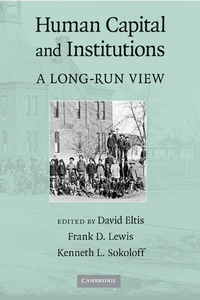
Human Capital and Institutions
A Long-Run View
Published on 17. August 2009
Book
Hardback
352 pages
978-0-521-76958-7 (ISBN)
Description
Human Capital and Institutions is concerned with human capital in its many dimensions and brings to the fore the role of political, social, and economic institutions in human capital formation and economic growth. Written by leading economic historians, including pioneers in historical research on human capital, the chapters in this text offer a broad-based view of human capital in economic development. The issues they address range from nutrition in pre-modern societies to twentieth-century advances in medical care; from the social institutions that provided temporary relief to workers in the middle and lower ranges of the wage scale to the factors that affected the performance of those who reached the pinnacle in business and art; and from political systems that stifled the advance of literacy to those that promoted public and higher education. Just as human capital has been a key to economic growth, so has the emergence of appropriate institutions been a key to the growth of human capital.
More details
Language
English
Place of publication
Cambridge
United Kingdom
Target group
Professional and scholarly
Illustrations
45 Tables, unspecified; 1 Maps; 29 Line drawings, unspecified
Dimensions
Height: 235 mm
Width: 157 mm
Thickness: 24 mm
Weight
664 gr
ISBN-13
978-0-521-76958-7 (9780521769587)
Copyright in bibliographic data and cover images is held by Nielsen Book Services Limited or by the publishers or by their respective licensors: all rights reserved.
Schweitzer Classification
Other editions
Additional editions
E-Book
11/2009
1st Edition
Cambridge University Press
€75.49
Available for download
E-Book
08/2009
1st Edition
Cambridge University Press
€63.99
Available for download
Persons
David Eltis is Robert W. Woodruff Professor of History at Emory University and has held visiting appointments at Harvard and Yale universities. He is author of The Rise of African Slavery in the Americas, co-compiler of The Transatlantic Slave Trade: A Database on CD-ROM - and its successor on www.slavevoyages.org - co-editor of Extending the Frontiers: Essays on the New Transatlantic Slave Trade Database (with David Richardson), co-editor of Slavery in the Development of the Americas (with Frank Lewis and Kenneth Sokoloff), and editor of Coerced and Free Migrations: Global Perspectives. He is also author and co-author of numerous articles on slavery, migration, and abolition, most recently in the American Historical Review and the William and Mary Quarterly. Frank D. Lewis is Professor of Economics at Queen's University, Kingston, Canada. He has written on historical issues involving agriculture, land settlement, transportation, Native American history, war, and slavery. His work has appeared in a variety of publications that include leading economic history and economics journals. Articles on the North American fur trade of the eighteenth century (with Ann Carlos) have been awarded prizes by the Canadian Economic Association and the Library Company of Philadelphia. Some of his more recent papers have appeared in the Economic History Review, the Journal of Economic History, and Explorations in Economic History. Kenneth L. Sokoloff (1953-2007) was Professor of Economics at the University of California, Los Angeles, and research associate at the National Bureau of Economic Research.
Content
Introduction David Eltis and Frank D. Lewis; Part I. Health and Living Standards: 1. Biotechnology and the burden of age-related diseases Robert W. Fogel; 2. Extending the reach of anthropometric history to the distant past Richard H. Steckel; 3. Insecurity, safety nets, and self-help in Victorian and Edwardian England George R. Boyer; Part II. Institutions and Schooling: 4. The evolution of schooling institutions in the Americas, 1800-1925 Stanley L. Engerman, Elisa V. Mariscal, and Kenneth L. Sokoloff; 5. Why the United States led in education: lessons from secondary school expansion, 1910 to 1940 Claudia Goldin and Lawrence F. Katz; 6. The production of engineers in New York colleges and universities, 1800-1950: some new data Michael Edelstein; Part III. Human Capital Outliers: 7. The life-cycle of great artists from Masaccio to Jasper Johns David W. Galenson and Robert Jensen; 8. An elite minority: Jews among the richest 400 Americans Peter Temin; Part IV. Constraints in Labor and Financial Markets: 9. Suffrage and the terms of labor Robert J. Steinfeld; 10. Prodigals and projectors: an economic history of usury laws in the United States from colonial times to 1900 Hugh Rockoff.