

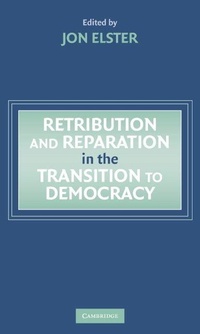
Retribution and Reparation in the Transition to Democracy
Published on 8. May 2006
Book
Hardback
352 pages
978-0-521-82973-1 (ISBN)
Description
The contributions in this volume offer a comprehensive analysis of transitional justice from 1945 to the present. They focus on retribution against the leaders and agents of the autocratic regime preceding the democratic transition, and on reparation to its victims. Part I contains general theoretical discussions of retribution and reparation. The essays in Part II survey transitional justice in the wake of World War II, covering Austria, Belgium, Denmark, France, Germany, Hungary, the Netherlands, and Norway. In Part III, the contributors discuss more recent transitions in Argentina, Chile, Eastern Europe, the former German Democratic Republic, and South Africa, including a chapter on the reparation of injustice in some of these transitions. The editor provides a general introduction, brief introductions to each part, and a conclusion that looks beyond regime transitions to broader issues of rectifying historical injustice.
Reviews / Votes
"How did, and how should, emerging democracies deal with members and supporters of fallen autocratic or occupation regimes? By fusing analytical approaches with historical perspectives, this fascinating and eminently readable volume addresses an enduring political question in a refreshing way, at once normative, theoretical, and empirical. A must-read."-Stathis N. Kalyvas, Yale University "This is a timely and important collection of rigorously argued essays that bring a welcome historical and comparative frame to the study of transitional justice in new democracies. Their nuanced considerations of the moral complexities in intergenerational claims for restitution and rich analyses of how emotions, intentions and beliefs shape trials and sanctions push our understanding of transnational justice to new levels."
-Mark Philip Bradley, Northwestern University "The most searching and illuminating book available on the promises and disappointments of transitional justice. Elster's introduction and concluding chapters are analytical masterpieces and almost every chapter is a treasure house of information and insight."
-Stephen Holmes, NYU School of Law "This is a highly enjoyable, analytically rigorous and historically rich collection of essays on a fascinating, timely, and consequential topic. It is an important contribution to the already substantial and growing literature on transitional justice...The chapters in this volume engage the reader in a continuous dialogue between theory and concrete examples, back and forth."
-Julio Rios-Figueroa, NYU School of Law, The Law and Politics Book Review
More details
Language
English
Place of publication
Cambridge
United Kingdom
Target group
Professional and scholarly
Dimensions
Height: 240 mm
Width: 161 mm
Thickness: 25 mm
Weight
757 gr
ISBN-13
978-0-521-82973-1 (9780521829731)
Copyright in bibliographic data and cover images is held by Nielsen Book Services Limited or by the publishers or by their respective licensors: all rights reserved.
Schweitzer Classification
Other editions
Additional editions
E-Book
01/2011
1st Edition
Cambridge University Press
€85.99
Available for download
E-Book
05/2006
Cambridge University Press
€93.99
Available for download
Person
Jon Elster is Robert K. Merton Professor of Social Science in the Department of Political Science at Columbia University. He has also taught in Paris, Oslo, and Chicago. His publications include Ulysses and the Sirens, Sour Grapes, Making Sense of Marx, The Cement of Society, Solomonic Judgements, Nuts and Bolts for the Social Sciences, Local Justice, Political Psychology, Strong Feelings, Alchemies of the Mind, and Ulysses Unbound. His research interests include the theory of rational choice, the theory of distributive justice, and the history of social thought.
Content
1. Introduction Jon Elster; Part I. General Issues: 2. Restitution: how far back should we go? Tyler Cowen; 3. Retribution Jon Elster; Part II. Germany and German-Occupied Countries after 1945: 4. Transitional justice in divided Germany after 1945 David Cohen; 5. Purges in France after the Liberation Henry Rousso; 6. Political justice in Austria and Hungary after World War II Istvan Deak; 7. Dealing with the past in Scandinavia Hans Fredrik Dahl; 8. Belgian and Dutch purges after World War II compared Luc Huyse; Part III. Latin America, Post-Communism, and South Africa: 9. Paranoids may be persecuted: post-totalitarian retroactive justice Aviezer Tucker; 10. Transitional justice in Argentina and Chile: a never ending story? Carlos H. Acuna; 11. Transitional justice in the German Democratic Republic and in Unified Germany Claus Offe and Ulrike Poppe; 12. Rough justice: rectification in post-authoritarian and post-totalitarian regimes Aviezer Tucker; 13. Accountability and the South African experience Alex Boraine; 14. Conclusion.