

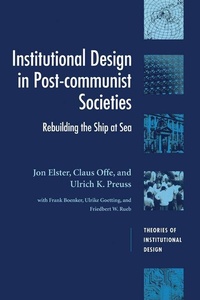
Institutional Design in Post-Communist Societies
Rebuilding the Ship at Sea
Published on 13. March 1998
Book
Hardback
364 pages
978-0-521-47386-6 (ISBN)
Description
The authors of this book have developed a new and stimulating approach to the analysis of the transitions of Bulgaria, the Czech Republic, Hungary, and Slovakia to democracy and a market economy. They integrate interdisciplinary theoretical work with elaborate empirical data on some of the most challenging events of the twentieth century. Three groups of phenomena and their causal interconnection are explored: the material legacies, constraints, habits and cognitive frameworks inherited from the past; the erratic configuration of new actors, and new spaces for action; and a new institutional order under which agency is institutionalized and the sustainability of institutions is achieved. The book studies the interrelations of national identities, economic interests, and political institutions with the transformation process, concentrating on issues of constitution making, democratic infrastructure, the market economy, and social policy.
Reviews / Votes
"New, interesting material." Comparative Politics "...a praiseworthy effort....Graduate level and above." Choice "...the substantive chapters are well crafted, detailed, and informative about such matters as the writing of constitutions, the working of electoral systems, the privatization of the economy, and the restructuring of the welfare states." Andrew C. Janos, Slavic ReviewMore details
Series
Language
English
Place of publication
Cambridge
United Kingdom
Target group
Professional and scholarly
Dimensions
Height: 235 mm
Width: 157 mm
Thickness: 26 mm
Weight
741 gr
ISBN-13
978-0-521-47386-6 (9780521473866)
Copyright in bibliographic data and cover images is held by Nielsen Book Services Limited or by the publishers or by their respective licensors: all rights reserved.
Schweitzer Classification
Persons
Content
1. Introduction: agenda, agency, and aims of Central East European transitions; 2. Mapping Eastern Europe; 3. Constitutional politics in Eastern Europe; 4. Building and consolidating democracies; 5. Building capitalism in Eastern Europe; 6. Social policy transformation; 7. Consolidation and the cleavages of ideology and identity; 8. Conclusion: the unfinished project.