

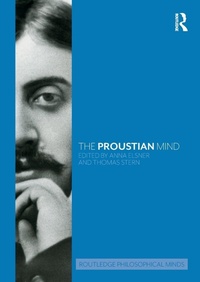
The Proustian Mind
1st Edition
Published on 4. October 2024
Book
Paperback/Softback
494 pages
978-1-032-38514-3 (ISBN)
Description
When Marcel Proust started to work on In Search of Lost Time in 1908, he wrote this question in his notebook: 'Should I make it a novel, a philosophical study, am I a novelist?' Throughout his famous multi-volume work, Proust directly engages several philosophers, and few novels are as thoroughly saturated with philosophical themes and concepts as In Search of Lost Time.
The Proustian Mind is an outstanding reference source to the rich philosophical range of Proust's work and the first major volume of its kind. Including 31 chapters by an international team of contributors, the volume is divided into seven clear parts:
Proust's life and works
metaphysics and epistemology
mind and language
aesthetics
ethics
gender and sexuality
predecessors, contemporaries and successors.
Within these sections, key Proustian themes are explored from a philosophical standpoint, including time, the self, memory, imagination, jealousy, beauty, love, subjectivity and desire. The final section considers Proust in relation to important philosophers such as Schopenhauer, Nietzsche, Bergson, Merleau-Ponty, Sartre, de Beauvoir and Deleuze.
The Proustian Mind is essential reading for those studying aesthetics, philosophy of literature, phenomenology and ethics, and will also be of interest to those in literature studying modernism, French literature and the relationship between literature and philosophy.
The Proustian Mind is an outstanding reference source to the rich philosophical range of Proust's work and the first major volume of its kind. Including 31 chapters by an international team of contributors, the volume is divided into seven clear parts:
Proust's life and works
metaphysics and epistemology
mind and language
aesthetics
ethics
gender and sexuality
predecessors, contemporaries and successors.
Within these sections, key Proustian themes are explored from a philosophical standpoint, including time, the self, memory, imagination, jealousy, beauty, love, subjectivity and desire. The final section considers Proust in relation to important philosophers such as Schopenhauer, Nietzsche, Bergson, Merleau-Ponty, Sartre, de Beauvoir and Deleuze.
The Proustian Mind is essential reading for those studying aesthetics, philosophy of literature, phenomenology and ethics, and will also be of interest to those in literature studying modernism, French literature and the relationship between literature and philosophy.
Reviews / Votes
"Interdisciplinarity is often praised, less frequently criticized, in both cases irrelevantly, since it so rarely actually exists. The Proustian Mind, which doesn't just set philosophy and literary studies side by side, but genuinely erases the boundary between them, is a very welcome exception, and one could do far worse than bunker down for a week with it..." - Ben Roth, MIND"...all of the sections feature countless insights as to Proust's relevance in various dimensions of philosophy..." - Bryan Counter, Studies in the Novel "This volume is a significant compendium not only for students and researchers working in the field of French literature but also those working in philosophy and intellectual history or other literary disciplines." - Francesco Marchionni, French Studies
"Interdisciplinarity is often praised, less frequently criticized, in both cases irrelevantly, since it so rarely actually exists. The Proustian Mind, which doesn't just set philosophy and literary studies side by side, but genuinely erases the boundary between them, is a very welcome exception, and one could do far worse than bunker down for a week with it..." - Ben Roth, MIND
"...all of the sections feature countless insights as to Proust's relevance in various dimensions of philosophy..." - Bryan Counter, Studies in the Novel
More details
Series
Language
English
Place of publication
London
United Kingdom
Publishing group
Taylor & Francis Ltd
Target group
College/higher education
Professional and scholarly
Academic, Postgraduate, Undergraduate, and Undergraduate Advanced
Dimensions
Height: 246 mm
Width: 174 mm
Thickness: 27 mm
Weight
895 gr
ISBN-13
978-1-032-38514-3 (9781032385143)
Copyright in bibliographic data and cover images is held by Nielsen Book Services Limited or by the publishers or by their respective licensors: all rights reserved.
Schweitzer Classification
Other editions
Additional editions
Anna Elsner | Thomas Stern
The Proustian Mind
E-Book
12/2022
1st Edition
Routledge
€61.99
Available for download
Anna Elsner | Thomas Stern
The Proustian Mind
E-Book
12/2022
1st Edition
Routledge
€61.99
Available for download
Anna Elsner | Thomas Stern
The Proustian Mind
Book
12/2022
1st Edition
Routledge
€299.40
Shipment within 15-20 days
Persons
Anna Elsner is an Assistant Professor of French Literature and Culture at the University of St. Gallen, Switzerland. She is the co-editor of Anamnesia: Private and Public Memory in Modern French Culture (2009), Medicine and Literature (forthcoming), and the author of Mourning and Creativity in Proust (2017).
Thomas Stern is an Associate Professor of Philosophy at University College London, UK. He is the author of Nietzsche's Ethics (2020), and Philosophy and Theatre (Routledge, 2013), and the editor of The New Cambridge Companion to Nietzsche (2019), and The Philosophy of Theatre, Drama and Acting (2017).
Thomas Stern is an Associate Professor of Philosophy at University College London, UK. He is the author of Nietzsche's Ethics (2020), and Philosophy and Theatre (Routledge, 2013), and the editor of The New Cambridge Companion to Nietzsche (2019), and The Philosophy of Theatre, Drama and Acting (2017).
Content
Introduction Anna Elsner and Thomas Stern Part 1: Life and Works 1. Marcel Proust: A Student of Philosophy William Carter 2. Proust's Philosophical Training Luc Fraisse Part 2: Metaphysics & Epistemology 3. The Mind in Time: Proust, Involuntary Memory, and the Adventure in Perception Garry L. Hagberg 4. In Search of Lost Place Anna Elsner 5. "Only Through Time Time is Conquered": Proust on Death Andrew Huddleston 6. The Self Ben Colburn 7. Knowledge Adam Watt 8. The Pursuit of Uncertainty: Knowledge, Deferral and Self-Defeat in Proust Richard Moran Part 3: Mind and Language 9. Memory Simon Kemp 10. Proustian Habit Thomas Stern 11. Subjectivity: A Proustian Problem Robert B. Pippin 12. Speech Michael Lucey Part 4: Aesthetics 13. Contemplating a Proustian Library Virginie Greene 14. The experience of beauty in Proust - a Freudian account Julia Peters and Anna-Lisa Sander 15. The Arts Jennifer Rushworth 16. Art and the Life-World: The Duck, the Rabbit and the Madeleine Gary Kemp Part 5: Ethics 17. Proust and the Philosophy of Love Martin Buijs 18. Proust and Lying: Ethics and Aesthetics David Ellison 19. "Each of us is indeed alone": Vulnerability in In Search of Lost Time Roos Slegers 20. Proust's Abraham, the Other L. Scott Lerner Part 6: Gender and Sexuality 21. The Logic of Gomorrah: Proust and the Subversion of Identities Justine Balibar 22. Proust on Desire Satisfaction Robbie Kubala 23. Proustian Jealousy Elisabeth Ladenson Part 7: In conversation with predecessors, contemporaries and successors 24. Proust and Romanticism Michael N. Forster 25. Proust and Schopenhauer David Bather Woods 26. Proust and Bergson: Fierce Criticality Suzanne Guerlac 27. Proust and Nietzsche on Self-Fashioning: Towards a Post-Metaphysical Reading of Proust Antoine Panaioti 28. The alter ego: Merleau-Ponty Anne Simon 29. Proust the Phenomenologist: Sartre and Beauvoir as Readers of Proust Lior Levy 30. Proust-Machine: Gilles Deleuze Thomas Baldwin and Patrick ffrench 31. Proust and Philosophical Influence Sebastian Gardner. Index