

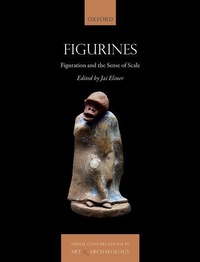
Figurines
Figuration and The Sense of Scale
Published on 22. October 2020
Book
Hardback
208 pages
978-0-19-886109-6 (ISBN)
Description
Figurines are objects of handling. As touchable objects, they engage the viewer in different ways from flat art, whether relief sculpture or painting. Unlike the voyeuristic relationship of viewing a neatly framed pictorial narrative as if from the outside, the viewer as handler is always potentially and without protection within the narrative of figurines. As such, they have potential for a potent, even animated, agency in relation to those who use them.
This volume concerns figurines as archaeologically-attested materials from literate cultures with surviving documents that have no direct links of contiguity, appropriation, or influence in relation to each other. It is an attempt to put the category of the figurine on the table as a key conceptual and material problematic in the art history of antiquity. It does so through comparative juxtaposition of close-focused chapters drawn from deep art-historical engagement with specific ancient cultures - Chinese, pre-Columbian Mesoamerican, and Greco-Roman. It encourages comparative conversation across the disciplines that constitute the art history of the ancient world through finding categories and models of discourse that may offer fertile ground for comparison and antithesis. It extends the rich and astute literature on prehistoric figurines into understanding the figurine in historical contexts, where literary texts and documents, inscriptions, or surviving terminologies can be adduced alongside material culture. At stake are issues of figuration and anthropomorphism, miniaturization and portability, one-off production and replication, and substitution and scale at the interface of archaeology and art history.
This volume concerns figurines as archaeologically-attested materials from literate cultures with surviving documents that have no direct links of contiguity, appropriation, or influence in relation to each other. It is an attempt to put the category of the figurine on the table as a key conceptual and material problematic in the art history of antiquity. It does so through comparative juxtaposition of close-focused chapters drawn from deep art-historical engagement with specific ancient cultures - Chinese, pre-Columbian Mesoamerican, and Greco-Roman. It encourages comparative conversation across the disciplines that constitute the art history of the ancient world through finding categories and models of discourse that may offer fertile ground for comparison and antithesis. It extends the rich and astute literature on prehistoric figurines into understanding the figurine in historical contexts, where literary texts and documents, inscriptions, or surviving terminologies can be adduced alongside material culture. At stake are issues of figuration and anthropomorphism, miniaturization and portability, one-off production and replication, and substitution and scale at the interface of archaeology and art history.
Reviews / Votes
Elsner's book should be used ... as a springboard for scholars and students to experiment with, pushing themselves to articulate and theorize their own approach to figurines, miniaturization, scale, and animation in their respective fields of study, and to conceive of figurines as semiotic icons in playful, creative ways. Scholars and students of art history, archaeology, and the study of material culture, will therefore find this book potent with questions that may inspire innovative studies in their own regions, cultures, and periods of specialty. * Liat Naeh, BMCR * Scintillating. * Michael Squire, Greece & Rome *More details
Series
Language
English
Place of publication
Oxford
United Kingdom
Target group
Professional and scholarly
Product notice
sewn/stitched
Cloth over boards
Illustrations
77 colour illustrations
Dimensions
Height: 246 mm
Width: 185 mm
Thickness: 15 mm
Weight
658 gr
ISBN-13
978-0-19-886109-6 (9780198861096)
Copyright in bibliographic data and cover images is held by Nielsen Book Services Limited or by the publishers or by their respective licensors: all rights reserved.
Schweitzer Classification
Other editions
Person
Jas Elsner is Professor of Late Antique Art at the University of Oxford and Humfry Payne Senior Research Fellow in Classical Archaeology and Art at Corpus Christi College, Oxford. He is also Visiting Professor of Art and Religion at the University of Chicago, and External Scientific Member of the Kunsthistorisches Institut in Florenz. He is a Member of the American Academy of Arts and Sciences and of the Max Planck Society, as well as a Fellow of the British Academy. He works on all areas of art and religion in antiquity and the early middle ages across Europe and Western Asia, including pilgrimage, travel-writing, and the description of art in texts, and is particularly interested in the problems of comparativism in art history. Along with the other contributors to this book, he is a member of the Center for Global Ancient Art at the University of Chicago which is committed to comparative study of archaeological and art historical issues in all cultures across the ancient world.
Content
Jas Elsner: Introduction
1: Richard Neer: Small Wonders: Figurines, Puppets, and the Aesthetics of Scale in Archaic and Classical Greece
2: Claudia Brittenham: Shifting Scales at La Venta
3: Wu Hung: Thinking Through Scale: The First Emperor's Sculptural Enterprise
4: Jas Elsner: The Death of the Figurine: Reflections on an Abrahamic Abstention
Claudia Brittenham: Epilogue
1: Richard Neer: Small Wonders: Figurines, Puppets, and the Aesthetics of Scale in Archaic and Classical Greece
2: Claudia Brittenham: Shifting Scales at La Venta
3: Wu Hung: Thinking Through Scale: The First Emperor's Sculptural Enterprise
4: Jas Elsner: The Death of the Figurine: Reflections on an Abrahamic Abstention
Claudia Brittenham: Epilogue