

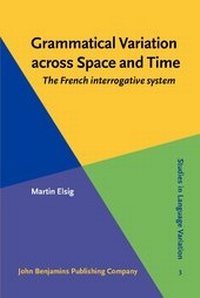
Grammatical Variation across Space and Time
The French interrogative system
Published on 4. February 2009
Book
Hardback
282 pages
978-90-272-3483-4 (ISBN)
Description
Interrogative clauses in French show abundant variation, especially with regard to the position of the subject vis-a-vis the finite verb, the placement of the wh-word, and the use of question markers such as est-ce que and ti/tu. This book presents a comprehensive study of the evolution and use of French interrogative constructions across a time span of approximately five hundred years by drawing on written sources (15th to 17th century) and oral data (19th and 20th century). Special attention is paid to the regional variation between European French and Quebec French. A variationist analysis reveals the relevant sociolinguistic factors conditioning variant choice. On the basis of the results obtained, the syntax of the different variants is modeled within the framework of generative grammar. In particular, the progressive diachronic decline and restriction of subject-verb inversion is argued to mirror the loss of verb movement. This book is of interest to anyone concerned with syntactic variation and change.
More details
Series
Language
English
Place of publication
Amsterdam
Netherlands
Target group
Professional and scholarly
Illustrations
+ index
Dimensions
Height: 245 mm
Width: 164 mm
Weight
685 gr
ISBN-13
978-90-272-3483-4 (9789027234834)
Copyright in bibliographic data and cover images is held by Nielsen Book Services Limited or by the publishers or by their respective licensors: all rights reserved.
Schweitzer Classification
Other editions
Additional editions
E-Book
02/2009
1st Edition
John Benjamins Publishing Company
€130.99
Available for download
Person
Content
1. List of figures; 2. List of tables; 3. Acknowledgments; 4. Chapter 1. Introduction; 5. Chapter 2. Overview of the literature; 6. Chapter 3. Data and methods; 7. Chapter 4. Results; 8. Chapter 5. Interpretation and discussion of the results; 9. Chapter 6. Conclusion; 10. Literary texts consulted; 11. References; 12. Index