

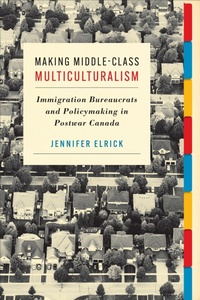
Making Middle-Class Multiculturalism
Immigration Bureaucrats and Policymaking in Postwar Canada
Published on 10. January 2022
Book
Paperback/Softback
242 pages
978-1-4875-2778-5 (ISBN)
Description
In the 1950s and 1960s, immigration bureaucrats in the Department of Citizenship and Immigration played an important yet unacknowledged role in transforming Canada's immigration policy. In response to external economic and political pressures for change, high-level bureaucrats developed new admissions criteria gradually and experimentally while personally processing thousands of individual immigration cases per year.
Making Middle-Class Multiculturalism shows how bureaucrats' perceptions and judgements about the admissibility of individuals - in socioeconomic, racial, and moral terms - influenced the creation of formal admissions criteria for skilled workers and family immigrants that continue to shape immigration to Canada. A qualitative content analysis of archival documents, conducted through the theoretical lens of a cultural sociology of immigration policy, reveals that bureaucrats' interpretations of immigration files generated selection criteria emphasizing not just economic utility, but also middle-class traits and values such as wealth accumulation, educational attainment, entrepreneurial spirit, resourcefulness, and a strong work ethic. By making "middle-class multiculturalism" a demographic reality and basis of nation-building in Canada, these state actors created a much-admired approach to managing racial diversity that has nevertheless generated significant social inequalities.
Making Middle-Class Multiculturalism shows how bureaucrats' perceptions and judgements about the admissibility of individuals - in socioeconomic, racial, and moral terms - influenced the creation of formal admissions criteria for skilled workers and family immigrants that continue to shape immigration to Canada. A qualitative content analysis of archival documents, conducted through the theoretical lens of a cultural sociology of immigration policy, reveals that bureaucrats' interpretations of immigration files generated selection criteria emphasizing not just economic utility, but also middle-class traits and values such as wealth accumulation, educational attainment, entrepreneurial spirit, resourcefulness, and a strong work ethic. By making "middle-class multiculturalism" a demographic reality and basis of nation-building in Canada, these state actors created a much-admired approach to managing racial diversity that has nevertheless generated significant social inequalities.
More details
Language
English
Place of publication
Toronto
Canada
Target group
Professional and scholarly
College/higher education
Product notice
Paperback (trade)
Illustrations
4 b&w figures, 5 b&w tables
Dimensions
Height: 225 mm
Width: 150 mm
Thickness: 15 mm
Weight
384 gr
ISBN-13
978-1-4875-2778-5 (9781487527785)
Copyright in bibliographic data and cover images is held by Nielsen Book Services Limited or by the publishers or by their respective licensors: all rights reserved.
Schweitzer Classification
Person
Jennifer Elrick is an assistant professor in the Department of Sociology at McGill University.
Content
1. Introduction
2. Bureaucratic Discretion in the Historical Canadian Context
3. Race/State/Nation: From Racist Exclusion to Intersectional Inclusion
4. Individual Merit and the Making of Multicultural Skilled Workers
5. Putting the "Class" in "Family Class"
6. Conclusion: The Legacy of Middle-Class Multiculturalism
Methodological Appendix
Endnotes
Bibliography
Tables
2. Bureaucratic Discretion in the Historical Canadian Context
3. Race/State/Nation: From Racist Exclusion to Intersectional Inclusion
4. Individual Merit and the Making of Multicultural Skilled Workers
5. Putting the "Class" in "Family Class"
6. Conclusion: The Legacy of Middle-Class Multiculturalism
Methodological Appendix
Endnotes
Bibliography
Tables