

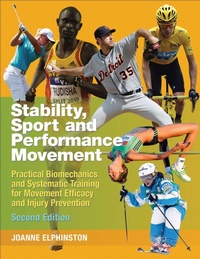
Stability, Sport and Performance Movement
Practical Biomechanics and Systematic Training for Movement Efficacy and Injury Prevention
2nd Edition
Published on 31. July 2013
Book
Paperback/Softback
304 pages
978-1-905367-42-9 (ISBN)
Description
Stability, Sport and Performance Movement, Second Edition, provides the tools for understanding human movement in simple but effective ways, complete with user-friendly tips to uncover potential physical barriers and unlock the potential for fluent, effortless movement.
More details
Edition
Second Edition
Language
English
Place of publication
Chichester
United Kingdom
Product notice
Paperback (trade)
Dimensions
Height: 274 mm
Width: 212 mm
Thickness: 22 mm
Weight
1144 gr
ISBN-13
978-1-905367-42-9 (9781905367429)
Copyright in bibliographic data and cover images is held by Nielsen Book Services Limited or by the publishers or by their respective licensors: all rights reserved.
Schweitzer Classification
Other editions
Previous edition

Book
12/2008
Lotus Publishing Limited
€50.94
Article exhausted; check for reprint
Person
Joanne Elphinston is a performance consultant, international lecturer, and physiotherapist working with elite and professional athletes, including medalists in Olympic Games, Commonwealth Games, and World Championships; Premiership footballers; and professional golfers. Elphinston has served as a performance movement consultant for the British Olympic Association and has advised professional sporting organizations on technical movement enhancement for performance, injury prevention, and rehabilitation. She also has extensive experience in child and adolescent movement development for sports and progression into senior competition. With author Paul Pook, she cowrote the best-selling book The Core Workout.
Content
Part I. Foundations and Fundamentals
Chapter 1. Force, Flow and Functional Force Management
Chapter 2. Exploring the Stability Concept
Chapter 3. The Anatomy of Stability
Chapter 4. Key Concept for Efficient Movement
Chapter 5. Functional Assessment
Part II. Developing Fluent Control
Chapter 6. Phase 1 – Activation and Awareness
Chapter 7. Phase 2 – Integration
Chapter 8. Phase 3 – Global Coordination
Chapter 9. Phase 4 – Dynamic Control
Chapter 10. Stability Across the Training Programme
Chapter 11. Sample Programmes
Chapter 12. Rehabilitation Pathways
Appendix 1. Commonly Used Terms
Appendix 2. List of Common Patterns
Appendix 3. Scoring Charts of the Capsule Functional Assessment
Chapter 1. Force, Flow and Functional Force Management
Chapter 2. Exploring the Stability Concept
Chapter 3. The Anatomy of Stability
Chapter 4. Key Concept for Efficient Movement
Chapter 5. Functional Assessment
Part II. Developing Fluent Control
Chapter 6. Phase 1 – Activation and Awareness
Chapter 7. Phase 2 – Integration
Chapter 8. Phase 3 – Global Coordination
Chapter 9. Phase 4 – Dynamic Control
Chapter 10. Stability Across the Training Programme
Chapter 11. Sample Programmes
Chapter 12. Rehabilitation Pathways
Appendix 1. Commonly Used Terms
Appendix 2. List of Common Patterns
Appendix 3. Scoring Charts of the Capsule Functional Assessment