

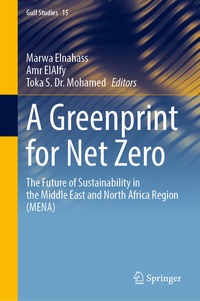
A Greenprint for Net Zero
Description
This book addresses a critical gap in understanding net-zero strategies and sustainability practices in the Middle East and North Africa region (MENA), exploring their intersection with data innovation, climate risk, climate governance, firm performance, firm risk, greenwashing, and green finance. In doing so, the book demonstrates how data innovation plays a crucial role in advancing net-zero goals by enabling organizations to optimize resource usage, identify emission hotspots, and improve operational efficiency through advanced data analytics, machine learning, and AI. The book underscores the need for vigilance against greenwashing, emphasizing transparent reporting practices and robust verification mechanisms to uphold credibility and trust in sustainability claims. Providing new insights provided by a diverse set of contributors, including industry leaders and policymakers, the book highlights the integration of financial and environmental sustainability into net-zero initiatives, emphasizing elements such as carbon accounting, biodiversity accounting, and economic resilience. This perspective is relatively unexplored, especially in comparison to other developed regions, making the book a pioneering resource in identifying and addressing the unique challenges and opportunities present in the MENA region in the global fight against climate change. With both theoretical and empirical studies, practical case studies, industry analyses, and policy evaluations, the book presents a comprehensive overview of how net-zero strategies can be effectively implemented to enhance sustainability practices, both regionally and globally. It is relevant to both scholars and policymakers in areas of economic development, environmental sustainability, and social equity, focused on the means of transition toward a low-carbon future.
More details
Persons
Marwa Elnahass is a professor in Accounting and Finance at Newcastle University Business School (NUBS) with a PhD from Lancaster University. She is a lead investigator for two divisions the "Responsible and Sustainable Innovation " and "FinTech" for the "Newcastle University Centres of Research Excellence (NUCoRE)" focused on Cyber Security and Resilience. Prof. Elnahass has successfully edited two editorial books in the World Scientific Publishing. In addition to her editorial roles, she also contributes as a panelist and a referee for UKRI and international research councils, such as AHRC, ESRC, and QNRF. Prof. Elnahass actively engages as a peer reviewer for several highly ranked and influential journals. Her extensive publication record includes over 30 articles on banking and governance, green finance, carbon accounting, and Islamic Finance in top-tier peer-reviewed ABS listed 3* and 4 academic journals, including the British Journal of Management, Business Strategy and Environment, Journal of Environmental Management .
Dr. Amr ElAlfy is an assistant professor in the School of Environment, Enterprise and Development (SEED) at the University of Waterloo and serves as a co-investigator for the municipal net-zero action research partnership (N-ZAP) project in Canada. His research focuses on exploring the intricate dynamics of sustainability, shedding light on non-financial reporting practices, and deciphering the materiality of sustainability risks and opportunities for investors. By bridging the gap between financial and non-financial metrics, his contributions aim to empower decision-makers with the knowledge to drive sustainable growth and responsible investment strategies. Dr. ElAlfy has a long history of working in business development in multinational conglomerates, namely Nestlé and 3M, where he led the marketing and Corporate Social Responsibility (CSR) agendas for the Middle East and Africa (MEA) Region.
Dr. Toka S. Mohamed's research at Qatar University focuses on financial inclusion, Islamic finance, and governance. She has published multiple articles in top-tier peer-reviewed academic journals and has been involved in several externally funded projects. This is coupled with a decade of industry experience serving in dynamic leadership roles, where she has been instrumental in advancing sustainability initiatives within her organization and across its supply chain partners, driving the adoption of eco-friendly practices. Her work aims to bridge the academia-industry gap to explore innovative solutions aligned with climate change and sustainable development.
Content
1 Navigating Net-Zero in the MENA Region: Setting the Stage for Sustainable Development Goals and Climate Action.- 2. Understanding Current Net-Zero Strategies in MENA Sectors: A Comprehensive Exploration Across Industries.- 3. Net-Zero Strategies and Sustainability Practices: Unveiling the Path to Environmental Responsibility.