

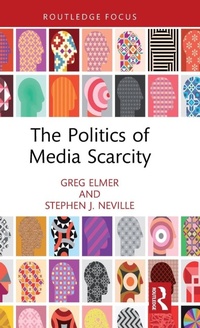
The Politics of Media Scarcity
1st Edition
Published on 31. January 2024
Book
Hardback
94 pages
978-1-032-50468-1 (ISBN)
Description
This book questions the predominance of "media abundance" as a guiding concept for contemporary mediated politics. The authors argue that media abundance is not a universal condition, and that certain individuals, communities, and even nations can more accurately be referred to as media scarce - where access to media technologies and content is limited, highly controlled, or surveilled.
Through case studies that focus on guerilla militants, incarcerated Indigenous people, and cold war-era infrastructure, including Soviet "closed" or "secret" cities and Canadian nuclear bunkers, the book's chapters interrogate how the once media scarce later "speak" to - and can be heard by - the predominant, abundant media culture. Drawing from several art projects and diverse cultural sites, the book highlights how media scarce communities negotiate and otherwise narrate their place in the world, their past experiences and lives, and escape from subjugation. To better understand media scarce politics, the book asks how and when communities become - by accident or force, by choice or necessity - media scarce.
This innovative and insightful text will appeal to students and scholars around the world working in the areas of media and politics, art and politics, visual studies, surveillance studies, and communication studies.
Through case studies that focus on guerilla militants, incarcerated Indigenous people, and cold war-era infrastructure, including Soviet "closed" or "secret" cities and Canadian nuclear bunkers, the book's chapters interrogate how the once media scarce later "speak" to - and can be heard by - the predominant, abundant media culture. Drawing from several art projects and diverse cultural sites, the book highlights how media scarce communities negotiate and otherwise narrate their place in the world, their past experiences and lives, and escape from subjugation. To better understand media scarce politics, the book asks how and when communities become - by accident or force, by choice or necessity - media scarce.
This innovative and insightful text will appeal to students and scholars around the world working in the areas of media and politics, art and politics, visual studies, surveillance studies, and communication studies.
Reviews / Votes
The Politics of Media Scarcity provides an engaging account of the complex double nature of media scarcity as both a form of marginalization and political practice for emancipation. In a world often connected with media abundance, this is a much-needed analysis of the absences, refusals, and push backs against oppressive forms of mediation towards a more hopeful future.Anne Kaun, Soedertoern University, Sweden
As media scholars we tend to focus on the nature and consequences of a media-saturated world and too often ignore the social and political ramifications of media paucity. This book subverts that tendency and challenges us to recognise and critique media scarcity and its impact on our social identities, our political participation and our economic security. Through a series of richly diverse case studies on South African militants, incarcerated Indigenous women, residents of 'secret'/nuclear cities, and the cold war bunker, it offers unique insights on the marginalising effects of media and how the politics of media scarcity can be reclaimed to disrupt abundant media power for social justice ends. Original and fascinating in equal measure.
Natalie Fenton, Goldsmiths College, UK
The Politics of Media Scarcity successfully weaves together case studies from different nations, institutional logics, and timeframes to persuade readers to consider the complexities behind communities and spaces that may appear, at face value, to be media-scarce and lacking.
By highlighting timely case studies from communities at the forefront of subverting violent power structures, this short book aims to inspire lasting shifts in perspectives within a culture of abundance.
Beatrys Rodrigues, Cultural Studies, July 2024
More details
Series
Language
English
Place of publication
London
United Kingdom
Publishing group
Taylor & Francis Ltd
Target group
College/higher education
Professional and scholarly
Academic, Postgraduate, and Undergraduate Advanced
Illustrations
9 s/w Abbildungen, 9 s/w Photographien bzw. Rasterbilder
9 Halftones, black and white; 9 Illustrations, black and white
Dimensions
Height: 222 mm
Width: 145 mm
Thickness: 10 mm
Weight
278 gr
ISBN-13
978-1-032-50468-1 (9781032504681)
Copyright in bibliographic data and cover images is held by Nielsen Book Services Limited or by the publishers or by their respective licensors: all rights reserved.
Schweitzer Classification
Other editions
Additional editions
Greg Elmer | Stephen J. Neville
The Politics of Media Scarcity
Book
05/2025
1st Edition
Routledge
€29.70
Shipment within 10-20 days
Greg Elmer | Stephen J. Neville
The Politics of Media Scarcity
E-Book
01/2024
1st Edition
Routledge
€24.99
Available for download
Greg Elmer | Stephen J. Neville
The Politics of Media Scarcity
E-Book
01/2024
1st Edition
Routledge
€24.99
Available for download
Persons
Greg Elmer is Professor and Bell Media Research Chair in the School of Professional Communication at Toronto Metropolitan University, Canada.
Stephen J. Neville is a PhD candidate in the Communication and Culture program at York University and Toronto Metropolitan University, Canada.
Stephen J. Neville is a PhD candidate in the Communication and Culture program at York University and Toronto Metropolitan University, Canada.
Content
1. Introduction: The Limits of Abundant Media
2. Media Scarcity in Apartheid South Africa
3. Retracking Incarceration: Cheryl L'Hirondelle's Ceremonial Infrastructure
4. Restaging the Soviet Secret City: The Good Life, the Toxic Life
5. Bunker media: Messages from the abundant and redundant underground
6. Conclusion: Future Politics of Media Scarcity
2. Media Scarcity in Apartheid South Africa
3. Retracking Incarceration: Cheryl L'Hirondelle's Ceremonial Infrastructure
4. Restaging the Soviet Secret City: The Good Life, the Toxic Life
5. Bunker media: Messages from the abundant and redundant underground
6. Conclusion: Future Politics of Media Scarcity