

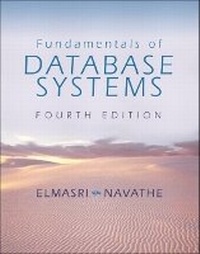
Fundamentals of Database Systems
International Edition
4th Edition
Published on 21. August 2003
Book
Paperback/Softback
1009 pages
978-0-321-20448-6 (ISBN)
Description
Fundamentals of Database Systems has become the world-wide leading textbook because it combines clear explanations of theory and design, broad coverage of models and real systems, and excellent examples with up-to-date introductions and modern database technologies. This book has been revised and updated to reflect the latest trends in technological and application development. This fourth edition expands on many of the most popular database topics, including SQL, security, and data mining along with an introduction to UML modeling and an entirely new chapter on XML and Internet databases.
More details
Edition
4th edition
Language
English
Place of publication
United States
Publishing group
Pearson Education (US)
Target group
Professional and scholarly
Dimensions
Height: 231 mm
Width: 188 mm
Thickness: 37 mm
Weight
1546 gr
ISBN-13
978-0-321-20448-6 (9780321204486)
Copyright in bibliographic data and cover images is held by Nielsen Book Services Limited or by the publishers or by their respective licensors: all rights reserved.
Schweitzer Classification
Other editions
New editions
Ramez Elmasri | Shamkant B. Navathe
Fundamentals of Database Systems, Global Edition
Book
08/2016
7th Edition
Pearson Education Limited
€90.49
Available immediately
Book
04/2006
5th Edition
Pearson
€64.36
Article exhausted; check for reprint
Previous edition
Ramez Elmasri | Shamkant B. Navathe
Fundamentals of Database Systems, with E-book
International Edition
Book
06/2002
3rd Edition
Pearson
€49.64
Article exhausted; check for reprint
Content
I. INTRODUCTION AND CONCEPTUAL MODELING.
1. Databases and Database Users.
2. Database System Concepts and Architecture.
3. Data Modeling Using the Entity-Relationship Model.
4. Enhanced Entity-Relationship and UML Modeling.
II. RELATIONAL MODEL: CONCEPTS, CONSTRAINTS, LANGUAGES, DESIGN, AND PROGRAMMING.
5. The Relational Data Model and Relational Database Constraints.
6. Relational Algebra and Relational Calculus.
7. Relational Database Design by ER- and EER-to-Relational Mapping.
8. SQL99-Schema Definition, Constraints, and Queries.
9. More SQL-Assertions, Views, and Programming Techniques.
III. DATABASE DESIGN THEORY AND METHODOLOGY.
10. Functional Dependencies and Normalization for Relational Databases.
11. Relational Database Design Algorithms and Further Dependencies.
12. Practical Database Design Methodology Using UML.
IV. DATA STORAGE, INDEXING, QUERY PROCESSING, AND PHYSICAL DESIGN.
13. Disk Organization, Basic File Structures, and Hashing.
14. Indexing Structures for Files.
15. Algorithms for Query Processing and Optimization.
16. Physical Database Design and Tuning.
V. TRANSACTION PROCESSING CONCEPTS.
17. Introduction to Transaction Processing Concepts and Theory.
18. Concurrency Control Techniques.
19. Database Recovery Techniques.
VI. OBJECT AND OBJECT-RELATIONAL DATABASES.
20. Object Database Concepts.
21. The ODMG Standard for Object Databases.
22. Object-Relational Systems and SQL3.
VII. FURTHER TOPICS.
23. Database Security, Authorization, and Encryption.
24. Enhanced Data Models for Advanced Applications.
25. Distributed Databases and Client-Server Architectures.
VIII. EMERGING TECHNOLOGIES.
26. Internet Databases and XML.
27. Data Warehousing and Data Mining Concepts.
28. Emerging Database Technologies and Applications.
Appendix A. Alternative Diagrammatic Notations for ER models.
Appendix B. Database Design and Application Implementation Case Study.
(New appendix on the Web including a detailed database design case study).
Appendix C. Parameters of Disks (old Appendix B).
Appendix D. The QBE Language (old section 9.5).
Appendix E. Hierarchical Data Model (old Appendix C dropped - moved to Web).
Appendix F. Network Data Model (old Appendix D dropped - moved to Web).
Bibliographic References.
Index.
1. Databases and Database Users.
2. Database System Concepts and Architecture.
3. Data Modeling Using the Entity-Relationship Model.
4. Enhanced Entity-Relationship and UML Modeling.
II. RELATIONAL MODEL: CONCEPTS, CONSTRAINTS, LANGUAGES, DESIGN, AND PROGRAMMING.
5. The Relational Data Model and Relational Database Constraints.
6. Relational Algebra and Relational Calculus.
7. Relational Database Design by ER- and EER-to-Relational Mapping.
8. SQL99-Schema Definition, Constraints, and Queries.
9. More SQL-Assertions, Views, and Programming Techniques.
III. DATABASE DESIGN THEORY AND METHODOLOGY.
10. Functional Dependencies and Normalization for Relational Databases.
11. Relational Database Design Algorithms and Further Dependencies.
12. Practical Database Design Methodology Using UML.
IV. DATA STORAGE, INDEXING, QUERY PROCESSING, AND PHYSICAL DESIGN.
13. Disk Organization, Basic File Structures, and Hashing.
14. Indexing Structures for Files.
15. Algorithms for Query Processing and Optimization.
16. Physical Database Design and Tuning.
V. TRANSACTION PROCESSING CONCEPTS.
17. Introduction to Transaction Processing Concepts and Theory.
18. Concurrency Control Techniques.
19. Database Recovery Techniques.
VI. OBJECT AND OBJECT-RELATIONAL DATABASES.
20. Object Database Concepts.
21. The ODMG Standard for Object Databases.
22. Object-Relational Systems and SQL3.
VII. FURTHER TOPICS.
23. Database Security, Authorization, and Encryption.
24. Enhanced Data Models for Advanced Applications.
25. Distributed Databases and Client-Server Architectures.
VIII. EMERGING TECHNOLOGIES.
26. Internet Databases and XML.
27. Data Warehousing and Data Mining Concepts.
28. Emerging Database Technologies and Applications.
Appendix A. Alternative Diagrammatic Notations for ER models.
Appendix B. Database Design and Application Implementation Case Study.
(New appendix on the Web including a detailed database design case study).
Appendix C. Parameters of Disks (old Appendix B).
Appendix D. The QBE Language (old section 9.5).
Appendix E. Hierarchical Data Model (old Appendix C dropped - moved to Web).
Appendix F. Network Data Model (old Appendix D dropped - moved to Web).
Bibliographic References.
Index.