

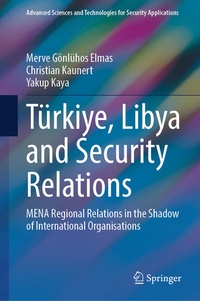
Tu¨rkiye, Libya and Security Relations
Description
This book examines the complex relationship between Türkiye and Libya, integrating Welsh Critical Security Studies (CSS) with contemporary realities. It argues that security encompasses more than just military power, focusing on the cultural, social, and political dimensions that influence security policies. The book delves into the regional dynamics shaped by international organisations like NATO and the UN, particularly post-World War II. It highlights how these organisations' geopolitical interests have impacted bilateral interactions, framing security through notions of influence and power. Key historical turning points are analysed to reveal their effects on military and political engagements between Türkiye and Libya. The book also critiques the roles of major international players, especially the United States, exposing the hegemonic forces that often compromise the sovereignty of states. Challenging conventional military-centric perspectives, the narrative emphasises human rights, economic stability, and social cohesion as fundamental to achieving genuine security. It advocates for emancipatory security practices that align with the nations' unique socio-cultural and political contexts. It suggests a collaborative future for Türkiye and Libya centred on regional aspirations and societal resilience. Through thorough empirical analysis, the authors provide valuable insights into local perceptions of security and the historical legacies influencing contemporary policies. This book serves as both an academic resource and a practical guide for policymakers and advocates navigating the complexities of international relations. Essential for scholars and practitioners alike, this book offers fresh perspectives on the intricate nature of security in an interconnected world and presents a compelling case for enhancing bilateral relations while challenging established norms.
More details
Other editions
Additional editions
Persons
Dr. Merve G. Elmas, born in 1991 in Switzerland, earned her Master's in History in Türkiye, focusing on the Ottoman army in WWI. She later completed her PhD under joint supervision and is now a Lecturer at Necmettin Erbakan University. Her research centers on the political dynamics of the MENA region, with an emphasis on international peace, security, terrorism, and institutions like NATO and the UN. She employs an interdisciplinary approach, combining historical analysis and contemporary political theory, exploring global influence on peace processes and conflict resolution.
Prof. Dr. Christian Kaunert is a Professor of International Security at Dublin City University and Professor of Policing and Security & Director of the International Centre for Policing and Security at the University of South Wales. He previously held roles at Vrije Universiteit Brussel and the University of Dundee. Kaunert has taught in universities worldwide and served as an expert for the European Parliament, NATO, and UNDP. His research has earned multiple Marie Curie Fellowships and Jean Monnet awards. He is Executive Editor of European Politics and Society and Editor of the Journal of Contemporary European Studies and Journal of European and American Intelligence Studies, and has led major research projects, including Horizon 2020 and Europe initiatives on terrorist radicalization. Holding a PhD in International Politics, he has played a key role in shaping European security studies.
Prof. Dr. Yakup Kaya, born in 1979 in Konya, Turkey, earned his degrees in History at Istanbul and Erciyes Universities. After a decade as a history teacher, he joined Necmettin Erbakan University in 2013, advancing to Full Professor in 2025. He heads the Division of History of the Republic of Turkey and specializes in Turkish democratization and foreign policy. He has authored numerous scholarly works, led research projects, and contributed to national and international conferences
Content
Introduction.- Conceptual Framework of the Influence.- Methodological Framework.- Historical Background.- he Turkish-Libyan Case: A Historical and Strategic Analysis of UN and NATO Influence.- Kuloghlis as an Important Fact in Turkish-Libyan Relationship.- The EU Dimension in the Turkish-Libyan Issue.