

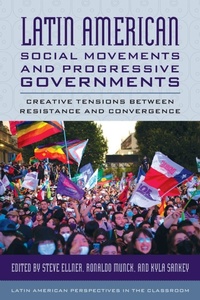
Latin American Social Movements and Progressive Governments
Creative Tensions between Resistance and Convergence
Published on 24. August 2022
Book
Paperback/Softback
336 pages
978-1-5381-6395-5 (ISBN)
Description
This book examines the tensions and convergences between social movements and twenty-first century progressive Latin American governments. Focusing on feminist, indigenous, environmental, rural, and labor movements, leading scholars present a well-rounded picture on a controversial topic and argue against the accepted view that robust Latin American social movements are independent of the state. This cutting-edge book will be an invaluable supplement for Latin American studies and beyond for courses on democracy, peace studies, labor studies, gender studies, and ethnic studies.
Reviews / Votes
This book makes an important contribution to understanding the relationship between the so-called 'Pink Tide' of left-leaning governments and the social movements in Latin America. The editors aim to move beyond the binary understanding of social movements in the region as being either completely autonomous or controlled by the state. The book also seeks to present social movements as more than a clash between progressive governments and a conservative, or neo-liberal, opposition.... [This] book is thought-provoking and timely, as it calls for a rethink of the existing literature on social movements in Latin America. Tellingly, it is published as part of the Rowman & Littlefield series 'Latin American Perspectives in the Classroom', and one can easily see how any of its chapters would offer an excellent starting-point for a rich class discussion. Its contribution is important, particularly as it features scholars from the region and findings from recent fieldwork. In the fast-paced political environment of the last few years, the book remains relevant after going to press which, given its thematic area, is no small feat. * International Affairs * This volume is indispensable for going beyond facile interpretations from the Right and segments of the Left that dismiss the Pink Tide as merely populism or not left enough. It is also a corrective to positions that imagine the possibility of a politics without the state or invariably imperfect political parties. As Munck argues in conclusion, it is not a matter of wholly supporting progressive governments, but of "at least starting from the premise that they are not the main enemy of social movements." * NACLA Report on the Americas * Pragmatic and nuanced, Ellner, Munck, and Sankey's edited volume does an excellent job of grappling with Latin America's social movements' often contradictory dance between autonomy and engagement with the region's left-wing governments. Country study chapters substantiate the book's conclusions by teasing out these complexities. -- Linda Farthing, co-author of Coup: A Story of Violence and Resistance in Bolivia This collection deftly captures the many paradoxes that govern Latin American politics, including the mutually dependent relationship between the state and social movements. The editors-Steve Ellner, Ronaldo Munck, and Kyla Sankey-have provided a work of essential reading for anyone who wants to understand Latin America today. -- Greg Grandin, Yale University Framed with conceptually engaging essays by some of the leading scholars in the field, this impressive volume offers a state-of-the-art primer on the dynamic relations between progressive states and new social movements in twenty-first-century Latin America. Broad enough to embrace the significantly different regimes that have been viewed as representatives of Latin America's embattled but resilient Pink Tide, this unique collaboration effectively dissects the 'creative tensions' that have imbricated states and social movements in Pink Tide and neoliberal politics. It makes clear that an earlier generation of scholarship that stressed the autonomy of social movements must be reassessed. Not least, this collection's ability to render complex political phenomena in very clear terms will make it indispensable for undergraduate courses on contemporary Latin America. -- Gilbert M. Joseph, co-author of Mexico's Once and Future Revolution: Social Upheaval and the Challenge of Rule since the Late Nineteenth CenturyMore details
Series
Language
English
Place of publication
United States
Publishing group
Bloomsbury Publishing Plc
Target group
College/higher education
US School Grade: From College Freshman to College Graduate Student
Illustrations
2 tables
Dimensions
Height: 229 mm
Width: 152 mm
Thickness: 20 mm
Weight
540 gr
ISBN-13
978-1-5381-6395-5 (9781538163955)
Copyright in bibliographic data and cover images is held by Nielsen Book Services Limited or by the publishers or by their respective licensors: all rights reserved.
Schweitzer Classification
Persons
Steve Ellner is a retired professor at the Universidad de Oriente, Puerto La Cruz, Venezuela, and is currently associate managing editor of Latin American Perspectives. His books include Rethinking Venezuelan Politics and the edited Latin American Extractivism, Latin America's Pink Tide, and Latin America's Radical Left.
Ronaldo Munck is a professor of sociology and director of the Centre for Engaged Research at Dublin City University and a senior researcher at the Instituto Interdisciplinario de Estudios e Investigaciones de America Latina of the Universidad de Buenos Aires. He is author of Rethinking Global Labour: After Neoliberalism and Social Movements in Latin America: Mapping the Mosaic.
Kyla Sankey teaches in the School of Business and Management at Queen Mary, University of London. Her work focuses on the history and politics of land struggles in Colombia, Latin American development, and social and labor movements in Latin America. Her publications include articles in the Journal of Agrarian Change, Journal of Developing Societies, Critical Sociology, and Latin American Perspectives.
Ronaldo Munck is a professor of sociology and director of the Centre for Engaged Research at Dublin City University and a senior researcher at the Instituto Interdisciplinario de Estudios e Investigaciones de America Latina of the Universidad de Buenos Aires. He is author of Rethinking Global Labour: After Neoliberalism and Social Movements in Latin America: Mapping the Mosaic.
Kyla Sankey teaches in the School of Business and Management at Queen Mary, University of London. Her work focuses on the history and politics of land struggles in Colombia, Latin American development, and social and labor movements in Latin America. Her publications include articles in the Journal of Agrarian Change, Journal of Developing Societies, Critical Sociology, and Latin American Perspectives.
Content
Foreword
Susan Eckstein
Introduction: Progressive Governments and Social Movements in Latin America: An Alternative Line of Thinking
Steve Ellner
PART 1: LABOR, RURAL, AND FEMINIST MOVEMENTS
Chapter 1: Popular Movements-Progressive Governments Dynamics: Considerations for an Analysis of the Latin American Experience
Federico M. Rossi
Chapter 2: Social Movement Consolidation and Strategic Shifts: The Brazilian Landless Movement during the Lula and Dilma Administrations
Anthony Pahnke
Chapter 3: Relations between Progressive Parties and Union Movements in the Southern Cone: A History of Encounters and Missed Connections
Fabricio Carneiro, Guillermo Fuentes, and Carmen Midaglia and Translated by Victoria J. Furio
Chapter 4: Routines of Interaction between Latin American Feminists and the State: Progressive Government Legacies and the Conservative and Right-Wing Turn
Eduardo Moreira da Silva and Clarisse Goulart Paradis and Translated by Luis Fierro
Chapter 5: Critical Collaboration, Self-Management, and Cooperative Economics: Convergence and Divergence in Feminist Movement Pathways in El Salvador and Nicaragua
Daniel P. Burridge
PART 2: SOCIAL MOVEMENTS AND PROGRESSIVE GOVERNMENTS IN BRAZIL AND ARGENTINA
Chapter 6: Social Movement Mobilization or Governability: Tracing the PT's Constitutionalist Junctures
Gabriel Funari
Chapter 7: Dynamics of Contention: Social Movements and Democracy in Argentina (1989-2019)
Leandro Gamallo and Translated by Mariana Ortega-Brena
PART 3: SOCIAL MOVEMENTS AND PROGRESSIVE GOVERNMENTS IN VENEZUELA, BOLIVIA, AND ECUADOR
Chapter 8: In the Empire's Crosshairs: Toward a World-Systemic History of Venezuela's Campesino Movement
Lucas Koerner
Chapter 9: Party-Base Linkages, Contestatory Mobilization, and "Creative Tensions" in Bolivia
John Brown
Chapter 10: Progressive Government, Neoliberalism, and the Popular Camp in Ecuador: A Crisis of Hegemony
Alejandra Santillana Ortiz and Sebastian Teran Avalos and Translated by Ronaldo Munck
PART 4: SOCIAL MOVEMENTS IN MEXICO, COLOMBIA, AND CHILE
Chapter 11: Social Movements, Political Linkages, and the Challenge to Democracy in Mexico
Emelio Betances
Chapter 12: From Protest to Politics: Social Movements and Progressive Parties in Chile and Colombia
Kyla Sankey and Aaron Tauss
Conclusion: The State, Social Movements, and Political Strategy in Latin America
Ronaldo Munck
About the Contributors
Susan Eckstein
Introduction: Progressive Governments and Social Movements in Latin America: An Alternative Line of Thinking
Steve Ellner
PART 1: LABOR, RURAL, AND FEMINIST MOVEMENTS
Chapter 1: Popular Movements-Progressive Governments Dynamics: Considerations for an Analysis of the Latin American Experience
Federico M. Rossi
Chapter 2: Social Movement Consolidation and Strategic Shifts: The Brazilian Landless Movement during the Lula and Dilma Administrations
Anthony Pahnke
Chapter 3: Relations between Progressive Parties and Union Movements in the Southern Cone: A History of Encounters and Missed Connections
Fabricio Carneiro, Guillermo Fuentes, and Carmen Midaglia and Translated by Victoria J. Furio
Chapter 4: Routines of Interaction between Latin American Feminists and the State: Progressive Government Legacies and the Conservative and Right-Wing Turn
Eduardo Moreira da Silva and Clarisse Goulart Paradis and Translated by Luis Fierro
Chapter 5: Critical Collaboration, Self-Management, and Cooperative Economics: Convergence and Divergence in Feminist Movement Pathways in El Salvador and Nicaragua
Daniel P. Burridge
PART 2: SOCIAL MOVEMENTS AND PROGRESSIVE GOVERNMENTS IN BRAZIL AND ARGENTINA
Chapter 6: Social Movement Mobilization or Governability: Tracing the PT's Constitutionalist Junctures
Gabriel Funari
Chapter 7: Dynamics of Contention: Social Movements and Democracy in Argentina (1989-2019)
Leandro Gamallo and Translated by Mariana Ortega-Brena
PART 3: SOCIAL MOVEMENTS AND PROGRESSIVE GOVERNMENTS IN VENEZUELA, BOLIVIA, AND ECUADOR
Chapter 8: In the Empire's Crosshairs: Toward a World-Systemic History of Venezuela's Campesino Movement
Lucas Koerner
Chapter 9: Party-Base Linkages, Contestatory Mobilization, and "Creative Tensions" in Bolivia
John Brown
Chapter 10: Progressive Government, Neoliberalism, and the Popular Camp in Ecuador: A Crisis of Hegemony
Alejandra Santillana Ortiz and Sebastian Teran Avalos and Translated by Ronaldo Munck
PART 4: SOCIAL MOVEMENTS IN MEXICO, COLOMBIA, AND CHILE
Chapter 11: Social Movements, Political Linkages, and the Challenge to Democracy in Mexico
Emelio Betances
Chapter 12: From Protest to Politics: Social Movements and Progressive Parties in Chile and Colombia
Kyla Sankey and Aaron Tauss
Conclusion: The State, Social Movements, and Political Strategy in Latin America
Ronaldo Munck
About the Contributors