

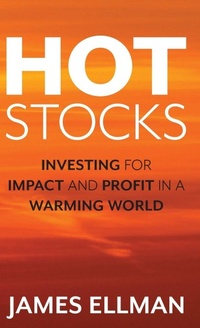
Hot Stocks
Investing for Impact and Profit in a Warming World
Published on 8. July 2020
Book
Hardback
240 pages
978-1-5381-3746-8 (ISBN)
Description
The world is warming, our portfolios will have to adapt, and the stocks we own can help shape our future; James Ellman shows how to invest wisely as climate change impacts multiple sectors across the stock market.
The costs of global warming and its mitigation will have a major impact on equity market performance over the next two decades. As the climate changes, investors will need to understand which are the best-positioned market sectors and stocks as well as those to avoid. Hot Stocks provides a roadmap detailing how to invest in this new reality. It evaluates the many ways global warming will affect profit flows in the economy:
* Impacts of a warmer climate, rising ocean levels, more frequent extreme storm events, land desertification and ocean acidification.
* Potential for government taxation on greenhouse gas emissions.
* Accelerating switching to renewable power systems that are increasingly cost competitive with those powered by oil fossil fuels.
* Government bans on sales of cars powered by internal combustion engines and the electrification of the terrestrial vehicle fleet.
* Potential for hydrocarbon reserves and equipment becoming impaired or 'stranded assets'.
* Rising demand for major infrastructure projects to protect valuable coastal real estate from inundation.
* Litigation aimed at forcing legacy polluters to pay mitigation costs.
The book drills down on how these changes will depress or support stocks in sectors such as the petroleum industry, automakers, renewable power providers, regional banking, property insurance, heavy equipment manufacturers, Real Estate Investment Trusts (REITs) and agricultural chemicals. The analysis then pivots away from a US-centric focus to identify those nations around the world whose economies are best positioned to successfully adjust to the impact of rising prevailing temperatures, as well as those likely to suffer the most from the trend.
The costs of global warming and its mitigation will have a major impact on equity market performance over the next two decades. As the climate changes, investors will need to understand which are the best-positioned market sectors and stocks as well as those to avoid. Hot Stocks provides a roadmap detailing how to invest in this new reality. It evaluates the many ways global warming will affect profit flows in the economy:
* Impacts of a warmer climate, rising ocean levels, more frequent extreme storm events, land desertification and ocean acidification.
* Potential for government taxation on greenhouse gas emissions.
* Accelerating switching to renewable power systems that are increasingly cost competitive with those powered by oil fossil fuels.
* Government bans on sales of cars powered by internal combustion engines and the electrification of the terrestrial vehicle fleet.
* Potential for hydrocarbon reserves and equipment becoming impaired or 'stranded assets'.
* Rising demand for major infrastructure projects to protect valuable coastal real estate from inundation.
* Litigation aimed at forcing legacy polluters to pay mitigation costs.
The book drills down on how these changes will depress or support stocks in sectors such as the petroleum industry, automakers, renewable power providers, regional banking, property insurance, heavy equipment manufacturers, Real Estate Investment Trusts (REITs) and agricultural chemicals. The analysis then pivots away from a US-centric focus to identify those nations around the world whose economies are best positioned to successfully adjust to the impact of rising prevailing temperatures, as well as those likely to suffer the most from the trend.
Reviews / Votes
[Ellman] shows how climate changes will strengthen or weaken stock sectors such as automakers, property insurance, petroleum, manufacturers, and more. Ellman also provides a global look at nations whose economies will be most and least impacted by rising temperatures. Readers new to the stock market will find this book easy to read and understand and will appreciate the investing perspective. Seasoned investors will find this guide insightful if they are thinking of adjusting their portfolios in relation to climate change." * Booklist * This book is strictly for prospective and professional investors. This go-to title advises investors on the strengths and weaknesses of companies in light of climate change. It covers key industries so that an investor can determine which industry is best to invest in. Although the author focuses more on U.S. stock there are also some recommendations on the international scale. The intent of this work is to not only show how companies fear global warming with traditional industries feeling the brunt, but to also explain how new markets can prosper in a warming world. This is also supported by various statistics that an investor can apply in the decision-making process. * Library Journal * Hot Stocks is an authoritative and wry guide to a business landscape going haywire. What should smart investors buy in a warming world? This book." -- McKenzie Funk, author of "Windfall: The Booming Business of Global Warming" James Ellman's insightful analysis of the catastrophe that is climate change shows how we can turn lemons into lemonade by investing wisely. -- Jordan Hymowitz, Managing Partner of Philadelphia Financial Management A brisk and eye-opening tour through the major sectors of the stock market that makes clear how important the impacts of global warming will be for equity investment returns. -- Andrea Mitroff, Former Managing Director, Global Equities Lead Portfolio Manager, TIAA Investments A thoughtful and comprehensive look at investment strategies for public stocks that factor in our changing climate. Ellman brings depth of analysis, and some humor, to a complex and timely topic. -- Barney Schauble, Managing Partner at Nephila Advisors, LLC, Chair of Ceres Hot Stocks is easy to read, compelling, and game-changing. James Ellman shows a deep understanding of the science of climate change and the coming disruption in geopolitics, technology, infrastructure, government policies, and consumer behavior that will put traditional financial holdings at high risk. Sector by sector, he explains the perils and advantages for specific companies, regions, and countries. The reader emerges with a new way of analyzing future winners and losers to build the strongest financial position in the gathering storm. -- Margaret Cheney, Commissioner, Vermont Public Utility CommissionMore details
Language
English
Place of publication
United States
Publishing group
Bloomsbury Publishing Plc
Illustrations
15 b/w illustrations; 20 tables
Dimensions
Height: 222 mm
Width: 145 mm
Thickness: 18 mm
Weight
475 gr
ISBN-13
978-1-5381-3746-8 (9781538137468)
Copyright in bibliographic data and cover images is held by Nielsen Book Services Limited or by the publishers or by their respective licensors: all rights reserved.
Schweitzer Classification
Other editions
Additional editions
E-Book
07/2020
1st Edition
Rowman & Littlefield Publishers
€32.99
Available for download
E-Book
07/2020
1st Edition
Rowman & Littlefield Publishers
€32.99
Available for download
Person
James Ellman has more than two decades of experience as a professional investor: first as an equity portfolio manager for Invesco and Merrill Lynch mutual funds, then at hedge funds Seacliff Capital and Ascend Capital. He lives near San Francisco with his wife and sons.
Content
Introduction: Welcome to the Anthropocene!
1. The Increasing Impact of Climate Change on Markets
2. Renewable Energy: Operators and Installers
3. Renewable Energy: Equipment Manufacturers
4. Hydrocarbons: The Biggest Loser
5. Financial Services: Underwater ATMs?
6. Infrastructure: Building Arks in a Flood
7. Transportation: The Decline and Fall of the Internal
Combustion Engine
8. Utilities: Pivoting without a Net
9. A Grab Bag from Pandora's Box
10. The Rest of the World
Conclusion
Notes
Bibliography
Index
About the Author
1. The Increasing Impact of Climate Change on Markets
2. Renewable Energy: Operators and Installers
3. Renewable Energy: Equipment Manufacturers
4. Hydrocarbons: The Biggest Loser
5. Financial Services: Underwater ATMs?
6. Infrastructure: Building Arks in a Flood
7. Transportation: The Decline and Fall of the Internal
Combustion Engine
8. Utilities: Pivoting without a Net
9. A Grab Bag from Pandora's Box
10. The Rest of the World
Conclusion
Notes
Bibliography
Index
About the Author