

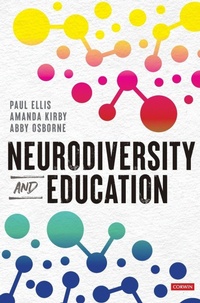
Neurodiversity and Education
1st Edition
Published on 17. February 2023
Book
Hardback
176 pages
978-1-5296-0036-0 (ISBN)
Description
Human brains are diverse: each one of us has a unique set of connections between billions of nerve cells.
Neurodiversity is about us all. It is not an exclusive club or one condition, difficulty, difference, or disorder.
Understanding more about the concept of neurodiversity helps us consider, respect and appreciate these differences. It helps us see potential rather than deficit.
This clear and practical book, which is useful for all apsects of learning and education discusses how an emphasis on neurodiverse 'ability' can cultivate a better world.
Neurodiversity is about us all. It is not an exclusive club or one condition, difficulty, difference, or disorder.
Understanding more about the concept of neurodiversity helps us consider, respect and appreciate these differences. It helps us see potential rather than deficit.
This clear and practical book, which is useful for all apsects of learning and education discusses how an emphasis on neurodiverse 'ability' can cultivate a better world.
More details
Language
English
Place of publication
London
United Kingdom
Target group
Professional and scholarly
Dimensions
Height: 250 mm
Width: 175 mm
Thickness: 14 mm
Weight
494 gr
ISBN-13
978-1-5296-0036-0 (9781529600360)
Copyright in bibliographic data and cover images is held by Nielsen Book Services Limited or by the publishers or by their respective licensors: all rights reserved.
Schweitzer Classification
Other editions
Additional editions
Paul Ellis | Amanda Kirby | Abby Osborne
Neurodiversity and Education
Book
02/2023
1st Edition
SAGE Publications Ltd
€58.50
Shipment within 3-4 weeks
Paul Ellis | Amanda Kirby | Abby Osborne
Neurodiversity and Education
E-Book
02/2023
1st Edition
Corwin UK
€52.49
Available for download
Paul Ellis | Amanda Kirby | Abby Osborne
Neurodiversity and Education
E-Book
02/2023
1st Edition
Corwin UK
€52.49
Available for download
Persons
Paul Ellis began teaching in schools and universities in the 1990s, and has held senior positions in two of the main international education providers since 2006. Within his current role, he is in charge of the worldwide recruitment and development of teacher-trainers. He has worked with teachers and school leaders on all continents to advise and support them in their professional learning. He has written or edited more than a dozen education books.
Amanda Kirby has held had a chair in developmental disorders in education at the University of South Wales since 2008. Her PhD was in emerging adulthood in developmental coordination disorder (DCD), from Leeds University. She is also a qualified general physician. She founded The Dyscovery Centre, a specialist centre for children and adults with developmental disorders, in 1997 and ran it until 2015. She is chair of Movement Matters, the U.K. umbrella organization for movement difficulties. She is also a patron of the Dyspraxia Association in New Zealand, medical advisor to the Dyspraxia Foundation in the United Kingdom, and a past advisor to the Dyspraxia Association in the Republic of Ireland. She has been on the international scientific committee for DCD and was part of the committee for the European guidelines for DCD and the 2019 International Guidelines for DCD. She is the CEO of Do-IT Solutions Ltd., a company providing person-centered assessments and support for people with neurodevelopmental disabilities (NDDs) and related difficulties. Her interests and publications have focused on NDDs (particularly DCD and co-occurrence) and their impact on children, adults, and their families. She has run large-scale research trials and European Union projects and has published books and peer-reviewed papers in the field. She is active on Twitter and LinkedIn where she promotes Neurodiversity awareness and shares advice and support strategies.
Abby Osborne works at the University of Bath in the Centre for Learning and Teaching as their Assessment and Feedback Lead. She has extensive experience of mentoring and tutoring students, from secondary to further and higher education. In addition, she now works as a Consultant to support busy teachers to develop their inclusive practice.
Through her work with students and teachers, Abby has developed many practical strategies to overcoming multiple barriers to learning which we all face. She has recently published two books on inclusive teaching and learning and worked with teachers across the globe, covering the educational journey from primary to post- graduate study.
Amanda Kirby has held had a chair in developmental disorders in education at the University of South Wales since 2008. Her PhD was in emerging adulthood in developmental coordination disorder (DCD), from Leeds University. She is also a qualified general physician. She founded The Dyscovery Centre, a specialist centre for children and adults with developmental disorders, in 1997 and ran it until 2015. She is chair of Movement Matters, the U.K. umbrella organization for movement difficulties. She is also a patron of the Dyspraxia Association in New Zealand, medical advisor to the Dyspraxia Foundation in the United Kingdom, and a past advisor to the Dyspraxia Association in the Republic of Ireland. She has been on the international scientific committee for DCD and was part of the committee for the European guidelines for DCD and the 2019 International Guidelines for DCD. She is the CEO of Do-IT Solutions Ltd., a company providing person-centered assessments and support for people with neurodevelopmental disabilities (NDDs) and related difficulties. Her interests and publications have focused on NDDs (particularly DCD and co-occurrence) and their impact on children, adults, and their families. She has run large-scale research trials and European Union projects and has published books and peer-reviewed papers in the field. She is active on Twitter and LinkedIn where she promotes Neurodiversity awareness and shares advice and support strategies.
Abby Osborne works at the University of Bath in the Centre for Learning and Teaching as their Assessment and Feedback Lead. She has extensive experience of mentoring and tutoring students, from secondary to further and higher education. In addition, she now works as a Consultant to support busy teachers to develop their inclusive practice.
Through her work with students and teachers, Abby has developed many practical strategies to overcoming multiple barriers to learning which we all face. She has recently published two books on inclusive teaching and learning and worked with teachers across the globe, covering the educational journey from primary to post- graduate study.
Content
Chapter 1: What is neurodiversity?
Chapter 2: Framing neurodiversity - past and present
Chapter 3: The 3Ms - Missed, Misdiagnosed and Misunderstood
Chapter 4: Mental health and wellbeing
Chapter 5: Reframing
Chapter 6: Universal Design
Chapter 7: The Inclusive Classroom
Chapter 8: Teaching and Learning
Chapter 9: Assessing neurodiverse learners
Chapter 10: Neurodiversity in the Education Workplace
Chapter 2: Framing neurodiversity - past and present
Chapter 3: The 3Ms - Missed, Misdiagnosed and Misunderstood
Chapter 4: Mental health and wellbeing
Chapter 5: Reframing
Chapter 6: Universal Design
Chapter 7: The Inclusive Classroom
Chapter 8: Teaching and Learning
Chapter 9: Assessing neurodiverse learners
Chapter 10: Neurodiversity in the Education Workplace