

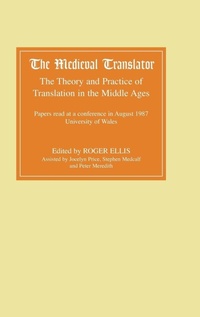
The Medieval Translator
The Theory and Practice of Translation in the Middle Ages
Published on 3. August 1989
Book
Hardback
208 pages
978-0-85991-284-6 (ISBN)
Description
These studies of the theory and practice of translation in the middle ages show a wide range of translational practices, on texts which range from anonymous Middle English romances and Biblical commentaries to the writings of Usk,Chaucer and Malory. Included among them is a paper on a hitherto unknown woman translator, Dame Eleanor Hull; a paper which compares a draft translation with its fair copy to show how its translator worked; a paper which shows how the mystic Rolle sought to "translate" his heightened spiritual experiences into words; and so on. In a medieval translation the general priority of meaning over form and style enabled, even obliged, the translator to act more like an author than like a scribe. Consequently, the study of medieval translation throws important light on contemporary, attitudes to, and understandings of, fundamental literary questions: for example, and most importantly, that of the role of the author.
Reviews / Votes
The study of translation, in fact, has central value for the understanding of mediaeval literature, involving as it does the very question of originality, of the transformation of received materials, and of the relationship between text and language...interesting and useful reading. * MEDIUM AEVUM 1991 *More details
Language
English
Place of publication
Cambridge
United Kingdom
Publishing group
Boydell & Brewer Ltd
Target group
College/higher education
Professional and scholarly
Product notice
Cloth over boards
Illustrations
4 s/w Abbildungen
4 b/w illus.
Dimensions
Height: 240 mm
Width: 161 mm
Thickness: 16 mm
Weight
487 gr
ISBN-13
978-0-85991-284-6 (9780859912846)
Copyright in bibliographic data and cover images is held by Nielsen Book Services Limited or by the publishers or by their respective licensors: all rights reserved.
Schweitzer Classification
Persons
NICHOLAS WATSON teaches English at Harvard University. His research focuses on medieval English and North European literature, intellectual history, visionary writing and the role of the written vernacular.
Content
Introduction - Roger Ellis
The fortunes of 'non verbum pro verbo': or, why Jerome is not a Ciceronian -
Late medieval English translation: types and reflections - J D Burnley
Chaucer as translator - T W Machan
Prologue and practice: Middle English lives of Christ - Ian Johnson
Dame Eleanor Hull: a fifteenth-century translator - Alexandra Barratt
The Ashmole Sir Ferumbras: translation in holograph - Steven H A Shepherd
Translation as expansion: poetic practice in the Old English Phoenix and some other poems - Anne Savage
Ipomedon to Ipomadon A: two views of courtliness - Rosalind Field
Malory's questing beast and the implications of author as translator - Catherine Batt
Translation and self-canonization in Richard Rolle's Melos Amoris - Nicholas Watson
Transposition: Thomas Usk's Testament of Love - Stephen Medcalf
The fortunes of 'non verbum pro verbo': or, why Jerome is not a Ciceronian -
Late medieval English translation: types and reflections - J D Burnley
Chaucer as translator - T W Machan
Prologue and practice: Middle English lives of Christ - Ian Johnson
Dame Eleanor Hull: a fifteenth-century translator - Alexandra Barratt
The Ashmole Sir Ferumbras: translation in holograph - Steven H A Shepherd
Translation as expansion: poetic practice in the Old English Phoenix and some other poems - Anne Savage
Ipomedon to Ipomadon A: two views of courtliness - Rosalind Field
Malory's questing beast and the implications of author as translator - Catherine Batt
Translation and self-canonization in Richard Rolle's Melos Amoris - Nicholas Watson
Transposition: Thomas Usk's Testament of Love - Stephen Medcalf