

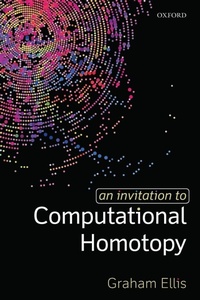
An Invitation to Computational Homotopy
Published on 13. August 2019
Book
Paperback/Softback
550 pages
978-0-19-883298-0 (ISBN)
Description
An Invitation to Computational Homotopy is an introduction to elementary algebraic topology for those with an interest in computers and computer programming. It expertly illustrates how the basics of the subject can be implemented on a computer through its focus on fully-worked examples designed to develop problem solving techniques.
The transition from basic theory to practical computation raises a range of non-trivial algorithmic issues which will appeal to readers already familiar with basic theory and who are interested in developing computational aspects. The book covers a subset of standard introductory material on fundamental groups, covering spaces, homology, cohomology and classifying spaces as well as some less standard material on crossed modules.
These topics are covered in a way that hints at potential applications of topology in areas of computer science and engineering outside the usual territory of pure mathematics, and also in a way that demonstrates how computers can be used to perform explicit calculations within the domain of pure algebraic topology itself. The initial chapters include in-depth examples from data mining, biology and digital image analysis, while the later chapters cover a range of computational examples on the cohomology of classifying spaces that are likely beyond the reach of a purely paper-and-pen approach to the subject.
An Invitation to Computational Homotopy serves as a self-contained and informal introduction to these topics and their implementation in the sphere of computer science. Written in a dynamic and engaging style, it skilfully showcases a range of useful machine computations, and will serve as an invaluable aid to graduate students working with algebraic topology.
The transition from basic theory to practical computation raises a range of non-trivial algorithmic issues which will appeal to readers already familiar with basic theory and who are interested in developing computational aspects. The book covers a subset of standard introductory material on fundamental groups, covering spaces, homology, cohomology and classifying spaces as well as some less standard material on crossed modules.
These topics are covered in a way that hints at potential applications of topology in areas of computer science and engineering outside the usual territory of pure mathematics, and also in a way that demonstrates how computers can be used to perform explicit calculations within the domain of pure algebraic topology itself. The initial chapters include in-depth examples from data mining, biology and digital image analysis, while the later chapters cover a range of computational examples on the cohomology of classifying spaces that are likely beyond the reach of a purely paper-and-pen approach to the subject.
An Invitation to Computational Homotopy serves as a self-contained and informal introduction to these topics and their implementation in the sphere of computer science. Written in a dynamic and engaging style, it skilfully showcases a range of useful machine computations, and will serve as an invaluable aid to graduate students working with algebraic topology.
Reviews / Votes
It expertly illustrates how the basics of the subject can be implemented on a computer through its focus on fully-worked examples designed to develop problem solving techniques. * Graham Ellis, Mathematical Reviews * The book is well equipped with exercises...providing a widespread of approaches to the material in the book.this book is definitely one I appreciate having read, and one that I can see myself recommending to students who already wish to go into something related to group theory. * Mikael Vejdemo-Johansson, Assistant Professor of Data Science at CUNY College of Staten Island, Mathematical Association of America *More details
Language
English
Place of publication
Oxford
United Kingdom
Target group
College/higher education
Dimensions
Height: 234 mm
Width: 156 mm
Thickness: 29 mm
Weight
825 gr
ISBN-13
978-0-19-883298-0 (9780198832980)
Copyright in bibliographic data and cover images is held by Nielsen Book Services Limited or by the publishers or by their respective licensors: all rights reserved.
Schweitzer Classification
Other editions
Additional editions
Graham Ellis
An Invitation to Computational Homotopy
E-Book
08/2019
1st Edition
OUP eBook
€64.49
Available for download
Graham Ellis
An Invitation to Computational Homotopy
Book
08/2019
Oxford University Press
€177.00
Shipment within 15-20 days
Person
Graham Ellis received his PhD from the University of Wales, Bangor, in 1984 and has taught at the National University of Ireland, Galway since 1987. He is the Established Professor of Mathematics at Galway. He has published research articles on computational algebra, group theory and low-dimensional topology.
Content
1: Path components and the fundamental group
2: Cellular homology
3: Cohomology of groups
4: Cohomological group theory
5: Cohomology of homotopy 2-types
6: Explicit classifying spaces
2: Cellular homology
3: Cohomology of groups
4: Cohomological group theory
5: Cohomology of homotopy 2-types
6: Explicit classifying spaces