

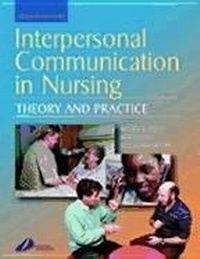
Interpersonal Communication in Nursing
2nd Edition
Published on 11. June 2003
Book
Paperback/Softback
200 pages
978-0-443-07270-3 (ISBN)
Description
Good communication is fundamental to effective nursing, and the teaching of interpersonal skills is now an established part of all nursing courses, at both pre-and post-registration level.
The book meets the student's needs, and is specifically tailored to nurses. It interweaves theoretical concepts of communication into the analysis of everyday nursing situations. This approach makes the book more interesting to read and has the added benefit of encouraging reflective practice.
After reading and studying this book, students and qualified staff should be better able to make sense of face-to-face communication and know how their interactions can be improved. Applies theory to nursing practice
Includes assignments drawn from varying nursing contexts
Focuses on the real world of nurses and their communication needs
Completely updated and revised.
The new edition has been thoroughly revised and has a new layout which is as follows:
PART A - Introduces readers to the broad principles of communication and their application in a wide range of situations.
PART B - comprises of in-depth content relating to the specialist communication, knowledge and skills required of nurses caring for patients/clients covered by the 4 branch programmes, i.e. adults, children, people with mental illness and people with learning disability.
PART C - covers the specialist communication needs and skills required of the registered practitioner at all levels following qualification.
The book meets the student's needs, and is specifically tailored to nurses. It interweaves theoretical concepts of communication into the analysis of everyday nursing situations. This approach makes the book more interesting to read and has the added benefit of encouraging reflective practice.
After reading and studying this book, students and qualified staff should be better able to make sense of face-to-face communication and know how their interactions can be improved. Applies theory to nursing practice
Includes assignments drawn from varying nursing contexts
Focuses on the real world of nurses and their communication needs
Completely updated and revised.
The new edition has been thoroughly revised and has a new layout which is as follows:
PART A - Introduces readers to the broad principles of communication and their application in a wide range of situations.
PART B - comprises of in-depth content relating to the specialist communication, knowledge and skills required of nurses caring for patients/clients covered by the 4 branch programmes, i.e. adults, children, people with mental illness and people with learning disability.
PART C - covers the specialist communication needs and skills required of the registered practitioner at all levels following qualification.
More details
Edition
2nd edition
Language
English
Place of publication
London
United Kingdom
Publishing group
Elsevier Health Sciences
Target group
College/higher education
Pre and post registration students/nurses
Product notice
Paperback (trade)
Unsewn / adhesive bound
Illustrations
55 ills.; Illustrations
Dimensions
Height: 247 mm
Width: 190 mm
Thickness: 14 mm
Weight
415 gr
ISBN-13
978-0-443-07270-3 (9780443072703)
Copyright in bibliographic data and cover images is held by Nielsen Book Services Limited or by the publishers or by their respective licensors: all rights reserved.
Schweitzer Classification
Other editions
Previous edition

Roger Ellis | Bob Gates | Neil Kenworthy
Interpersonal Communication in Nursing Theory and Practice
Theory and Practice
Book
06/1995
Churchill Livingstone
€22.27
Article exhausted; check for reprint
Persons
Content
1 - Defining communication. 2 - The person in communication. 3 - Social factors affecting communication. 4 - Psychological Factors affecting communication. 5 - Improving communication. 6 - Communicating in support groups. 7 - The counselling relationship. 8 - The mentoring relationship. 9 - Communication and clinical supervision. 10 - Communication and leadership. 11 - Communication with the wider world