

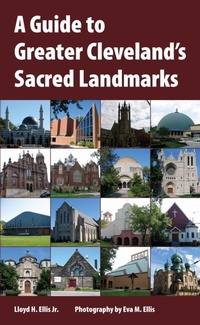
A Guide to Greater Cleveland's Sacred Landmarks
Published on 7. November 2012
Book
Paperback/Softback
456 pages
978-1-60635-121-5 (ISBN)
Description
An informative guide to the Cleveland area's houses of worship
The sacred landmarks of Cleveland and the surrounding area provide a fascinating array of architectural styles and often serve as visual focal points and social centers in the area's many ethnic communities. In A Guide to Greater Cleveland's Sacred Landmarks, author Lloyd Ellis describes the origins of the area's religious communities, outlines the history of their buildings, interprets their architectural styles, and provides details on significant interior features.
Ellis profiles seventy-five Protestant churches, fifty-seven Catholic churches, eight Jewish institutions, eight Orthodox churches, three Mosques, two Unitarian churches, and a Hindu temple, and provides readers with fifteen recommended tours around Cuyahoga County. He describes each structure by explaining its importance as a religious, cultural, or architectural landmark, and accompanies each entry with an exterior photograph.
In addition to serving as a reference to thriving religious institutions, A Guide to Greater Cleveland's Sacred Landmarks preserves the memory of the area's extinct or endangered religious communities, passing the stories of past generations to generations in the future. Anyone interested in greater Cleveland's architectural, religious, and ethnic history will welcome this well-researched and richly illustrated guide.
The sacred landmarks of Cleveland and the surrounding area provide a fascinating array of architectural styles and often serve as visual focal points and social centers in the area's many ethnic communities. In A Guide to Greater Cleveland's Sacred Landmarks, author Lloyd Ellis describes the origins of the area's religious communities, outlines the history of their buildings, interprets their architectural styles, and provides details on significant interior features.
Ellis profiles seventy-five Protestant churches, fifty-seven Catholic churches, eight Jewish institutions, eight Orthodox churches, three Mosques, two Unitarian churches, and a Hindu temple, and provides readers with fifteen recommended tours around Cuyahoga County. He describes each structure by explaining its importance as a religious, cultural, or architectural landmark, and accompanies each entry with an exterior photograph.
In addition to serving as a reference to thriving religious institutions, A Guide to Greater Cleveland's Sacred Landmarks preserves the memory of the area's extinct or endangered religious communities, passing the stories of past generations to generations in the future. Anyone interested in greater Cleveland's architectural, religious, and ethnic history will welcome this well-researched and richly illustrated guide.
More details
Series
Language
English
Place of publication
Kent, OH
United States
Target group
Professional and scholarly
Product notice
Paperback (trade)
Unsewn / adhesive bound
Dimensions
Height: 226 mm
Width: 140 mm
Thickness: 25 mm
Weight
567 gr
ISBN-13
978-1-60635-121-5 (9781606351215)
Copyright in bibliographic data and cover images is held by Nielsen Book Services Limited or by the publishers or by their respective licensors: all rights reserved.
Schweitzer Classification
Other editions
Additional editions
Jr. Lloyd H. Ellis
Guide to Greater Cleveland's Sacred Landmarks
E-Book
11/2012
The Kent State University Press
€29.99
Available for download
Jr. Lloyd H. Ellis
Guide to Greater Cleveland's Sacred Landmarks
E-Book
11/2012
The Kent State University Press
€29.99
Available for download
Persons
Lloyd H. Ellis Jr., who was a diplomat and farm manager prior to attending medical school, was director of Emergency Services at University Hospitals of Cleveland and Medical Advisor of the Cleveland Emergency Medical Service. In retirement he has earned a Ph.D. in art history and has written about Italian Renaissance art theory, modernist residential architecture, and the history of book clubs. He may be found online at: www.lloydellis.com.