

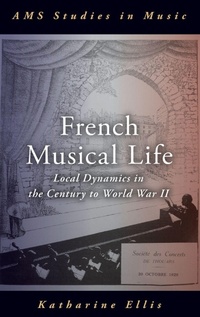
French Musical Life
Local Dynamics in the Century to World War II
Published on 2. February 2022
Book
Hardback
438 pages
978-0-19-760016-0 (ISBN)
Description
Explicitly or not, the historical musicology of post-Revolutionary France has focused on Paris as a proxy for the rest of the country. This distorting lens is the legacy of political and cultural struggle during the long nineteenth century, indicating a French Revolution unresolved both then and now. In light of the capital's power as the seat of a centralizing French state (which provincials found 'colonizing') and as a cosmopolitan musical crossroads of nineteenth-century Europe, the struggles inherent in creating sustainable musical cultures outside Paris, and in composing local and regionalist music, are ripe for analysis. Replacement of 'France' with Paris has encouraged normative history-writing articulated by the capital's opera and concert life. Regional practices have been ignored, disparaged or treated piecemeal.
This book is a study of French musical centralization and its discontents during the period leading up to and beyond the "provincial awakening" of the Belle Epoque. The book explains how different kinds of artistic decentralization and regionalism were hard won (or not) across a politically turbulent century from the 1830s to World War II. In doing so it redraws the historical map of musical power relations in mainland France. Based on work in over 70 archives, chapters on conservatoires, concert life, stage music, folk music and composition reveal how tensions of State and locality played out differently depending on the structures and funding mechanisms in place, the musical priorities of different communities, and the presence or absence of galvanizing musicians. Progressively, the book shifts from musical contexts to musical content, exploring the pressure point of folk music and its translation into "local color" for officials who perpetually feared national division. Control over composition on the one hand, and the emotional intensity of folk-based musical experience on the other, emerges as a matter of consistent official praxis. In terms of "French music" and its compositional styles, what results is a surprising new historiography of French neoclassicism, bound into and growing out of a study of diversity and its limits in daily musical life.
This book is a study of French musical centralization and its discontents during the period leading up to and beyond the "provincial awakening" of the Belle Epoque. The book explains how different kinds of artistic decentralization and regionalism were hard won (or not) across a politically turbulent century from the 1830s to World War II. In doing so it redraws the historical map of musical power relations in mainland France. Based on work in over 70 archives, chapters on conservatoires, concert life, stage music, folk music and composition reveal how tensions of State and locality played out differently depending on the structures and funding mechanisms in place, the musical priorities of different communities, and the presence or absence of galvanizing musicians. Progressively, the book shifts from musical contexts to musical content, exploring the pressure point of folk music and its translation into "local color" for officials who perpetually feared national division. Control over composition on the one hand, and the emotional intensity of folk-based musical experience on the other, emerges as a matter of consistent official praxis. In terms of "French music" and its compositional styles, what results is a surprising new historiography of French neoclassicism, bound into and growing out of a study of diversity and its limits in daily musical life.
Reviews / Votes
All France is not Paris. Katharine Ellis trains her keen researcher's eye on concerts, opera, conservatories, and other aspects of music-making in Lyon and other French centers during the years from Berlioz to Les Six. Compendious, exquisitely precise, written with total clarity-and instantly indispensable. * Ralph P. Locke, Emeritus Professor of Musicology, Eastman School of Music/University of Rochester, author of Musical Exoticism: Images and Reflections * Katharine Ellis's latest book, French Musical Life: Local Dynamics in the Century to World War II, is a significant achievement. It is the first in-depth study of French music in relation to decentralization and cultural regionalism. The scale of the study, covering the complex musical dialogues between Paris and the regions and within the provinces themselves from the 1830s to the 1930s, will set a new standard for future scholarship within French cultural history. Beautifully written and argued with consummate subtlety and sophistication, Ellis brings to life musical institutions and music making from across France in ways that challenge and entice the reader. * Barbara L. Kelly, Director of Research and Professor of Musicology, Royal Northern College of Music * The book offers a timely lesson in archive theory and provides a template for scholars interested in the power of local archives to undo previous under standings of music and politics. * Fanny Gribenski, New York University * The book is big in the sense of importance, as local musical life in nineteenth- and twentieth-century France has thus far only been researched piecemeal. * Madeline Roycroft, Musicology Australia *More details
Series
Language
English
Place of publication
New York
United States
Target group
Professional and scholarly
Illustrations
31 figures
Dimensions
Height: 240 mm
Width: 161 mm
Thickness: 28 mm
Weight
819 gr
ISBN-13
978-0-19-760016-0 (9780197600160)
Copyright in bibliographic data and cover images is held by Nielsen Book Services Limited or by the publishers or by their respective licensors: all rights reserved.
Schweitzer Classification
Other editions
Additional editions
E-Book
10/2021
OUP eBook
€43.49
Available for download
E-Book
10/2021
OUP eBook
€43.49
Available for download
Person
Katharine Ellis is 1684 Professor of Music at the University of Cambridge. She is widely published on the history of musical France in the nineteenth and early twentieth centuries. Her previous monographs cover canon-formation and the press, the early music revival, and Benedictine musical politics c.1900. She has been elected to the Academia Europaea, the British Academy, and the American Philosophical Society.
Content
Introduction
-Centralization and its discontents
-Decentralization, deconcentration, regionalism
-Politics, then and now
-A Study in four Parts
-Approaches
Part I Education
Introduction
Chapter 1: The National Conservatoire System
-Class and access: working-class men
-Class and status: young bourgeoises
-Power, hard and soft
-Directorial discretion: curricula
-The 1930s: towards reform
Chapter 2: Educational Independence
-Pedagogical Difference c.1900
-The Schola's ghostly presences I: Montpellier
-The Schola's ghostly presences II: Severac's vision, Le Havre and Nancy
-Strasbourg
-Bordeaux
-Composition: the final frontier
Part II Concert Rites
Introduction
Chapter 3: Choral Voices
-Orpheons: uniformity and regional identity
-Cathedral maitrises
-Mixed choirs: Poitou-Charentes and Strasbourg
-Belle Epoque ambition: Bordes, Witkowski and Lyon
Chapter 4: Instrumental Music and Urban Gravitas
-Private, public, "populaire"
-The Symphony orchestra as musical hub
-Amateur to professional
-Provincial programming: orchestral, chamber and specialist ensembles
-Local vs. (inter)national
Part III Stage Musics
Introduction
Chapter 5: Opera Against the Odds
-The 1864 liberte des theatres
-Municipal perspectives
-Industry perspectives
Chapter 6: Operatic Competition
-The Cafe-Concert
-Operetta
-Touring: individual and collective
-Technology
Chapter 7: Opera Inside and Out
-Wagner's "tour de France"
-Couleur locale in Paris and at home
-Open-air opera
Part IV Folk, Region, Nation
Introduction
Chapter 8: Folk Musics
-The French folk-music problem
-Politics of collection, transcription, and classification
-Soundscapes of popular Catholicism
-Folk music, the peasant, and the bourgeoisie
-Display, domestication, tourism
-Coda
Chapter 9: Composition
-A View from 1937
-Provincial career paths
-Rethinking the Schola's regionalism
-The Allure of the Russian Five
-Back to opera: regionalism and nation
-Mode, multi-regionalism, and patrimoine
Conclusions
-"Decentralization" through the lens of Lyon
-Musical localism
-Repositioning the rural
Bibliography
Index
-Centralization and its discontents
-Decentralization, deconcentration, regionalism
-Politics, then and now
-A Study in four Parts
-Approaches
Part I Education
Introduction
Chapter 1: The National Conservatoire System
-Class and access: working-class men
-Class and status: young bourgeoises
-Power, hard and soft
-Directorial discretion: curricula
-The 1930s: towards reform
Chapter 2: Educational Independence
-Pedagogical Difference c.1900
-The Schola's ghostly presences I: Montpellier
-The Schola's ghostly presences II: Severac's vision, Le Havre and Nancy
-Strasbourg
-Bordeaux
-Composition: the final frontier
Part II Concert Rites
Introduction
Chapter 3: Choral Voices
-Orpheons: uniformity and regional identity
-Cathedral maitrises
-Mixed choirs: Poitou-Charentes and Strasbourg
-Belle Epoque ambition: Bordes, Witkowski and Lyon
Chapter 4: Instrumental Music and Urban Gravitas
-Private, public, "populaire"
-The Symphony orchestra as musical hub
-Amateur to professional
-Provincial programming: orchestral, chamber and specialist ensembles
-Local vs. (inter)national
Part III Stage Musics
Introduction
Chapter 5: Opera Against the Odds
-The 1864 liberte des theatres
-Municipal perspectives
-Industry perspectives
Chapter 6: Operatic Competition
-The Cafe-Concert
-Operetta
-Touring: individual and collective
-Technology
Chapter 7: Opera Inside and Out
-Wagner's "tour de France"
-Couleur locale in Paris and at home
-Open-air opera
Part IV Folk, Region, Nation
Introduction
Chapter 8: Folk Musics
-The French folk-music problem
-Politics of collection, transcription, and classification
-Soundscapes of popular Catholicism
-Folk music, the peasant, and the bourgeoisie
-Display, domestication, tourism
-Coda
Chapter 9: Composition
-A View from 1937
-Provincial career paths
-Rethinking the Schola's regionalism
-The Allure of the Russian Five
-Back to opera: regionalism and nation
-Mode, multi-regionalism, and patrimoine
Conclusions
-"Decentralization" through the lens of Lyon
-Musical localism
-Repositioning the rural
Bibliography
Index