

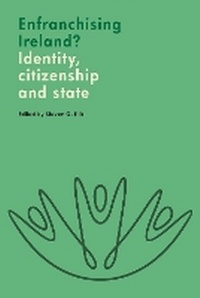
Enfranchising Ireland?
Identity, citizenship and state
Published on 2. May 2018
Book
Paperback/Softback
175 pages
978-1-908997-84-5 (ISBN)
Description
The rights and duties associated with the concept of citizenship are a central aspect of the process of identity-building and state formation. This book explores the origin and evolution of the concepts of citizenship and identity in Ireland from a broadly historical perspective, tracing their development in terms of rights and duties, from classical times, through the medieval period and the era partition in Ireland, to the present difficulties surrounding Brexit and the refugee crisis.
Ireland's population has, by the standards of states elsewhere in Europe, remained fairly stable and homogeneous, at least until recently. The present refugee crisis presents Ireland with the prospect of asylum seekers and other migrants with very different cultures, traditions and senses of identity arriving on a scale quite unknown previously, with consequent difficulties surrounding their admission and integration into Irish society.
An examination of how the basic criteria and conditions under which citizenship has been conferred here compares with those for granting citizenship in other parts of Europe suggests that evolution of citizenship concepts in Ireland has more generally accorded with familiar European patterns of development.
Depending on how future relations between the UK and the EU are agreed following Brexit, however, the island of Ireland faces the prospect of immigrants from other EU member states enjoying what are in effect the rights of citizens in the Republic of Ireland but no such rights in Northern Ireland.
The rights and duties associated with the concept of citizenship are a central aspect of the process of identity-building and state formation. This book explores the origin and evolution of the concepts of citizenship and identity in Ireland from a broadly historical perspective, tracing their development in terms of rights and duties, from classical times, through the medieval period and the era partition in Ireland, to the present difficulties surrounding Brexit and the refugee crisis.
Ireland's population has, by the standards of states elsewhere in Europe, remained fairly stable and homogeneous, at least until recently. The present refugee crisis presents Ireland with the prospect of asylum seekers and other migrants with very different cultures, traditions and senses of identity arriving on a scale quite unknown previously, with consequent difficulties surrounding their admission and integration into Irish society.
An examination of how the basic criteria and conditions under which citizenship has been conferred here compares with those for granting citizenship in other parts of Europe suggests that evolution of citizenship concepts in Ireland has more generally accorded with familiar European patterns of development.
Depending on how future relations between the UK and the EU are agreed following Brexit, however, the island of Ireland faces the prospect of immigrants from other EU member states enjoying what are in effect the rights of citizens in the Republic of Ireland but no such rights in Northern Ireland.
Ireland's population has, by the standards of states elsewhere in Europe, remained fairly stable and homogeneous, at least until recently. The present refugee crisis presents Ireland with the prospect of asylum seekers and other migrants with very different cultures, traditions and senses of identity arriving on a scale quite unknown previously, with consequent difficulties surrounding their admission and integration into Irish society.
An examination of how the basic criteria and conditions under which citizenship has been conferred here compares with those for granting citizenship in other parts of Europe suggests that evolution of citizenship concepts in Ireland has more generally accorded with familiar European patterns of development.
Depending on how future relations between the UK and the EU are agreed following Brexit, however, the island of Ireland faces the prospect of immigrants from other EU member states enjoying what are in effect the rights of citizens in the Republic of Ireland but no such rights in Northern Ireland.
The rights and duties associated with the concept of citizenship are a central aspect of the process of identity-building and state formation. This book explores the origin and evolution of the concepts of citizenship and identity in Ireland from a broadly historical perspective, tracing their development in terms of rights and duties, from classical times, through the medieval period and the era partition in Ireland, to the present difficulties surrounding Brexit and the refugee crisis.
Ireland's population has, by the standards of states elsewhere in Europe, remained fairly stable and homogeneous, at least until recently. The present refugee crisis presents Ireland with the prospect of asylum seekers and other migrants with very different cultures, traditions and senses of identity arriving on a scale quite unknown previously, with consequent difficulties surrounding their admission and integration into Irish society.
An examination of how the basic criteria and conditions under which citizenship has been conferred here compares with those for granting citizenship in other parts of Europe suggests that evolution of citizenship concepts in Ireland has more generally accorded with familiar European patterns of development.
Depending on how future relations between the UK and the EU are agreed following Brexit, however, the island of Ireland faces the prospect of immigrants from other EU member states enjoying what are in effect the rights of citizens in the Republic of Ireland but no such rights in Northern Ireland.
More details
Language
English
Place of publication
Dublin
Ireland
Target group
Professional and scholarly
Dimensions
Height: 235 mm
Width: 157 mm
ISBN-13
978-1-908997-84-5 (9781908997845)
Copyright in bibliographic data and cover images is held by Nielsen Book Services Limited or by the publishers or by their respective licensors: all rights reserved.
Schweitzer Classification
Other editions
Additional editions
E-Book
05/2018
Royal Irish Academy
€21.99
Available for download
E-Book
05/2018
Royal Irish Academy
€21.99
Available for download
Person
Steven G. Ellis is emeritus professor of history at the National University of Ireland, Galway. His research focuses on Irish and British history in the fifteenth and sixteenth centuries. His recent publications include Defending English ground: war and peace in Meath and Northumberland, 1460-1542 (2015) and (with Christopher Maginn) The Tudor discovery of Ireland (2015).
Steven G. Ellis is emeritus professor of history at the National University of Ireland, Galway. His research focuses on Irish and British history in the fifteenth and sixteenth centuries. His recent publications include Defending English ground: war and peace in Meath and Northumberland, 1460-1542 (2015) and (with Christopher Maginn) The Tudor discovery of Ireland (2015).
Steven G. Ellis is emeritus professor of history at the National University of Ireland, Galway. His research focuses on Irish and British history in the fifteenth and sixteenth centuries. His recent publications include Defending English ground: war and peace in Meath and Northumberland, 1460-1542 (2015) and (with Christopher Maginn) The Tudor discovery of Ireland (2015).