


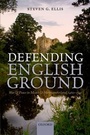
Defending English Ground
War and Peace in Meath and Northumberland, 1460-1542
Published on 7. May 2015
Book
Hardback
234 pages
978-0-19-969629-1 (ISBN)
Description
A key duty of the Renaissance monarchy was the defence of its subjects. For the English monarchy, the rule and defence from enemies beyond the long-landed frontiers in Ireland and the English far-north proved an intractable problem. It was not, however, a duty which was accorded a high priority by successive Yorkist and early Tudor kings, nor is it an aspect of state formation which has attracted much attention from modern historians. This study assesses traditional arrangements for defending English ground, the impact of the frontier on border society, and the way in which the topography and patterns of settlement in border regions shaped the character of the march and border itself.
Defending English Ground focuses on two English shires, Meath and Northumberland, in a period during which the ruling magnates of these shires who had hitherto supervised border rule and defence were mostly unavailable to the crown. Unwilling to foot the cost of large garrisons and extended fortifications, successive kings increasingly shifted the costs of defence onto the local population, prompting the border gentry and minor peers to organize themselves through county communities for the rule and defence of the region. This strategy was generally successful in Ireland where the military threat presented by 'the wild Irish' was not so formidable, but in the English far-north Tudor reform, centralized control, and the burden of defence against the Scots soon led to 'the decay of the borders'.
Defending English Ground focuses on two English shires, Meath and Northumberland, in a period during which the ruling magnates of these shires who had hitherto supervised border rule and defence were mostly unavailable to the crown. Unwilling to foot the cost of large garrisons and extended fortifications, successive kings increasingly shifted the costs of defence onto the local population, prompting the border gentry and minor peers to organize themselves through county communities for the rule and defence of the region. This strategy was generally successful in Ireland where the military threat presented by 'the wild Irish' was not so formidable, but in the English far-north Tudor reform, centralized control, and the burden of defence against the Scots soon led to 'the decay of the borders'.
Reviews / Votes
Steven Ellis has clearly demonstrated here the value of comparative studies, and he has shown the quality of work that is feasible... He expresses a concern that it might be regarded as rather a dry book (p. ix). However, not only does he provide fascinating detail on his subject, he opens the book with an introduction that may ruffle a few feathers * Henry A. Jefferies, Ulster University * Defending English Ground is a welcome and valuable contribution to the developing subject of frontier and border studies. It is refreshing to see another work circumvent the traditional and rather anachronistic 1485 divide, and chart the development and management of two regions throughout the course of the Yorkist and early Tudor periods. * Edward William Geal, Sixteenth Century Journal * Ellis's study of the economy and social structures of the two counties is welcome, aided by a series of exceptionally well-produced maps ... this rich data is where Ellis's work has always broken new ground and in this respect Defending English Ground is no exception ... Defending English Ground will find a wide audience among scholars of Ireland and the north of England in the early Tudor period, and also students of wider European border regions in the early modern period. * Renaissance Quarterly *More details
Product info
Print PDF
Language
English
Place of publication
Oxford
United Kingdom
Target group
College/higher education
Professional and scholarly
Illustrations
6 maps, 4 tables
Dimensions
Height: 240 mm
Width: 161 mm
Thickness: 17 mm
Weight
520 gr
ISBN-13
978-0-19-969629-1 (9780199696291)
Schweitzer Classification
Other editions
Additional editions
E-Book
05/2015
1st Edition
OUP eBook
€67.49
Available for download
Person
Steven G. Ellis studied at Manchester University, Queen's University, Belfast, and the National University of Ireland. He has been Professor of History at NUI Galway since 1991. He teaches mainly British and Irish history, 1300-1700. His current research interests focus on British state formation, regions, and frontier societies
Content
Note on coinage and dates ; List of maps ; List of abbreviations ; Foreward ; Introduction: English military frontiers and regions in Renaissance times ; 1. Region and frontier in the English state: the English far north and the English Pale in Ireland ; 2. Border defence and the character of the marches ; 3. A crisis of lordship: Yorkist Meath and Northumberland ; 4. Ruling the marches: county communities in frontier societies ; 5. 'Keeping the border': the readeption of early Tudor Meath ; 6. 'The decay of the borders': early Tudor Northumberland ; Conclusion: Defending English ground in early Tudor times ; Appendices ; Bibliography ; Index