

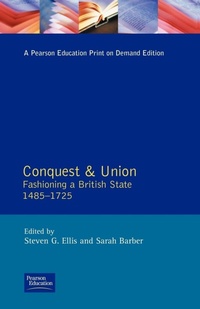
Conquest and Union
Forging a Multi-National British State 1485-1707
1st Edition
Published on 17. May 1995
Book
Paperback/Softback
400 pages
978-0-582-20963-3 (ISBN)
Description
The British Isles is a multi-national arena, but its history has traditionally been studied from a distinctively English -- often, indeed, London -- perspective. Now, however, the interweaving of the distinct but mutually-dependent histories of the four nations is at the heart of some of the liveliest historical research today. In this major contribution to that research, eleven leading scholars consider key aspects of the internal relations of England, Scotland, Ireland and Wales in the early modern period, and the problems of accommodating different -- and resistant -- cultures to a single centralizing polity.
The contributors are: Sarah Barber; Toby Barnard; Ciaran Brady; Keith M. Brown; Jane Dawson; Steven G. Ellis; David Hayton; Philip Jenkins; Alan Macinnes; Michael Mac Craith; and John Morrill.
The contributors are: Sarah Barber; Toby Barnard; Ciaran Brady; Keith M. Brown; Jane Dawson; Steven G. Ellis; David Hayton; Philip Jenkins; Alan Macinnes; Michael Mac Craith; and John Morrill.
More details
Language
English
Place of publication
London
United Kingdom
Publishing group
Taylor & Francis Ltd
Target group
Professional and scholarly
Dimensions
Height: 216 mm
Width: 140 mm
Thickness: 19 mm
Weight
441 gr
ISBN-13
978-0-582-20963-3 (9780582209633)
Copyright in bibliographic data and cover images is held by Nielsen Book Services Limited or by the publishers or by their respective licensors: all rights reserved.
Schweitzer Classification
Other editions
Additional editions
Book
08/2016
1st Edition
Routledge
€206.60
Shipment within 10-20 days
E-Book
06/2014
1st Edition
Routledge
€73.49
Available for download
E-Book
06/2014
1st Edition
Routledge
€73.99
Available for download
Persons
Steven G. Ellis, Sarah Barber
Content
List of Maps.
List of abbreviations.
Glossary.
Preface.
Introduction: the concept of British history.
1. The fashioning of Britain.
2. Tudor state formation and the shaping of the British Isles.
3. Comparable histories? Tudor reform in Wales and Ireland.
4. Anglo-Scottish protestant culture and integration in 16th century Britain.
5. The Anglian Church and the unity of Britain: the Welsh experience, 1560-1714.
6. The Gaelic reaction to the Reformation.
7. Gaelic culture in the 17th century: polarisation and assimilation.
8. Scotland and Ireland under the Commonwealth: a question of loyalty.
9. The origins of a British aristocracy: integration and its limitation before the treaty of Union.
10. Scotland and Ireland in the later Stewart monarchy.
11. Constitutional experiments and political expediency.
Conclusion: a state of Britishness?
List of abbreviations.
Glossary.
Preface.
Introduction: the concept of British history.
1. The fashioning of Britain.
2. Tudor state formation and the shaping of the British Isles.
3. Comparable histories? Tudor reform in Wales and Ireland.
4. Anglo-Scottish protestant culture and integration in 16th century Britain.
5. The Anglian Church and the unity of Britain: the Welsh experience, 1560-1714.
6. The Gaelic reaction to the Reformation.
7. Gaelic culture in the 17th century: polarisation and assimilation.
8. Scotland and Ireland under the Commonwealth: a question of loyalty.
9. The origins of a British aristocracy: integration and its limitation before the treaty of Union.
10. Scotland and Ireland in the later Stewart monarchy.
11. Constitutional experiments and political expediency.
Conclusion: a state of Britishness?