

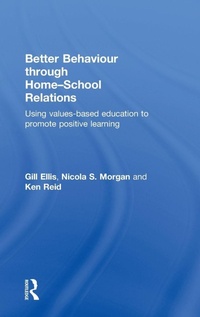
Better Behaviour through Home-School Relations
Using values-based education to promote positive learning
1st Edition
Published on 31. January 2013
Book
Hardback
240 pages
978-0-415-50416-4 (ISBN)
Description
How can we create effective partnerships between home, school and the community?
How can the relationships and communication between families and school be strengthened?
How can families help schools to improve behaviour in their children, both at home and at school?
Using a tried and tested framework that has been successfully implemented throughout a wide variety of very different schools and settings, 'Family Values' is a Scheme which engages and empowers families to work in close collaboration with schools and organisations, and which results in long-term improvements in behaviour, communication, pupil achievement and relationships. The 'Family Values' Scheme has been proven to:
Help pupils to be more academically diligent
Help schools to assume a calmer, more peaceful ambience
Forge better pupil-teacher relationships
Improve Pupil and teacher wellbeing
Help parents to be more engaged with the school
Improve children's literacy, behaviour and attendance
Provide head teachers and their staff with an effective whole-school strategy.
The authors' award-winning 'Family Values' Scheme is underpinned by sound theoretical principles, and they show here how it has been successfully put into practice through case studies in real school settings. The book explores how the Scheme promotes social, emotional and family system theories, and, in linking effectively to SEAL (social and emotional aspects of learning), the Scheme compliments existing personal and social education programmes in all schools.
Showing schools and organisations how to create effective partnerships with families and the community in a fun, exciting and sustainable way, Better Behaviour through Home-School Relations will be of huge benefit to all school staff, as well as local authorities, support groups, parents, charities and services.
How can the relationships and communication between families and school be strengthened?
How can families help schools to improve behaviour in their children, both at home and at school?
Using a tried and tested framework that has been successfully implemented throughout a wide variety of very different schools and settings, 'Family Values' is a Scheme which engages and empowers families to work in close collaboration with schools and organisations, and which results in long-term improvements in behaviour, communication, pupil achievement and relationships. The 'Family Values' Scheme has been proven to:
Help pupils to be more academically diligent
Help schools to assume a calmer, more peaceful ambience
Forge better pupil-teacher relationships
Improve Pupil and teacher wellbeing
Help parents to be more engaged with the school
Improve children's literacy, behaviour and attendance
Provide head teachers and their staff with an effective whole-school strategy.
The authors' award-winning 'Family Values' Scheme is underpinned by sound theoretical principles, and they show here how it has been successfully put into practice through case studies in real school settings. The book explores how the Scheme promotes social, emotional and family system theories, and, in linking effectively to SEAL (social and emotional aspects of learning), the Scheme compliments existing personal and social education programmes in all schools.
Showing schools and organisations how to create effective partnerships with families and the community in a fun, exciting and sustainable way, Better Behaviour through Home-School Relations will be of huge benefit to all school staff, as well as local authorities, support groups, parents, charities and services.
More details
Language
English
Place of publication
London
United Kingdom
Publishing group
Taylor & Francis Ltd
Target group
College/higher education
Professional and scholarly
Academic, Postgraduate, Professional, and Professional Practice & Development
Illustrations
19 s/w Photographien bzw. Rasterbilder, 22 s/w Zeichnungen, 8 s/w Tabellen
8 Tables, black and white; 22 Line drawings, black and white; 19 Halftones, black and white
Dimensions
Height: 240 mm
Width: 161 mm
Thickness: 18 mm
Weight
529 gr
ISBN-13
978-0-415-50416-4 (9780415504164)
Copyright in bibliographic data and cover images is held by Nielsen Book Services Limited or by the publishers or by their respective licensors: all rights reserved.
Schweitzer Classification
Other editions
Additional editions
Gill Ellis | Nicola S. Morgan | Ken Reid
Better Behaviour through Home-School Relations
Using values-based education to promote positive learning
E-Book
02/2013
1st Edition
Routledge
€51.49
Available for download
Gill Ellis | Nicola S. Morgan | Ken Reid
Better Behaviour through Home-School Relations
Using values-based education to promote positive learning
E-Book
02/2013
1st Edition
Routledge
€51.49
Available for download
Gill Ellis | Nicola S. Morgan | Ken Reid
Better Behaviour through Home-School Relations
Using values-based education to promote positive learning
Book
01/2013
1st Edition
Routledge
€65.79
Shipment within 15-20 days
Persons
Gill Ellis is the head teacher of a large primary school in South Wales.
Nicola S. Morgan is a qualified teacher and behaviour management consultant.
Ken Reid (OBE) is presently the adviser to the Welsh government on behaviour and attendance. He was formerly Deputy Vice Chancellor and Research Professor at Swansea Metropolitan University. He is also the national president of SEBDA.
Nicola S. Morgan is a qualified teacher and behaviour management consultant.
Ken Reid (OBE) is presently the adviser to the Welsh government on behaviour and attendance. He was formerly Deputy Vice Chancellor and Research Professor at Swansea Metropolitan University. He is also the national president of SEBDA.
Content
List of illustrations Foreword Acknowledgements 1. Introduction: what is a family? 2. The family unit 3. One parent families, schools and raising achievement 4. Engaging with parents 5. Values-based education 6. How the family values scheme works: key principles 7. How the fvs operates 8. Establishing the fvs: the coed eva story 9. Case studies 10. The head teacher's perspective 11. Log files 12. Courage 13. Even more evaluation 14. Conclusion References Index