

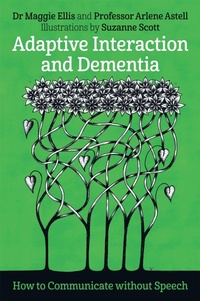
Adaptive Interaction and Dementia
How to Communicate without Speech
Published on 21. November 2017
Book
Paperback/Softback
192 pages
978-1-78592-197-1 (ISBN)
Description
This guide to Adaptive Interaction explains how to assess the communication repertoires of people with dementia who can no longer speak, and offers practical interventions for those who wish to interact with them.
Outlining the challenges faced by people living with advanced dementia, this book shows how to relieve the strain on relationships between them, their families, and professional caregivers through better, person-centred communication. It includes communication assessment tools and guidance on how to build on the communication repertoire of the individual with dementia using nonverbal means including imitation, facial expressions, sounds, movement, eye gaze and touch. With accessible evidence and case studies based on the authors' research, Adaptive Interaction can be used as the basis for developing interactions without words with people living with dementia.
Outlining the challenges faced by people living with advanced dementia, this book shows how to relieve the strain on relationships between them, their families, and professional caregivers through better, person-centred communication. It includes communication assessment tools and guidance on how to build on the communication repertoire of the individual with dementia using nonverbal means including imitation, facial expressions, sounds, movement, eye gaze and touch. With accessible evidence and case studies based on the authors' research, Adaptive Interaction can be used as the basis for developing interactions without words with people living with dementia.
Reviews / Votes
At last a book that is written in a way that everyone can understand and use in their daily work. Person-centred and practical, this is something that will without doubt change the lives of people affected by dementia. -- Cathy Baldwin, Organisational Development Manager (Quality), Alzheimer's Society In this book the authors take us on an exciting learning journey by developing our understanding of communication, helping us to become communication partners and then equipping us with the knowledge of Adaptive Interaction. Using sensitive personal examples, the text enhances our ability and skills in such a way as to ensure we treat the person living with dementia as an equal and valued citizen engaged with the world and people around them in a truly meaningful way. -- Henry Simmons, Chief Executive, Alzheimer Scotland The reader is provided with an overview of dementia which is easy to understand which also makes this book a valuable resource for anyone involved in the care of people living with dementia. -- Angela Moore, Admiral Nurse Clinical Lead, Rutland County CouncilMore details
Language
English
Place of publication
London
United Kingdom
Target group
College/higher education
Professional and scholarly
Product notice
Paperback (UK-trade)
Illustrations
9 black and white illustrations
Dimensions
Height: 154 mm
Width: 229 mm
Thickness: 17 mm
Weight
292 gr
ISBN-13
978-1-78592-197-1 (9781785921971)
Copyright in bibliographic data and cover images is held by Nielsen Book Services Limited or by the publishers or by their respective licensors: all rights reserved.
Schweitzer Classification
Other editions
Additional editions
E-Book
11/2017
Jessica Kingsley Publishers
€29.99
Available for download
Persons
Dr Maggie Ellis is Lecturer at the School of Psychology & Neuroscience, University of St Andrews, UK. Arlene Astell is Professor at the School of Psychology & Clinical Language Sciences, University of Reading, UK and at the Department of Occupational Sciences & Occupational Therapy, University of Toronto, Canada.
Content
Dedication. Acknowledgements. Preface. 1. Both Sides Now - Advanced Dementia From the Inside Out. 2. We've Only Just Begun - Learning the Language of Dementia. 2.1. The Impact of Dementia on Relationships. 2.2. Changes in Behaviour. 2.3. Malignant Social Psychology. 2.4. Improving Communication. 2.5. Nonverbal Communication. 2.6. Chapter Summary. 3. I Hear You Now - Collaborative Communication. 3.1. Human Communication. 3.2. Models of Communication. 3.3. Individuals with Additional Communication Needs. 3.4. Intensive Interaction. 3.5. Adaptive Interaction. 3.6. Summary. 4. Let's Work Together - Learning the Language of Dementia. 4.1. Step 1: Getting to Know You. 4.2. Step 2: Communication Environment. 4.3. Step 3: Identifying the Communicative Repertoire. 4.4. Step 4: Creating a Connection. 4.5. Step 5: Building the Connection. 4.6. Summary. 5. A Beautiful Noise: Chrissie's Story. 6. I'm Looking Through You: Eleanor's Story. 7. The Sound of Silence: Bert's Story. Epilogue. Appendix - Adaption Interaction Process Charts. References. Index.