

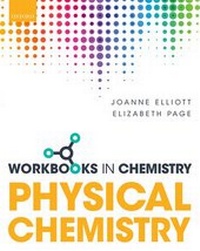
Workbook in Physical Chemistry
Published on 16. February 2017
Book
Paperback/Softback
192 pages
978-0-19-872949-5 (ISBN)
Description
Are you afraid of unfamiliar questions? Do you struggle to know how even to begin answering them? Problem solved!
Use the Workbooks in Chemistry series to:
- Know the facts: review the concepts you need to draw on to answer the question
- Understand the strategy: learn how to approach each question in a systematic way
- Master the solution: get to the right answer first time
The Workbooks in Chemistry series takes a worked example led approach to help you develop the problem-solving skills you need to understand how to approach unfamiliar questions and to answer them successfully.
Written to build the confidence of every reader, its extensive worked examples, enriched with guidance and advice, are matched with relevant problems to help you maximise your performance and achieve success during the formative early years of your degree programme, and beyond.
Use the Workbooks in Chemistry series to:
- Know the facts: review the concepts you need to draw on to answer the question
- Understand the strategy: learn how to approach each question in a systematic way
- Master the solution: get to the right answer first time
The Workbooks in Chemistry series takes a worked example led approach to help you develop the problem-solving skills you need to understand how to approach unfamiliar questions and to answer them successfully.
Written to build the confidence of every reader, its extensive worked examples, enriched with guidance and advice, are matched with relevant problems to help you maximise your performance and achieve success during the formative early years of your degree programme, and beyond.
Reviews / Votes
I wish I had these books when I started at university. So many relevant examples are worked through, and the solutions to the examples are descriptive instead of just being a simple answer, which makes learning much easier. * Michelle Rasmussen, University of Roskilde * Having lots of examples to work through really helps you cement your learning, and is fantastic preparation for exams and further studies. * Adam Stubbs, Newcastle University * If only this book had existed during my first year, it would have made the task of studying so much easier! The workbook provides a blended balance between detail and simplicity, in a way that other books fail to match. * Matthew-John Tully, University of Bangor * The text covers many of the areas that I have had problems with at A-level and at university level, making it very useful to students in the transition between the two. * Felix Rummel, University of Manchester * I like the book. It has very clear structure, everything is nicely in sections and boxes with good illustrations. It assumes little knowledge and will be accessible to most readers while covering advanced topics as well. Adam Prada, University of Cambridge The comments and worked examples are fantastic and make the book particularly useful. As a student you can never have enough worked examples or questions to try so a workbook is a great way to enhance what you are given in your course. * Rebecca Snelgrove, Keele University *More details
Series
Language
English
Place of publication
Oxford
United Kingdom
Target group
Adult education
Dimensions
Height: 275 mm
Width: 221 mm
Thickness: 9 mm
Weight
434 gr
ISBN-13
978-0-19-872949-5 (9780198729495)
Copyright in bibliographic data and cover images is held by Nielsen Book Services Limited or by the publishers or by their respective licensors: all rights reserved.
Schweitzer Classification
Persons
Dr Joanne Elliott is an Associate Professor in Physical Chemistry at the University of Reading and a Fellow of the HEA. She teaches physical chemistry throughout the undergraduate course. Her research interests lie in the field of electrochemistry and nanostructured materials, especially with regard to electroanalysis, surface catalysis, and the development of modified electrodes.
Elizabeth Page is Professor of Chemical Education at the University of Reading where she teaches inorganic and coordination chemistry. She is also the first year tutor in the Department and her educational work focuses on the secondary to tertiary transition, and team and problem based learning. Elizabeth received the RSC Education Award in 2010 and is a University and National Teaching Fellow and Senior Fellow of the HEA.
Elizabeth Page is Professor of Chemical Education at the University of Reading where she teaches inorganic and coordination chemistry. She is also the first year tutor in the Department and her educational work focuses on the secondary to tertiary transition, and team and problem based learning. Elizabeth received the RSC Education Award in 2010 and is a University and National Teaching Fellow and Senior Fellow of the HEA.
Content
1: Fundamentals 2: Thermodynamics 3: Chemical Equilibrium 4: Phase Equilibrium 5: Reaction Kinetics 6: Electrochemistry